






Israeli forces storm the main hospital in southern Gaza, saying hostages were likely held there
Israeli forces have stormed the main hospital in southern Gaza in what the army says is a search for the remains of hostages taken by Hamas
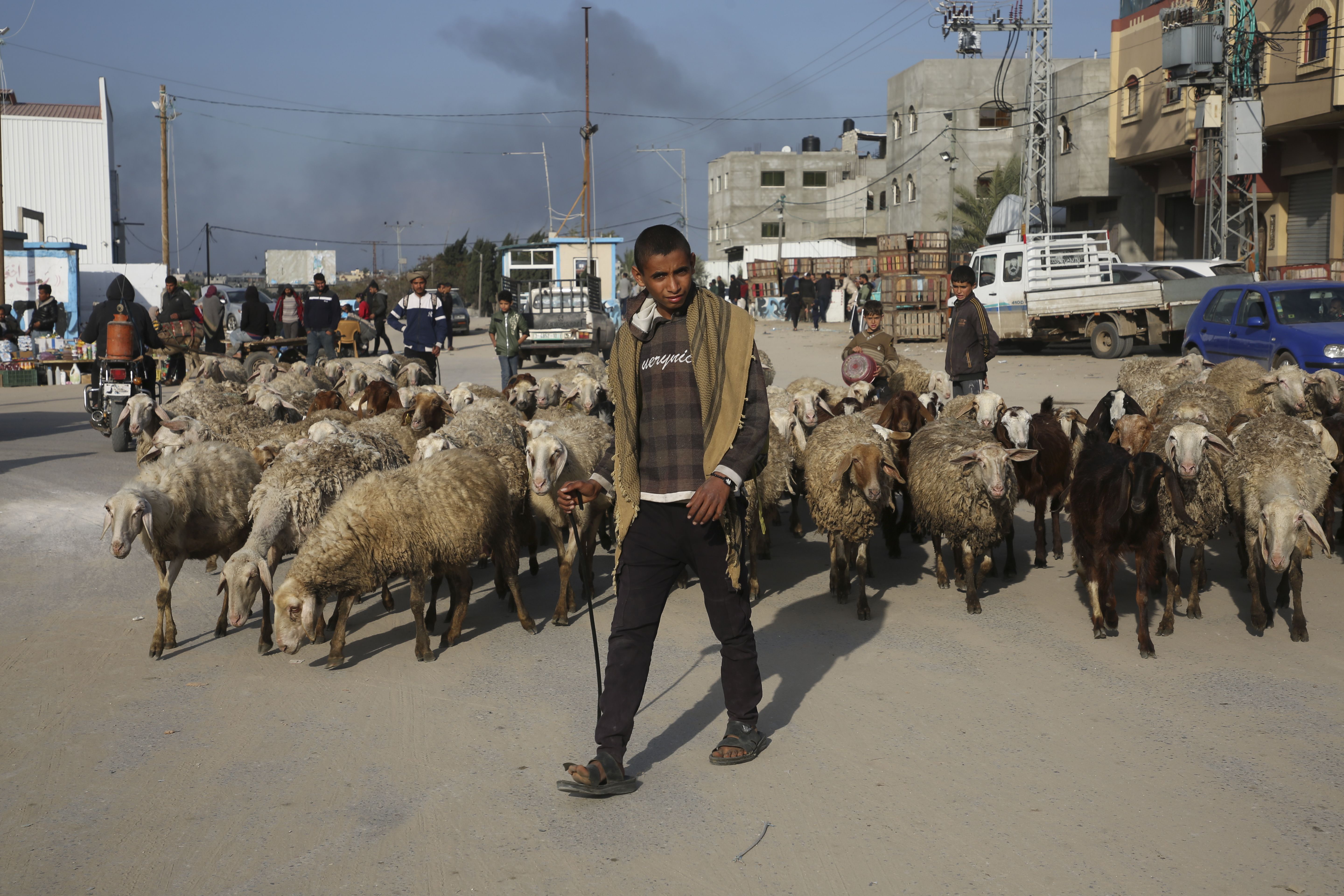
RAFAH, Gaza Strip (AP) — Israeli forces stormed the main hospital in southern Gaza on Thursday, hours after Israeli fire killed a patient and wounded six others inside the complex. The Israeli army said it was seeking the remains of hostages taken by Hamas.
The raid on Nasser Hospital came after troops had besieged the facility for nearly a week, with hundreds of staff, patients and others inside struggling under heavy fire and dwindling supplies, including food and water. A day earlier, the army ordered thousands of displaced people who had taken shelter there to leave the hospital in the city of Khan Younis, the focus of Israel’s offensive against Hamas in recent weeks.
The war shows no sign of ending, and the risk of a broader conflict grew as Israel and Lebanon’s Hezbollah militant group stepped up attacks after a particularly deadly exchange on Wednesday.
The military said it had “credible intelligence” that Hamas had held hostages at Nasser Hospital and that the hostages’ remains might still be inside. Rear Adm. Daniel Hagari, the chief military spokesperson, said forces were conducting a “precise and limited” operation there and would not forcibly evacuate medics or patients. Israel accuses Hamas of using hospitals and other civilian structures to shield its fighters.
A released hostage told The Associated Press last month that she and over two dozen other captives had been held in Nasser Hospital. International law prohibits the targeting of medical facilities; they can lose those protections if they are used for military purposes, though operations against them still must be proportional to any threat.
As troops searched hospital buildings, they ordered the more than 460 staff, patients and their relatives to move into an older building in the compound that isn’t equipped to treat patients, the Gaza Health Ministry said. They were “in harsh conditions with no food or baby formula” and severe water shortages, it said.
Six patients were left in intensive care, along with three infants in incubators with no staff to attend to them. The ministry said fuel for generators would soon run out, endangering their lives.
Separately, Israel launched airstrikes into southern Lebanon for a second day after killing 10 civilians and three Hezbollah fighters on Wednesday in response to a rocket attack that killed an Israeli soldier and wounded several others.
It was the deadliest exchange of fire along the border since the start of the Israel-Hamas war. Israel and Hezbollah — an ally of Hamas — have traded fire daily, raising the risks of a broader conflict.
Hezbollah has not claimed responsibility for Wednesday’s rocket attack. Sheikh Nabil Kaouk, a senior member of the group, said it is “prepared for the possibility of expanding the war” and would meet “escalation with escalation, displacement with displacement, and destruction with destruction.”
Negotiations over a cease-fire in Gaza, meanwhile, appear to have stalled, and Israeli Prime Minister Benjamin Netanyahu has vowed to continue the offensive and expand it to the Gaza city of Rafah, near Egypt, until Hamas is destroyed and scores of hostages taken during the militants’ Oct. 7 attack are freed.
In a phone call Thursday, President Joe Biden again cautioned Netanyahu against moving forward with a military operation in Rafah before coming up with a “credible and executable plan” to ensure the safety of Palestinian civilians, the White House said Thursday,
SCENES OF PANIC IN HOSPITAL
Nasser Hospital has been the latest focus of Israeli military operations that have gutted Gaza’s health sector as it struggles to treat a constant stream of people wounded in daily bombardments.
Israeli troops, tanks and snipers have surrounded the hospital for at least a week, and fire from outside has recently killed several people inside, according to health officials.
“There’s no water, no food. Garbage is everywhere. Sewage has flooded the emergency ward,” said Raed Abed, a wounded patient who was among those who left Nasser Hospital on Israeli orders Wednesday.
Still suffering from a severe stomach wound, Abed said he initially collapsed as he got out of his hospital bed and tried to leave. He then waited outside for hours as troops made those leaving pass by five at a time, arresting some and making them strip to their underwear, he said. Finally, he walked for miles until he reached the border town of Rafah, where he was put in a hospital. Lying in a bed there, he wheezed in pain from his wound as he spoke.
Overnight, a strike slammed into one of Nasser Hospital’s wards, killing one patient and wounding six others, Dr. Khaled Alserr, one of the remaining surgeons there, told the AP.
Video showed medics scrambling to move patients down a corridor filled with smoke or dust, while in a dark room a wounded man screamed in pain as gunfire echoed outside.
“The situation is escalating every hour and every minute,” Alserr said.
The international aid group Doctors Without Borders said its staff had to flee the hospital Thursday, leaving patients behind, and that one staffer was detained at an Israeli checkpoint.
Troops were still searching the hospital hours after the entered, military spokesman Hagari said. He said dozens of militants were arrested from the hospital grounds, including three who participated in the Oct. 7 attack. He also said troops found grenades and mortar shells, and that Israeli radar determined that militants fired mortars from the hospital grounds a month ago.
NO END IN SIGHT TO THE WAR
The war began when Hamas militants on Oct. 7 burst out of Gaza and attacked several Israeli communities, killing some 1,200 people and taking another 250 hostage. More than 100 captives were freed during a cease-fire in November in exchange for 240 Palestinian prisoners.
Around 130 hostages remain in Gaza, a fourth of whom are believed to be dead. Netanyahu has come under intense pressure from hostages’ families and the wider public to make a deal to secure their freedom, but his far-right coalition partners could bring down his government if he is seen as being too soft on Hamas. Dozens of hostages’ relatives protested and blocked traffic Thursday outside the military’s headquarters, where the War Cabinet also meets.
Israel responded to the Hamas attack with one of the deadliest and most destructive military campaigns in recent history.
At least 28,663 Palestinians have been killed, mostly women and children, and more than 68,000 wounded, according to Gaza’s Health Ministry, which does not distinguish between civilians and combatants. Some 80% of the population has been driven from their homes, and a quarter are starving amid a worsening humanitarian catastrophe. Large areas in northern Gaza, the first target of the offensive, have been completely destroyed.
Israeli media reported that CIA Director William Burns flew to Israel to meet with Netanyahu to discuss efforts for a cease-fire.
Hamas says it will not release all the remaining captives until Israel ends its offensive, withdraws and frees Palestinian prisoners, including top militants.
Netanyahu has rejected those demands and says Israel will soon expand its offensive into Rafah, Gaza’s southernmost city. Over half of Gaza’s population of 2.3 million has sought refuge in Rafah after fleeing fighting elsewhere.
Airstrikes late Wednesday in central Gaza killed at least 11 people, including four children and five women, according to hospital records. Relatives gathered around bodies wrapped in white shrouds outside Al-Aqsa Martyrs Hospital in the central town of Deir al-Balah before the remains were placed in a truck to be taken for burial.
One man struggled to let go, lying down and holding one of the bodies on the truck as he wept.
Mroue reported from Beirut and Lidman from Jerusalem. Associated Press writer Kareem Chehayeb in Beirut contributed to this report.
Find more of AP’s coverage at https://apnews.com/hub/israel-hamas-war
Palestinians fleeing the Israeli offensive on Khan Younis arrive at Rafah, Gaza Strip. Wednesday, Feb. 14, 2024.
Palestinians fleeing the Israeli offensive on Khan Younis arrive at Rafah, Gaza Strip. Wednesday, Feb. 14, 2024. AP Photo/Hatem Ali)
Palestinians fleeing the Israeli offensive on Khan Younis arrive at Rafah, Gaza Strip. Wednesday, Feb. 14, 2024. AP Photo/Hatem Ali)
Palestinians fleeing the Israeli offensive on Khan Younis arrive at Raf
Civil defence and rescue workers remove rubbles from a building that was attacked Wednesday night by an Israeli airstrike, in Nabatiyeh town, south Lebanon, Thursday, Feb. 15, 2024. The airstrike killed and injured several people and child, Lebanon’s state news agency reported.
Civil defense and rescue workers remove rubbles from a building that was attacked Wednesday night by an Israeli airstrike, in Nabatiyeh town, south Lebanon, Thursday, Feb. 15, 2024. The airstrike killed several people, Lebanon’s state news agency reported.
Civil defence and rescue workers remove rubbles from a building that was attacked Wednesday night by an Israeli airstrike, in Nabatiyeh town, south Lebanon, Thursday, Feb. 15, 2024. The airstrike killed and injured several people and child, Lebanon’s state news agency reported.
Civil defence and rescue workers remove rubbles from a building that was attacked Wednesday night by an Israeli airstrike, in Nabatiyeh town, south Lebanon, Thursday, Feb. 15, 2024. The airstrike killed and injured several people and child, Lebanon’s state news agency reported.
Civil defence and rescue workers remove rubbles from a building that was attacked Wednesday night by an Israeli airstrike, in Nabatiyeh town, south Lebanon, Thursday, Feb. 15, 2024. The airstrike killed and injured several people and child, Lebanon’s state news agency reported.
Civil defence and rescue workers remove rubbles from a building that was attacked Wednesday night by an Israeli airstrike, in Nabatiyeh town, south Lebanon, Thursday, Feb. 15, 2024. The airstrike killed and injured several people and child, Lebanon’s state news agency reported. The attack is a major escalation along the already tense Lebanon-Israel border and came hours after another attack in a southern Lebanese village killed a woman and her two sons.
Palestinians carry relatives killed in the Israeli bombing of the Nusseirat refugee camp to a truck at Al Aqsa Hospital in Deir al Balah, Gaza Strip, on Thursday, Feb. 15, 2024.
Destroyed buildings stand in the Gaza Strip as seen from southern Israel, Thursday, Feb. 15, 2024.
Palestinians mourn their relatives killed in the Israeli bombing of the Nusseirat refugee camp in the Gaza Strip at Al Aqsa Hospital in Deir al Balah on Thursday, Feb. 15, 2024.
Palestinians pray for the relatives killed in the Israeli bombing of the Nusseirat refugee camp in the Gaza Strip at Al Aqsa Hospital in Deir al Balah on Thursday, Feb. 15, 2024.
Palestinians mourn their relatives killed in the Israeli bombing of the Nusseirat refugee camp in the Gaza Strip at Al Aqsa Hospital in Deir al Balah on Thursday, Feb. 15, 2024.
Palestinians mourn their relatives killed in the Israeli bombing of the Nusseirat refugee camp in the Gaza Strip at Al Aqsa Hospital in Deir al Balah on Thursday, Feb. 15, 2024.
Israeli tanks move on an area at the Israeli-Gaza border, as seen from southern Israel, Thursday, Feb. 15, 2024.
Destroyed buildings stand in the Gaza Strip as seen from southern Israel, Thursday, Feb. 15, 2024.
Israeli tanks move on an area at the Israeli-Gaza border, as seen from southern Israel, Thursday, Feb. 15, 2024.
Mourners carry the coffins of the victims who were killed in an Israeli strike last night, during their funeral procession in Qantara village, south Lebanon, Thursday, Feb. 15, 2024. The civilian death toll from two Israeli airstrikes in Lebanon has risen to 10, Lebanese state media reported Thursday, making the previous day the deadliest in more than four months of cross-border exchanges.
Amal Atwi, the mother of Hussein Jalal Mohsin, who was killed in an Israeli strike last night, mourns during his funeral procession in Qantara village, south Lebanon, Thursday, Feb. 15, 2024. The civilian death toll from two Israeli airstrikes in Lebanon has risen to 10, Lebanese state media reported Thursday, making the previous day the deadliest in more than four months of cross-border exchanges.
Jalal Mohsin, kisses the the body of his child Amir, who was killed in an Israeli strike last night, during his funeral procession in Qantara village, south Lebanon, Thursday, Feb. 15, 2024. The civilian death toll from two Israeli airstrikes in Lebanon has risen to 10, Lebanese state media reported Thursday, making the previous day the deadliest in more than four months of cross-border exchanges.
Mourners pray over the coffins of the victims who were killed in an Israeli strike last night, during their funeral procession in Qantara village, south Lebanon, Thursday, Feb. 15, 2024. The civilian death toll from two Israeli airstrikes in Lebanon has risen to 10, Lebanese state media reported Thursday, making the previous day the deadliest in more than four months of cross-border exchanges.
Amal Atwi, the mother of Hussein Jalal Mohsin, who was killed in an Israeli strike last night, mourns during his funeral procession in Qantara village, south Lebanon, Thursday, Feb. 15, 2024. The civilian death toll from two Israeli airstrikes in Lebanon has risen to 10, Lebanese state media reported Thursday, making the previous day the deadliest in more than four months of cross-border exchanges.
Palestinians pray in a damaged mosque following an Israeli strike in Rafah, southern Gaza Strip, Thursday, Feb. 15, 2024.
Palestinian women sew diapers in Rafah, southern Gaza Strip, Thursday, Feb. 15, 2024. Palestinians in Gaza have experienced severe shortages of basic necessities since the war began on Oct. 7.
Palestinians salvage materials from a factory destroyed in the Israeli bombardment of the Gaza Strip in Deir al Balah, Gaza Strip, Thursday, Feb. 15, 2024.
Palestinians search for survivors after an Israeli airstrike on building of Rayan family in Nusseirat refugee camp, central Gaza Strip, Thursday, Feb. 15, 2024.
Palestinians search for survivors after an Israeli airstrike on building of Rayan family in Nusseirat refugee camp, central Gaza Strip, Thursday, Feb. 15, 2024.
Palestinians search for survivors after an Israeli airstrike on building of Rayan family in Nusseirat refugee camp, central Gaza Strip, Thursday, Feb. 15, 2024.
Israeli helicopter flies over Khan Younis, Gaza Strip, Thursday, Feb. 15, 2024.
Palestinians search for survivors after an Israeli airstrike on building of Rayan family in Nusseirat refugee camp, central Gaza Strip, Thursday, Feb. 15, 2024.
A Palestinian woman sews diapers in Rafah, southern Gaza Strip, Thursday, Feb. 15, 2024. Palestinians in Gaza have experienced severe shortages of basic necessities since the war began on Oct. 7.
Palestinians watch an Israeli helicopter near Khan Younis, Gaza Strip, Thursday, Feb. 15, 2024.
Israeli armored vehicle moves near the Israeli-Gaza border, as seen from southern Israel, Thursday, Feb. 15, 2024.
Israeli helicopter flies over Palestinian fishermen near Khan Younis, Gaza Strip, Thursday, Feb. 15, 2024.
Palestinians ride on a donkey cart past factories destroyed in the Israeli bombardment of the Gaza Strip in Deir al Balah, Gaza Strip, Thursday, Feb. 15, 2024.
Palestinians watch an Israeli helicopter fly over Khan Younis, Gaza Strip, Thursday, Feb. 15, 2024.
A Palestinain buy pulls a cart in Khan Younis, Gaza Strip, Thursday, Feb. 15, 2024.
