






Down but not out
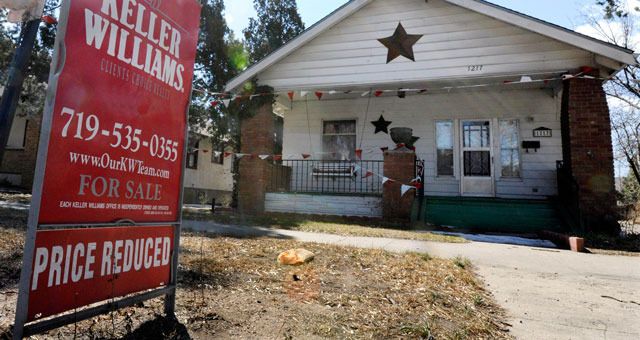
For-sale signs summed up the state of the Pikes Peak region’s housing market last year:
“Price reduced” was the simple message several signs carried.
A national recession, sagging consumer confidence, thousands of area job losses and record numbers of local foreclosures combined to drive down single-family home prices in two-thirds of Colorado Springs and El Paso County neighborhoods during 2008 when compared with the previous year, according to The Gazette’s fourth annual analysis of housing appreciation in the Pikes Peak region.
Last year saw the largest number of neighborhoods that experienced year-over-year price declines in The Gazette analysis, which used El Paso County land records as its source of data.
“We’re going backwards,” said Nancy Rusinak of Rusinak Real Estate in Colorado Springs.
The picture was brighter for El Paso County as a whole, however.
Countywide, home prices increased a little less than 1 percent in 2008 over 2007, according to The Gazette’s analysis. And while 2008 was a downer for some neighborhoods, it was only one year; long-term appreciation rates remained positive for the county and several individual areas.
“You can’t throw in this year (2008) and say it’s representative of a long-term trend,” Fred Crowley, an economist at the University of Colorado at Colorado Springs, said about prices.
Also, Colorado Springs and El Paso County still fared better last year than many communities, especially those in previously hot housing areas in the Southwest, California and Florida.
Las Vegas and Phoenix prices, for example, dropped 33.6 percent and 35.5 percent, respectively, in the fourth quarter of 2008 when compared with the same period the previous year, according to the National Association of Realtors. Los Angeles dropped 31.4 percent and in Florida, Miami’s prices fell 32.3 percent.
Two of the biggest factors that affected Colorado Springs-area home prices last year were foreclosures and short sales. In fact, last year’s neighborhood home prices were worse when foreclosures and short sales, which were excluded from past Gazette studies, were added to the mix of properties analyzed (see an explanation of foreclosures, short sales and how The Gazette determined this year’s figures on Page 12). With those distressed properties, roughly eight out of 10 neighborhoods saw falling home prices in 2008.
Distressed properties weren’t the only problem for the local market. Area residents fearful of layoffs and skittish about the slumping economy didn’t buy homes, and reduced demand also hurt prices.
Also, the local market for expensive homes, $500,000 and up, especially was hit hard, said Becky Gloriod, who specializes in high-end properties for Gloriod & Associates, a Springs residential brokerage. Not only were so-called jumbo loans, $417,000 and up, difficult to obtain, but many potential buyers of higher-end homes watched the value of their stock portfolios tumble, prompting them to delay purchases, Gloriod said.
The Gazette’s annual home-price analysis uses El Paso County Assessor’s Office records to determine median prices and appreciation rates on a countywide and neighborhood-by-neighborhood basis in Colorado Springs, other cities and towns in El Paso County and the county’s unincorporated areas.
For tax-assessment purposes, the Assessor’s Office breaks up El Paso County into 19 economic areas, which are composed of 80 smaller, single-family neighborhoods. The Assessor’s Office puts together those neighborhoods by grouping similar homes and housing styles – making certain it’s assessing property equally and attempting to avoid mixing mansions with modulars. Assessor’s Office data are continually updated, so 2008 figures are subject to change.
Using the Assessor’s data, The Gazette tallied sales of single-family homes (not townhomes or condominiums) in each of the 80 neighborhoods during 2008. Then, the median price – or midpoint – of those sales was determined.
NEW FACTORS, NEW FORMULA
The newspaper compared the 2008 median price in each neighborhood with the median price in 2007, and determined the percentage change. In addition to the 80 neighborhoods, the newspaper calculated the same figure for the county as a whole.
The first analysis was published in 2006, and looked at the previous year’s prices, as well as those dating to 1996. With the latest year’s data, The Gazette has charted home prices on a countywide and neighborhood basis from 1996 to 2008.
There are a few qualifiers regarding the analysis.
Among the 80 El Paso County Assessor’s Office neighborhoods, some are relatively small residential areas, while others are large, sparsely populated tracts where few home sales take place each year. In those sprawling areas or even in a small neighborhood, a few sales can dramatically affect yearly price changes.
Also, some neighborhood prices rise and fall significantly from year to year, and a large percentage reduction in one year might seem more dramatic because it followed a big increase the year before.
Previous Gazette analyses didn’t include foreclosures and short sales; instead, prices were determined based on traditional home sales between willing buyers and sellers. But as sales of distressed properties have mounted, The Gazette added them to gauge their effect.
In its look at 2008 home sales and prices, The Gazette found:
Home sales totaled 5,482 last year, a 42.4 percent decline from 9,511 in 2007. Add foreclosures and short sales, and the number of homes sold in 2008 climbed to 7,448.
Based on last year’s sales, the overall median price in El Paso County rose to $228,000, a 0.93 percent gain from $225,900 in 2007. Last year’s slight gain in countywide prices probably resulted from a solid number of sales in the first half of the year, Rusinak said.
“The last six months, we hardly sold anything” and prices suffered as a result, she said.
When foreclosures and short sales were included, the 2008 median price dropped to $208,000, down 7.9 percent from 2007.
Of the county’s 80 single-family residential neighborhoods, 52, or 65 percent, saw a decline in 2008 median prices when compared with the previous year. In 2007, 31 neighborhoods saw year-over-year price declines.
“A lot of areas I have seen, certainly, declined from last year and the year before,” said Brian Maecker, a real estate agent with Re/Max Advantage in Colorado Springs. “I feel prices have declined all the way back to 2004 levels.”
When foreclosures and short sales were added to last year’s home sales, 68 – or 85 percent – of the 80 county neighborhoods experienced a decline in prices during 2008.
A neighborhood in far southwest El Paso County saw a 38.4 percent drop in year-over-year prices, the biggest percentage decline among the 80 neighborhoods.
However, the area had only five nondistressed sales last year. Of neighborhoods with at least 50 home sales in 2008, the biggest percentage decline in prices occurred in the Northgate and Flying Horse area on the Springs’ far north side, a 13.8 percent drop.
The biggest percentage gain in prices, 37.7 percent, took place in Kissing Camels, the gated community known for million-dollar mansions and killer views. Kissing Camels had six nonforeclosed home sales last year. Among neighborhoods where at least 50 homes sold in 2008, the biggest price increase was in eastern El Paso County, in a large area that includes Peyton and the east edge of Black Forest. Prices there increased 9.4 percent when compared with the previous year.
Last year’s slump in prices triggered a contraction in long-term appreciation rates in 52 of 80 neighborhoods. For example, from 1996-2007, the median home price in greater Manitou Springs increased 120.3 percent. But because of last year’s housing slump, the 1996-2008 appreciation in prices fell to 109.5 percent. Similar shrinkages in long-term values occurred in several parts of the county in 2008.
A BUYER’S MARKET
As weak as the housing market was last year, buyers now have a chance to purchase homes in every price range and neighborhood, and with long-term, fixed-rate mortgages that have been around 5 percent or below for the past several weeks.
The federal government’s economic stimulus package also should help, said Bill Hurt, president of ERA Shields Real Estate in Colorado Springs. It included an $8,000 tax credit for first-time buyers or purchasers who haven’t owned a home for three years. To qualify, buyers must purchase by Dec. 1.
Thousands of additional soldiers scheduled to arrive later this year at Fort Carson, on Colorado Springs’ southern edge, will be key for the housing market, several experts said. Not only will they help absorb some of the inventory of homes, but they’ll also attract investors who will purchase properties to resell or rent.
Jobs also will drive the local real estate market, and attracting employers will be critical, some experts say. And all jobs will matter, Hurt said. Even lower-paid positions will help some families buy homes and soak up inventory, he said. As that happens, owners of entry-level homes can move up into higher-priced properties, and so on, Hurt said.
Some in the national media already are bullish on the Springs. In its April issue, Money Magazine predicted Colorado Springs would be among the first areas to recover because it never saw the unrealistic run-up in prices that other cities experienced. The magazine forecast that Colorado Springs-area prices will drop 1.9 percent over the next 12 months. That’s far less than the magazine’s predicted 7.8 percent decline in Denver, a 17 percent drop in Las Vegas or a 19.7 percent loss in Phoenix.
“It’s not vibrant by any stretch of the imagination,” Hurt said of the current market. “But we’re still in an area where people want to be.”
Contact the writer at 636-0228
For-sale signs across the region, such as this one on East Platte Avenue in Colorado Springs, indicate that asking prices have fallen. Photo by JERILEE BENNETT, THE GAZETTE
