






WOMEN’S HOCKEY: U.S. tired of looking up at Canada
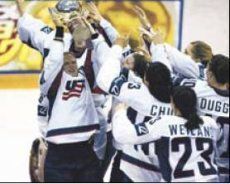
Two months had passed. Natalie Darwitz recently sat inside the lobby of a Colorado Springs hotel, wearing a wide smile and recalling how the U.S. women’s ice hockey team beat Canada twice to win the world championship. “Did that really happen?” she asked. It did happen. And it sets the stage for a rematch between the world’s top teams at the 2010 Vancouver Games. The U.S. has played second fiddle to Canada, with 21 losses in gold medal games of the Olympics, the world championship, the Four Nations Cup and the now-defunct Pacific Rim Championship. In Colorado Springs-based USA Hockey circles, there’s talk that the tide is turning, evidenced by gold medal game wins by the U.S. over Canada at two of the past three world championships. The Americans rebounded from a 1-0 loss to Finland at the world championship in April in Harbin, China, with consecutive wins over Canada – 4-2 in the qualifying round and 4-3 in the gold medal game. “I get a huge smirk on my face every time I think about it,” said Darwitz, part of a 22-player women’s national performance evaluation camp that began Monday at the Olympic Training Center. “I sit back and I’m like, ‘Wow, we really accomplished a great feat.’ Beating Canada twice in a row with our backs against the wall is quite special.” Chances are the U.S. and Canada will remain the teams to beat heading into the Four Nations Cup in November in Lake Placid, N.Y., and the next world championship in April 2009 in Finland. The U.S. features an effective blend of young and old players under world championship coach Jackie Barto, who coaches the Ohio State women’s hockey team, and USA Hockey women’s director Michele Amidon, a former national team member and college coach. University of Wisconsin goaltender Jessie Vetter earned wins in both games against Canada. She went 3-1 at the world championship with a 1.72 goalsagainst average and a .881 save percentage. Olympians Darwitz, Caitlin Cahow, Julie Chu, Jenny Potter and Angela Ruggiero combined for 34 points. Darwitz scored two goals in each game against Canada, and Potter had two power-play goals in the gold medal game. “Both games, there was this expectation that we weren’t going to lose,” said Cahow, who never had won a major tournament against Canada. “I didn’t doubt at one point the entire time, and that was something that was really new for me in a USA jersey. It was one of the first times I knew we could outplay them. “It’s a realization of what we know we’re capable of. We’ve always been capable of beating Canada. This is the kind of experience that allows you to feel confident about what you’re doing and how you’re working together as a unit and where we’re going.” Cahow called the world championship the “ultimate warm-up” for the Olympics, where the U.S. won a gold in Nagano in 1998, a silver in Salt Lake City in 2002 and a bronze in Turin in 2006. “This was the best-case scenario,” Darwitz said. “It’s going to up the ante for the Olympics. It’s definitely going to raise the bar quite a bit.”
Photo by