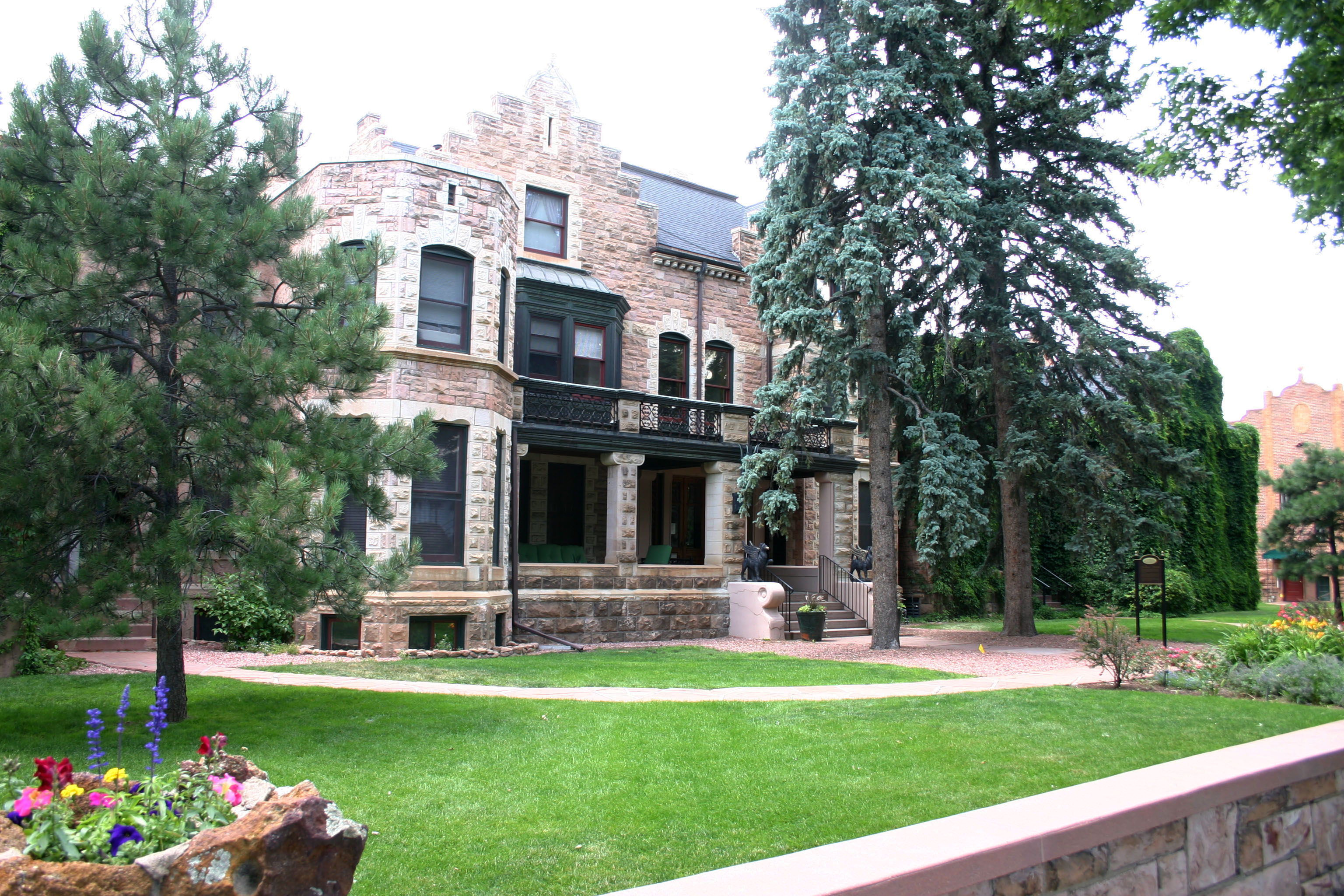
The former Hagerman Mansion, 610 N. Cascade Ave., Colorado Springs, is one of five buildings that comprises the Cascade Park Apartments. It was originally built by James J. Hagerman, who made his fortune as owner of the Milwaukee Iron Co. He came to Colorado Springs in 1884 in hopes of finding relief from his tuberculosis. As his health improved, he became president of the Colorado Midland Railway as well as acquiring interests in silver and coal mines and stone quarries. The property had been vacant for about 15 years when it was acquired by Benjamin Lefkowsky. (Gazette file)
Colorado Springs is full of places with historic significance. This series breaks the area up into walkable chunks with brief descriptions of each featured structure or area.The information here is based on a 2003 survey done by the City of Colorado Springs, which itself was an update of a 1985 survey. Updates and photos were done by The Gazette’s Doug Fitzgerald.The North Parkside area fits between Monument Valley Park on the west and Cascade Avenue on the east. For more Gazette lists, check out our lists page.
The former Hagerman Mansion, 610 N. Cascade Ave., Colorado Springs, is one of five buildings that comprises the Cascade Park Apartments. It was originally built by James J. Hagerman, who made his fortune as owner of the Milwaukee Iron Co. He came to Colorado Springs in 1884 in hopes of finding relief from his tuberculosis. As his health improved, he became president of the Colorado Midland Railway as well as acquiring interests in silver and coal mines and stone quarries. The property had been vacant for about 15 years when it was acquired by Benjamin Lefkowsky. (Gazette file)Schock/Hammer Residence 23 Boulder Crescent Street Built sometime between 1900-07, this late-Victorian/shingle style home was occupied in 1910 by Ben Schock, and embalmer at the Hallett & Baker Undertaking Company, and his wife Marietta. A later resident was Frank C. Hammer, who was a music teacher and the organist at St. Mary’s church for 48 years.Miller Residence 16 Boulder Court George A. Miller, a bookkeeper for the Hassell Iron Works, and his wife Katherine are the first known residents of this home, a Dutch Colonial Revival built in 1902. The home has had many residents since, ranging from a post office superintendent to a tea salesman to a curio shop owner.Gladstone Apartments 10 Boulder Crescent Street This structure, erected in 1909, is built in the Prairie Style, which is rare for Colorado Springs. The three-story structure cost “upwards of $50,000,” according to a February, 1909, Gazette article. The article went on to state “The value of the building and its permanent nature, indicates that faith of the owner in the business future of Colorado Springs, and is additional proof of the prosperity of this city.”Marian House 14 W. Bijou Street This home, which has been added to several times, was built between 1890-92 for Charles L. and Josephine Tutt. A boyhood friend of Spencer Penrose, Charlie Tutt partnered with his friend in mines, reduction mills and related ventures in the Cripple Creek area and, later, in Colorado City. By 1942, the home had been converted into lodging rooms for teachers at nearby St. Mary’s School. A two-story addition was added in 1952-53. The building was again transformed in the 1980s to its current usage as a soup kitchen for needy and indigent residents.Widdicomb/Kiser Residence 31 Boulder Crescent Street Built between 1892-95, this was originally the residence of Robert H. and Marion K. Widdicomb. It was the longtime home of Dr. Arthur J. Kiser, a dentist in the Burns Building from 1919-62, and his wife Mary. Kiser had come west sometime between 1910-15 during the Cripple Creek gold rush and remained interested in mining the rest of his life.Abbott/Johnson Residence 11 West View Place Built in the 1890s, this home’s earliest recorded occupants were Ambrose T. and Mayme H. Abbott. Ambrose was the superintendent of the Rock Island and Pacific Railway. Lorraine and Sina Johnson lived here for nearly 30 years, beginning in 1931. Johnson was a salesman for several local companies.Crescent Lily Inn 6 Boulder Crescent Street Built around 1902 for Robert and Elizabeth Waugh. Robert Waugh was a Civil War veteran who participated in the creation of a provisional government for West Virginia in 1961. He was later appointed as Indian Agent in Utah by President Benjamin Harrison. The home was likely built as a boarding house from the beginning and in 1910 it is listed as housing the Waughs, their two children and five roomers. It is now a bed and breakfast.The Crescent Apartments 2 Boulder Crescent Street Frank Johnson, who also built the neighboring Gladstone Apartments, had this building erected around 1913. Johnson was a prolific builder, raising and selling more than 50 homes in Colorado Springs. He also continued his father’s work as a rancher. In fact, he came to Colorado Springs at the age of 6 as his father drove a herd of 200 cattle from Iowa to Colorado Springs.Boulder Crescent Park Boulder Crescent Street & Cascade Avenue Established prior to 1890 as a central feature of the Boulder Crescent neighborhood, which is one of the best-preserved historic areas in Colorado Springs. In 1913, an orange granite boulder was placed in the park with a plaque memorializing the 1868 deaths of Charles Everhart, 17, George Robbins, 11, and Franklin Robbins, 8, who perished in an Indian attack.O’Brien Residence 302 N. Cascade Avenue Built in 1910, this Bungalow-style residence has been the home of a lawyer, a dentist, a building contractor and a nurse, among others. By 1960, the basement was being rented to a Gazette salesman, Scott Glasgow. Glasgow had purchased the home by 1965 and was operating Scotty H. Glasgow Advertising and Sound Recording out of the location.Salisch Residence 306 N. Cascade Avenue Built as a one-story dwelling sometime between 1900-07, it was the home of Austria-Poland immigrant David S. Salisch and his wife, Elizabeth, both of whom were tailors. Also living there was Henry W. Wyman, a jeweler. The house was renovated and expanded over the years and by 1965 was listed as including 16 apartments. In the 1940s, several lodgers were listed here, all of whom were women.Young Life 420 N. Cascade Avenue This building was constructed in 1947 to house Shepard’s Citations, a producer of legal publications and among the most significant businesses to locate in the Colorado Springs-area in the post-WWII era. The publications referenced precedent and supported evidence in legal cases and were widely used by lawyers throughout the U.S. The reinforced-concrete building was designed by Charles E. Thomas, who was chosen by Spencer Penrose to design the Shrine of the Sun and other projects. Thomas also served as mayor of Colorado Springs in 1917. When the building opened, the Gazette-Telegraph reported that “representatives of three of the top printing equipment companies in the nation … termed the new home of Shepard’s Citations ‘one of the finest publishing plants in the country.’ ” The building was later acquired by Young Life, a nondenominational Christian youth organization.Gutmann Residence 12 W. St. Vrain Street This was the home of Ferdinand L. and Thusmelda Gutmann, who owned and operated a pharmacy located at 134 N. Tejon in the Everhart building. The store’s motto was “Remember, we don’t sell liquors.” The bungalow-style home stayed in the Gutmann family into at least the 1960s. It is now owned by Young Life, a nondenominational Christian youth organization.Wray Residence 33 W. Willamette Avenue This was the home of some local luminaries in its early days. From 1906-09, it was the home of Henry Russell Wray and his wife, Martha. Wray, a broker doing business out of the Mining Exchange Building, was described by Manley Ormes as one of the intellectuals who “enhanced and enlarged the living here.” Wray was involved with the Chamber of Commerce, the Town & Gown Golf Club (now Patty Jewett Golf Club), the Saturday Nights (a mountain climbing and outing club) and the Colorado Springs Art Club. In 1909, Dr. Henry C. Watt and his wife, Marjory, rented the home. Marjory was the daughter of William Jackson Palmer and Watt was his physician.Biggar/Weller Residence 610 Park Terrace This house was part of an area developed by Benjamin Lefkowsky, who fled his homeland in 1917 in advance of the Russian Revolution. Lefkowsky was described as an “artist, businessman, soldier in the Russian czar’s Hussars, an adventurer, and a gentleman.” Verne H. Weller, president of the Weller Lumber and Supply Company, lived here in the 1940s and 50s.Hagerman Carriage House 16 W. Willamette Avenue Now one of five buildings that comprises the Cascade Park Apartments, this was originally the carriage house, heating plant and servants’ quarters for the estate of James J. Hagerman, which was built in 1885. It was converted into apartments by Benjamin Lefkowsky, who acquired the property in 1922.Lefkowsky/Britain Residence 615 Zyder Zee This street was added as part of the 5-acre development by Benjamin Lefkowsky in the 1920s. The views of the mountains and Monument Valley, along with lush landscaping made the area “one of the show places of the region.”The former Russ-Amer Apartments, 624 N. Cascade Ave., Colorado Springs, is now a part of the Cascade Park Apartments, is an addition to the Hagerman Mansion. The mansion was acquired by Benjamin Lefkowsky in 1922. Lefkowsky originally intended to convert the old mansion into an international art studio, but those plans never materialized. A 1939 Gazette article says Lefkowsky “built a variety of housing in the area. These buildings are distinguished by an eclectic architecture and a use of somewhat exotic European forms and motif. Heavily landscaped yards set off with stone fences and other decorative elements combine with the distinct buildings to give the area a picturesque quality.” (Gazette file)Garrett Residence 710 N. Cascade Avenue Built in 1911, this was the longtime home of John W. and Fannie C. Garrett. John Garrett owned a sporting goods store and was one of the early members of the AdAmAn Club. He was also a world-renowned marksman. John Garrett died in 1937. Fannie Garrett lived in the home until her death in 1962.Pastorius Residence 720 N. Cascade Avenue This house is significant for its association with the development of North Cascade as a residential area with several substantial residences during the Cripple Creek boom. According to a previous survey form, it is the “only remaining Cripple Creek era mansion south of Colorado College still in single-family use on its original lot.” The home was built by Francis Daniel Pastorius, who was president of the Colorado Investment and Realty Company. Pastorius moved to Colorado Springs in 1885 and became wealthy during the Cripple Creek Boom. He was also a noted horticulturist and founded the Colorado Springs Cottage Garden Club. After his death, his widow, Mary, wed noted lawyer Victor William Hungerford. Her new husband was the organizer and commander of Battery C 0f the Colorado National Guard, which served on the Mexican border in 1916-17 and in World War I. Hungerford subsequently served on the Colorado Springs City Council from 1921-29 and was council president/mayor from 1927-29.The Woman’s Club 20 Mesa Road Built in 1940, this was a private residence until 1955, when a building permit was issues to covert the house into the Woman’s Club. Colorado Springs historian Manley Ormes said that the club was “actively and effectively interested in the moral welfare of the city” and noted that it was “conceded to be the most conspicuous and influential woman’s club in the city.” The house was donated to Colorado College in 2003.Van Briggle Pottery Company 231 W. Uintah Street / 1125 Glen Avenue Anne Gregory Van Briggle, widow of Artus Van Briggle, had this pottery manufacturing building erected in 1907-08. She and Emma Kinkhead, a high school student assistant, designed the terra cotta ornamentation. Anne Gregory Van Briggle came to Colorado Springs in 1900 to teach at the local high school. She met and married Artus Van Briggle in 1902 and the couple established the Van Briggle Stock Pottery Company. Artus Van Briggle died in 1904 and Anne continued as president and art director until 1912, when she leased the company to others. The building survived a fire in 1919 and a flood of Monument Creek in 1935. It continued to operate under the Van Briggle name until it was sold to Colorado College in 1968. It’s now the home of the college’s physical plant.