






Briggeman | Air Force football woes this season are familiar, which is reason for optimism
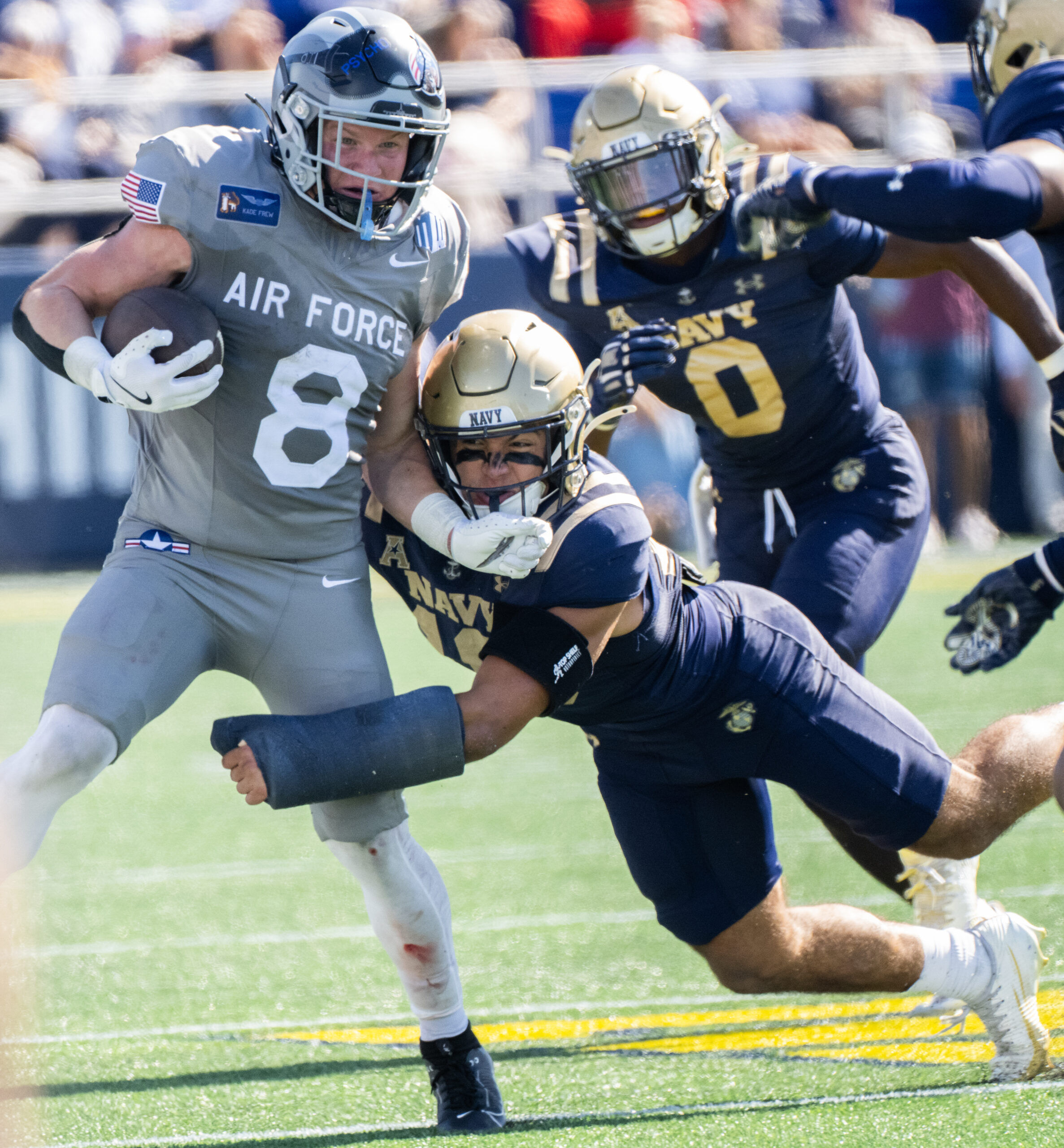
LAS VEGAS – The good and bad news for Air Force – in a season that keeps bringing both in droves, often on successive offensive and defensive possessions – is that it’s been here before.
And there’s a good chance they’ll be here again down the road.
The Falcons (1-4, 0-3 Mountain West) head to unbeaten UNLV (5-0, 1-0) on Saturday stuck in a four-game losing streak. They are thriving on one side of the ball and among the nation’s worst on the other.
This is not all that different from last season, when the team lost seven in a row following an opening victory. That squad then closed the campaign with four consecutive victories.
“We know how to turn it around,” fullback Dylan Carson said after a loss last week at Navy. “And we’re going to turn it around.”
The need for correcting the course from the bleakest point might be the new norm for Air Force, and the product of its unique position in college football.
UNLV coach Dan Mullen mentioned several times this week that his team featured the fewest returning starters in the nation. But his two-deep is sprinkled with transfers to fill those gaps.
Quarterback Anthony Colandrea came from Virginia. Leading receiver Jaden Bradley arrived after stops at Pitt and Charlotte. On defense, six of the top 10 tacklers played at other NCAA Division I programs, including Alabama, Georgia, Texas A&M, Michigan State and Kansas State.
Mullen, in his first year with the Rebels, understands his program’s unique advantage within the transfer portal.
“Great facilities, great team, great culture, great city,” Mullen said.
Air Force plays an entirely different game. If the Falcons want to restock the pantry, they must go to the garden knowing all the while that certain plants might never take to the rugged conditions and others might struggle to replenish after an abundant harvest. Also, a pesky critter might help itself to a meal. You simply make do with what is left, even if it means picking something prematurely from the vine.
There are no quick fixes, only different methods to mix the stew.
The results have been on display for all to see over the past two years.
In 2024 the Falcons averaged fewer than 13 points per contest during the seven-game losing streak as the offense auditioned quarterbacks and broke in a new offensive line. The defense held its own to a point, but the ask was far too great.
The team figured it out, though, and won the final four games with a vintage, ground-dominated Air Force look.
This year the offense, behind much of the same line that turned a corner last year and a breakout season from sophomore quarterback Liam Szarka, is on pace to be among the most prolific units since the Falcons adopted an option offense 45 years ago.
On defense, however, the critters have arrived in the garden in the form of two key transfers (defensive back Lincoln Tuioti-Mariner and outside linebacker David Santiago) and injuries (cornerbacks Levi Brown and Jordan Elie-Stuart, linebacker Dallas Daley and safeties JT Tomescko and Houston Hendrix are among the players to miss time).
That’s left the Falcons, particularly in the secondary where sophomores and freshmen have taken the bulk of the snaps, to use what has been available. It has only exacerbated the issue to face a run of opposing offenses at Utah State, vs. Boise State and Hawaii and at Navy that each present unique systems that are among the best at what they do among programs outside the power conferences.
As the defense has given up an average of 476.8 yards per game (131st in the nation), there might be a tendency to point to the coaches. But this is largely the same staff under coordinator Brian Knorr that directed a unit in 2022 that gave up just 254.4 yards per game and 277.7 the following year, among the best in the nation. They haven’t suddenly forgotten how to coach.
I asked Navy coach Brian Newberry last week what he thought was the key to avoiding the ups and downs that seem so inevitable for service academies in the current game where player movement is virtually unrestricted and the lure of Name, Image, Likeness money (also not available to academies) often encourages that movement.
He pointed to X’s and O’s that play to your roster’s strengths and cover up deficiencies, but mostly he stressed coaching the young players in the program. Keeping the garden watered.
“You’ve got to make sure you develop those guys and you stay together when those things aren’t clicking perfectly, and you keep working,” Newberry said. “That’s the only thing you can do, right? And you go back to the drawing board and figure out ways to make it work.”
The Falcons are staring at that drawing board yet again. Just as they did last year, when they rallied in a way that, I would argue, meant more than squeaking out six wins and playing a bowl game in Albuquerque or Boise.
Last year, at its lowest moment, Air Force had lost seven in a row and hadn’t played an FBS program to within 10 points. The Falcons had just been beaten soundly at Army.
Yet, the following week, cornerback Trey Williams, now serving as a second lieutenant, pointed out that “this is the perfect opportunity” for a leader.
Why do we, as a nation, offer sports at our service academies if not to simulate struggle and let the teams find ways, together, to overcome?
I don’t know what will happen on Saturday or for the second half of the season. My hunch is that the biggest win available to Air Force at this point will be keeping Szarka out of the portal. With him at the quarterback the margin of error grows. Even this team, with as bad as the defense has been, has been a snap or two away in most games.
But whatever happens with Szarka or anyone else, a bunch of impactful seniors will depart after this season. Just like always.
The modern game is different in its challenges, but cycles like this have long been the norm. The 2013 Air Force team went 2-10, but the program recovered by winning 10 games the next year. Losing seasons in 2017 and ’18 were followed by a run where Air Force averaged 10 wins over the next four full seasons.
Arguably the two best teams in program history, the 12-1 squads from 1985 and 1998, were followed by teams that went 6-5 and did not play in bowl games.
It has never been easy for the academies to compete. Again, that’s kind of the point.
What has allowed Air Force to remain a consistent threat – as it should be seen on Saturday even as a seven-point underdog – is its ability to utilize what it has and improve. It may not have experience in the secondary right now, but it has experience in its locker room in that department. And that’s why I would expect this season to take a another positive, fruitful late-season trajectory.
