






New reclamation proposal raises questions about Pikeview Quarry’s future
The operator of the Pikeview Quarry is seeking the state’s permission to amend the reclamation plan for the massive scar in northwest Colorado Springs, cutting the project cost by millions of dollars.
The new plan proposes carving a hillside near the lower part of the mine, which hangs on the front face of the Rampart Range above the Rockrimmon and Mountain Shadows neighborhoods, to provide material to build a stable slope — instead of taking much of the needed fill from the steep terrain above the quarry as originally planned.
Quarry operator Castle Aggregate says the new proposal would be safer because less material would be pushed down from the top of the mine, where the land is still moving more than 10 years after a 2008 slide. The reduction in cost is, in part, because some of the work has already been done, said Castle President Jerry Schnabel.
But a local critic of the company fears the new proposal, which could be approved as early as March, cuts corners and would lead to a bigger, uglier scar.
Developer Warren Dean has hired a consultant who spent more than two decades working for the state’s mining division and shares his concerns that the proposal would create a steeper slope than the existing plan — and one that’s less stable.
“I have to stare at it as a citizen of Colorado Springs and El Paso County. And it’s not right,” said Dean, who also opposed another mining plan by the quarry operator’s parent company. “It shows that we do not value and clearly cannot take care of our natural environment, which sends a message to the world.”
Despite the warnings from Dean, local officials haven’t protested the new plan, and the public appears hardly aware of the reclamation proposal.
“We need to tell our residents in those neighborhoods what to expect and that this is going to work,” said Colorado Springs City Council President Richard Skorman. “I’m surprised that we haven’t been more proactive as a city government.”
Pikeview Quarry mostly falls within an unincorporated area of county land. But county officials say there’s little they can do about the new reclamation plan because the quarry predates land use and zoning regulations.
The quarry has existed for more than a century, and Castle Concrete has owned and mined it since 1969.
In the 1970s, the county sought to bring the Pikeview Quarry, along with two other local quarries, into compliance with the land use code. But Castle Concrete sued and won the lawsuit, according to the county’s Planning and Community Development Department.
“We have to be very careful about what we do because we have a court case that established a precedent here,” said county Commissioner Stan VanderWerf, whose district includes the quarry. “I wish we lived in a perfect world where we could figure out a way to instantaneously remove that scar, but I’m not sure how we get there.”
Though the public comment period has closed on the new reclamation proposal, Skorman said he would still see if the city is able to assess the plan and potentially weigh in.
“I am concerned because we need to really understand what’s going on up there. Even though the quarry is in the county, whatever happens has a huge impact on the city,” he said.
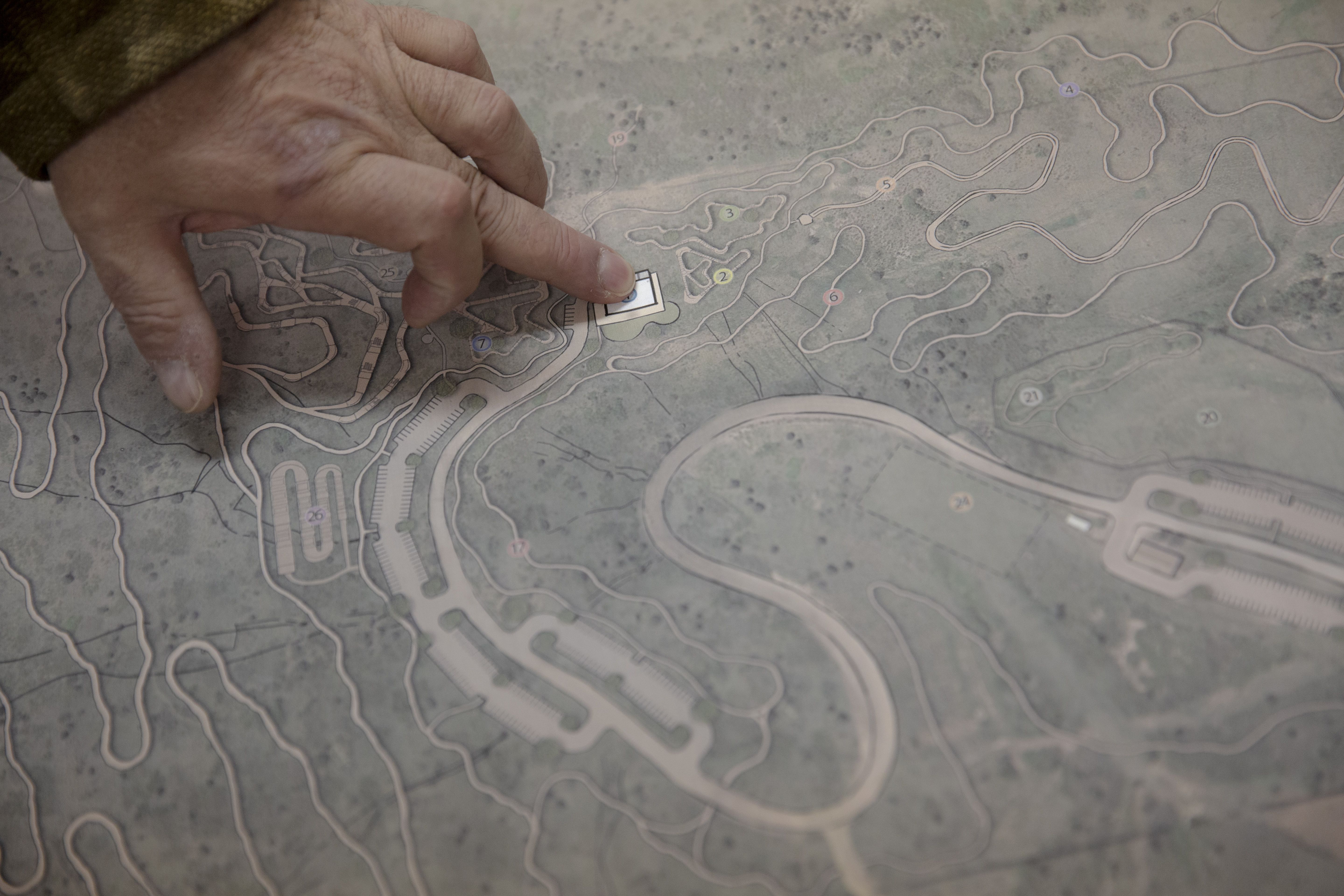
Castle Aggregate President Jerry Schnabel points to the location of the proposed day lodge plaza and maintenance facility on the Colorado Springs bike park concept plan draft on Friday, January 24, 2020 at Pikeview Quarry in Colorado Springs, Colorado. (Photo by Katie Klann, The Gazette)
A vision of Pikeview’s future
The silence surrounding the new plan is a stark contrast from the conversation about Front Range mining scars in the 1990s, when the topic was a key part of the environmentalist agenda at the local and state levels.
In the Pikes Peak region, hundreds of volunteers spent thousands of hours planting trees at the Queens Canyon quarry near Garden of the Gods, now hailed as the gold standard for local reclamation. The community-driven effort went beyond requirements of the state, which has reclamation standards that some consider minimal.
The Pikeview Quarry got some attention in 2018 when a plan was unveiled to build a “world class bike park” on the reclaimed land. Transit Mix Concrete, which previously operated the quarry, pitched the plan as it sought the state’s permission to mine a separate patch of rugged land in a southwestern part of the county.
But Transit Mix never got the green light to build the quarry at Hitch Rack Ranch off Colorado 115. And the local concrete company, owned by Chicaco-based Continental Materials since 1955, was last year sold to a Switzerland-based building materials giant.
Continental Materials retained Pikeview Quarry, along with the local Black Canyon Quarry, and rebranded them as Castle.
Meanwhile, the city is keeping mum on the bike park proposal, saying Pikeview is just one site under consideration for the attraction.
As Castle looks to the quarry’s future, the new reclamation proposal raises questions about whether the community will need to step in to help finish the job — and what the foothills will look like when it’s done.
Schnabel said he hopes the quarry will one day double as bighorn sheep habitat and the bike park, with trails zigzagging across a sparsely treed slope. What is now the quarry’s shop would become an events center, and the quarry floor would be buried under hundreds more feet of compacted fill.
That dirt and rock fill would be carved from the lower areas of the site, including the hillside that the shop now sits on, and also come from other city construction projects, he said.
He said reclamation would begin this year and could be completed within five years. Others, though, say that timeline may be unrealistic.
The proposed reclamation plan would disturb roughly 40 more acres of land, in addition to the 100 that have already been mined, Schnabel said.
About 127 acres of the roughly 240-acre permit area had been disturbed as of 2017, according to a recent inspection report from the state mining division.
Under the existing reclamation plan, material would be taken from 10 acres or so above the quarry, creating a “huge visual impact,” Schnabel said.
But instead of cutting benches at the top of the mine that would resemble corrugated cardboard, Castle wants to shave off some of the decomposing granite in the quarry’s upper regions, leaving what would look like natural rock outcroppings resembling those seen at Blodgett Peak Open Space, Schnabel said.
“It’s either up on top, where it’s highly visible, or down low where I can hide it to a large degree from most of the viewscape,” he said on a recent tour of the quarry.
Under the new plan, less material would have to be pushed downhill using heavy machinery. Rather, bulldozers and scrapers would build the fill up from below, Schnabel said.
“Basically, we’re cleaning up a lot of our piles and cleaning up a lot of our materials and putting them in the toe from the bottom up because it’s absolutely safer,” he said.
The view from the top of the quarry on Friday, January 24, 2020 at Pikeview Quarry in Colorado Springs, Colorado. (Photo by Katie Klann, The Gazette)
Price of reclamation
Schnabel estimates reclamation will cost between $10 million and $15 million, though the most recent estimate the company provided to the state was about $10 million.
To ensure that companies follow through on reclamation, the state holds a bond for the cost, which is released when the reclamation is done.
But for years, the bond held for Pikeview’s reclamation was about $4.2 million — enough to cover just the initial phases of the existing plan.
After an inspection in January 2019, the state mining division notified Castle that the bond was to increase to nearly $22 million, or about what the company estimated reclamation would cost, in total, in its existing plan.
The company responded with an April 30 letter appealing the bond amount.
“By working towards an alternative reclamation plan, we can assure the state will be protected for a bond amount much lower than the current mine plan,” Schnabel wrote in the letter.
At a hearing before the Mined Land Reclamation Board last summer, Castle agreed to post a $15 million bond and submit a new reclamation plan, according to a board order.
Approval of the plan and the bond are ultimately up to the board, which will likely hold a public hearing on the reclamation proposal at its March meeting. That date could be pushed, though, depending on how long the state’s review of the plan takes, said Russ Means, minerals program director for the Colorado Division of Reclamation, Mining and Safety.
A rocky history
While Schnabel asserts that the new plan will be much safer, Dean and his consultant, Carl Mount, fear otherwise.
Many of their concerns stem from the site’s history of instability — 2 million tons of limestone came crashing down the quarry’s stair-stepped ledges in the span of about 10 seconds on Dec. 2, 2008.
Now, the company is proposing building a steeper reclaimed slope than the one in its current plan, which was devised to provide long-term support to the area affected by the 2008 slide.
And Dean and Mount are worried that Castle hasn’t done its due diligence when it comes to how that buttress will be engineered and how the fill will be compacted to ensure it stays put.
“If you don’t have engineering stability, it doesn’t matter what you do in terms of topsoil and vegetation,” said Mount, whose career at the state mining division included years spent reviewing reclamation plans as a senior environmental specialist. “If it slides down a hill, all the topsoil in the world isn’t going to help you.”
Schnabel said many of their concerns are unfounded. Testing would ensure that the material is suitable fill and that it’s successfully compacted once it’s placed. The company is also working with the same geotechnical team it’s had since 2009, and the firm has completed a stability analysis, he said.
The state mining board found Transit Mix was at fault in the 2008 slide and issued a cease-and-desist order in June 2009, requiring that the company pay a $4,200 fine and submit a new plan to stabilize and reclaim the quarry. The board found that miners had removed rock that was serving as a buttress to a slope, which ultimately triggered the failure. Transit Mix admitted at a hearing before the board that it mined more than it should have, according to a board order.
But it wasn’t all the company’s fault — the Colorado Geological Survey noted that the nature of the land also played a factor in the 2008 slide. Its report attributed the slope failure, in part, to “the inherent weakness of the rock mass” caused by “the abundant discontinuities related to the Rampart Range fault zone.”
The quarry wasn’t declared safe until 2013, and operations there continued until last fall. Ending mining was an economic decision, Schnabel said.
“The slide potential makes it very difficult to get the material to the floor without putting people in danger. So the economics are such that it’s costing more to extract the material than it is (worth) to sell,” Schnabel said.
The slide continues to “settle in on itself,” he said.
It’s moving about a tenth of a foot each month, he said.
Three million tons of rubble have been cleared from the slide area. And about 200 feet of fill has been placed, building up the quarry floor and stabilizing what’s left of the slide, Schnabel said.
Issues with instability have affected Pikeview operations for decades, according to the Colorado Geological Survey’s report. Two slides took place in the 1970s, when rock slabs 20- to 30-feet thick and hundreds of thousands of tons in size came loose. In 1993, near the area of the 2008 slide, a 25-foot thick rock slab weighing about 500,000 tons slid 400 to 500 feet down the slope.
The 2008 slide led to another slope failure the following year that sent a million tons of limestone tumbling down the quarry walls.
The quarry experienced its latest slide following the floods of May 2015, according to an inspection report filed with the state.
“This quarry has been sliding since the ’70s,” said Dean. “So you can’t go cheap on the quality of (those) materials and how that material is placed in position. And you better double check your engineering.”
Concerns for the future
Mount also doubts the company’s understanding of the land.
“They don’t know exactly what they’re buttressing or what they’re trying to buttress for,” he said. “The history of the site indicates that they don’t really know where the weak points in the limestone are.”
Dean and Mount are concerned, too, that the company hasn’t proposed adequate safeguards to prevent runoff from coming down the steep, reclaimed slope, which would erode and destabilize the land.
Compaction can safeguard against erosion, but Dean and Mount have doubts about the company’s methods there, as well. Pushing some material downhill and rolling over it with heavy machinery, as Castle has proposed, isn’t a proper compaction method, Mount said.
Schnabel, however, said the new plan proposes adequate drainage, including a riprap-lined ditch that will direct water from above the quarry and route it around the sides.
Dean and Mount share another worry: that the slope will be too steep to operate the equipment used for revegetation. New grasses and plants could struggle to take hold, they fear.
They’ve both outlined each of their concerns in a series of memos to the state.
“We do not have satisfactory answers. So we continue to object,” said Dean, who serves on governing boards for the Nature Conservancy in Colorado and Great Outdoors Colorado. He lives southwest of Colorado Springs and was a major opponent of the proposed Hitch Rack Ranch Quarry.
The state mining division sought answers to some of Dean’s questions in a Jan. 23 letter to the company. The letter asks for more information about aspects of the plan including fill testing and compaction, revegetation, drainage and erosion protection.
The state also requested data from a system that monitors land movement at the site.
“Review of site history indicates water may have been a factor in previous slides. As such, further scrutiny of stormwater management above the slide area is warranted,” Timothy Cazier, an environmental protection specialist for the mining division, said in the letter to Schnabel.
Andrew Bird, president of the homeowner’s association in the nearby Peregrine neighborhood, was surprised to learn that the company was seeking approval for an amended reclamation plan.
“The concern has to be, can we make this safe, and can we clean this eyesore up so it presents itself like the rest of the city?” Bird said. “It needs to be put back to as it was originally before they started scraping the quarry out of there. I just hope they can live up to that.”
The state mining division doesn’t require that residents be individually notified of new reclamation proposals unless they are within 200 feet of a quarry site, and no one lives that close to Pikeview.
A handful of local and state agencies have been informed of the proposed amendment, legal notices have run in the newspaper and a sign has been posted at the mine’s entrance.
“It’s a closed process, which keeps the public in the dark, and I think the reclamation standards are minimal at best,” Dean said. “When I told the city about it, they were surprised. And the city should care.”
State law dictates what criteria the Mined Land Reclamation Board can consider when approving or denying an application. Those criteria don’t include aspects of a reclamation plan such as traffic, land use and noise — those are the purview of the local government, state mining division officials say.
The bike park
Colorado Springs Parks, Recreation and Cultural Services offered little new information about the bike park plan.
“Additional work would be needed as part of parks’ due diligence if it were to move forward,” city spokeswoman Vanessa Zink said in an email. “A lot of this revolves around the reclamation,”
The city is also “pursuing a potential open space acquisition” of about 150 acres, east and north of Pikeview, owned by Castle, Zink said.
It’s the “buffer property” around the quarry, Schnabel said. The land was slated for housing development until the city approached the company about the acquisition. Two developers have expressed interest if the bike park proposal doesn’t pan out, he said.
“I think the best use of that land would be to make it open space,” said City Councilman Don Knight, whose district includes the property near the mine. “Then it comes down to the budget. We have other land that we’re trying to buy too, so we would have to rack and stack the priorities.”
The city is also eyeing Castle’s Black Canyon Quarry, the smaller mountainside scar seen from the city’s west side, as a potential open space that would provide access to Waldo Canyon.
Renderings of the bike park generated excitement among members of the cycling community when they were unveiled in spring 2018, and the El Pomar Foundation has donated $1 million to the city to help pay for the construction of the park on the Pikeview Quarry scar or another site.
But it’s unclear who else would pay for the bike park.
“At this time, it’s premature to talk about arrangements or finances, but we can confirm that we continue to communicate with Castle,” Zink said.
Castle Aggregate President Jerry Schnabel explains the proposed reclamation process on Friday, January 24, 2020 at Pikeview Quarry in Colorado Springs, Colorado. “Basically, we’re cleaning up a lot of our piles and cleaning up a lot of our materials and putting them in the toe from the bottom up because it’s absolutely safer,” he said. (Photo by Katie Klann, The Gazette)
Castle Aggregate President Jerry Schnabel explains the reclamation plan from the top of the quarry on Friday, January 24, 2020 at Pikeview Quarry in Colorado Springs, Colorado. Pikeview Quarry is operated by Castle Aggregate. (Photo by Katie Klann, The Gazette)
Castle Aggregate President Jerry Schnabel drives through the different sections of the quarry on Friday, January 24, 2020 at Pikeview Quarry in Colorado Springs, Colorado. (Photo by Katie Klann, The Gazette)