






Second powerful wind storm could hit Front Range on Friday
Hang onto, well — everything.
A windstorm similar to the one that blew down hundreds of trees across Colorado last weekend could hit the eastern mountains, Front Range cities and plains as early as Friday afternoon, the National Weather Service said Wednesday.
“It’s strange that we’re getting two of them so close together,” said meteorologist Makoto Moore. “We do get wind storms this time of year, but two damaging wind events within about a week is kind of unusual.”
Gusts up to 90 mph are forecast for the mountains, and up to 65 mph along the Interstate 25 corridor, Moore said, noting that it’s still a little unclear as to when and how hard the winds might hit. It is expected to clear out sometime Saturday.
The windy weather is courtesy of the jet stream dropping down across the desert southwest, he said.
Snow is predicted along the Continental Divide, so there could be blizzard conditions in some areas, he said.
Last weekend’s storm felled so many trees in the Arapaho and Roosevelt national forests that officials there issued a warning Wednesday for those cutting Christmas trees be on the lookout for falling trees.
That shouldn’t be a problem in the tree-cutting areas in the Pike National Forest, where those with permits can begin cutting Christmas trees on Nov. 28, said Barb Timock, spokeswoman for the Pike and San Isabel national forests.
“We have not experienced a major blow down in the tree-cutting areas” near Woodland Park, she said.
Still, she cautioned those venturing into the forests for hikes or other purposes to be aware that windy weather can cause trees to topple and branches to come down.
“Stay out of the forest when it is windy,” she said. “And be aware of changing condition when you are out there.”
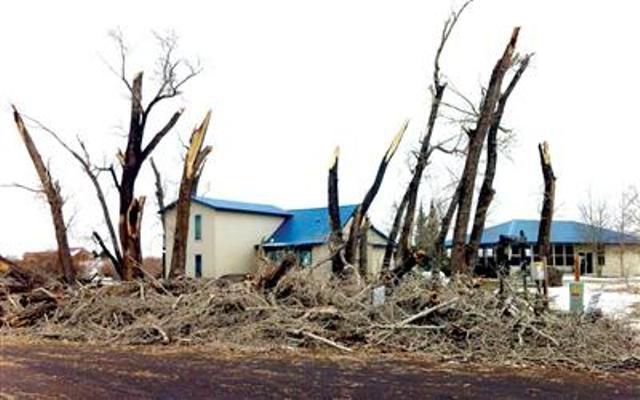
Along with the Arapaho and Roosevelt national forests and Rocky Mountain National Park, the Wet Mountain Valley also was hit hard by last weekend’s winds. Some residents in more remote areas were without power from Saturday until Wednesday, according to the Canon City Daily Record.
Wind gusts in excess of 100 mph were reported in Westcliffe, Moore said, noting that there were no official measurements.
National Forest spokeswoman Elsha Kirby said enough trees were blown down in the Salida area to spur area residents to call and ask if they could collect firewood.
Although that is sometimes allowed under such circumstance, permits are required to take firewood from the forests. And, depending on the number of trees down and whether they’re overlapping each other, it can be treacherous work, Timock said.
She said a number of factors play into blow downs, including strong winds, the health of the trees and the type of trees. For example, the Pike National Forest has a lot of Ponderosa pine, which have strong root systems.
Spruce trees, common in the San Isabel National Forest, topple a bit more easily, she said.Trees weakened by insects or drought also are more susceptible to such high winds, she said.
—Contact Sue McMillin: 636-0251 Twitter @suemcmillin Facebook Gazette Sue McMillin
Majestic trees snapped off at their tops and a collapsed storage building were among the wind casualties at St. Andrews Golf Course just outside of Westcliffe. Photo by The Pueblo Chieftain