






Mainstream ads still showing up on misleading sites despite efforts to stop it
Jihadi rapists. Muslim invaders. Faked mass shootings. Pizzagate.
Somebody browsing highly partisan websites in recent weeks could have seen articles about all of these subjects — and on the same pages seen cheerful green ads for the Girl Scouts, bearing the slogan “Helping Girls Change the World!”
Such juxtapositions, documented by a Washington Post review of advertising on hundreds of websites, are more than simply jarring. They are products of online advertising systems that regularly put mainstream ads alongside content from the political fringes — and dollars in the pockets of those producing polarizing and politically charged headlines.
This mismatch of online content and ads, which digital advertising companies have been working to fix, goes to the heart of how the Internet economy works.
Tens of billions of dollars are at stake in the promises of online ad systems to match advertising pitches with receptive targets. But the automated systems that place many of these ads are driven by sophisticated, proprietary algorithms that are hard for advertisers to understand or control, many complain.
These systems, which have powered the rise of Google, Facebook and dozens of lesser-known technology companies, also can have the unintended effect of fueling the creation and spread of extreme content online — on the political left and the right — independent researchers and industry experts say. Sensationalized headlines bring clicks. Clicks bring ads. Ads bring revenue. And the advertisers often have limited options for avoiding potentially objectionable websites.
Google and other online advertising companies vowed to address such issues last year after The Washington Post and other news organizations discovered mainstream advertisements near hateful, racist and violent content. Though online ad networks have made strides in these areas, they have struggled to handle other categories of content that are less extreme but still upsetting to some advertisers, including the sharply political, conspiratorial and sometimes misleading content The Post recently reviewed.
“As platforms race to curb the spread of politically polarizing and sensationalized content, their ad product teams build tools to help publishers better promote and monetize it,” said Jonathan Albright, research director at the Tow Center for Digital Journalism at Columbia University. “There’s an internal conflict, and it comes down to reputation and trust versus revenue.”
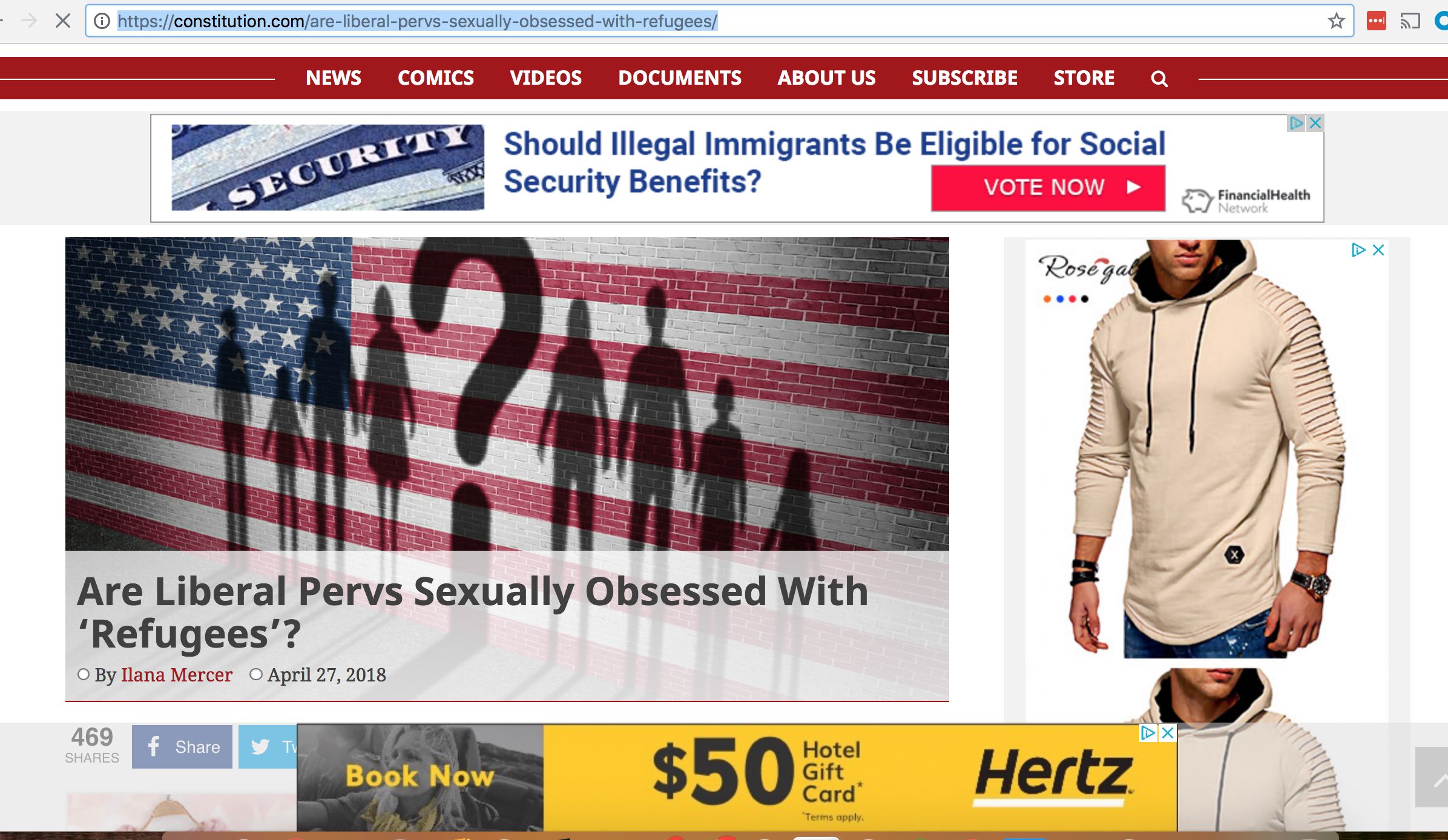
The Post’s review of websites found a Hertz ad appearing with a story asking, “Are Liberal Pervs Sexually Obsessed with ‘Refugees’?” and an American Red Cross ad with a post comparing an arm band worn by David Hogg, a survivor of a Florida school shooting and activist against gun violence, to a Nazi symbol.
A Jeep ad appeared with a story calling one of the women who has accused Supreme Court nominee Brett Kavanaugh of sexual misconduct a “15-year-old horny girl” who was seeking “to impress” Kavanaugh. The story also suggested, citing only an unverified tweet, that the accuser had made a similar complaint about a previous Supreme Court nominee, Neil Gorsuch.
Google, whose software and online networks had a role in placing many of the ads reviewed by the Post, declined to comment on individual sites that carry its ads or on the particular advertisers that use its network or software to place ads. But several pages containing inflammatory headlines, images and articles no longer showed Google-placed ads after The Post contacted the company and asked it to review them for possible policy violations.
The company said in a statement, “We have strict policies that govern what kind of content we place ads on, and if we find a page or website that violates our policies, we take immediate action. Even when a site does not violate our content policies, we understand that advertisers may not want their ads appearing on certain sites or types of content. That’s why we give our advertisers the ability to block certain categories of content if they choose.”
Google says it does not serve ads on sites that feature hate speech, including bullying, harassment or content deemed derogatory or dangerous, and it prohibits publishers that misrepresent their identities. Last year, Google removed 320,000 publishers from the ad network for policy violations and blacklisted nearly 90,000 websites and 700,000 mobile apps, it said.
Advertisers were surprised and displeased to learn their ads had appeared with controversial content.
The Girl Scouts said they were unsure what ad network placed the ads on the sites reviewed by The Post but did not believe Google was responsible. “When we are made aware that one of our ads has appeared alongside content we consider incompatible with our mission, we take immediate steps to add those sites to our ‘black list’ of prohibited websites, and trust that our content will be removed,” the Girl Scouts said in a statement.
Beyond the impact on advertisers, many independent analysts see mainstream advertising support for such sites as a key front in curbing content that may contain elements of truth but is politically charged, lacking appropriate context and topped by headlines designed to appeal to readers’ emotions. Some of this content also invokes debunked conspiracy theories and allegations that so-called “crisis actors” faked mass shootings.
Many technology companies prohibit posts or articles that obscure their sources or seek to deceive users of a platform. Hateful or violent content typically is against platform rules as well.
But there is a broad category of online material that is not in violation of tech-company policies yet still is unwelcome to mainstream advertisers, say analysts, researchers and industry officials. They say advertisers generally want to have their pitches appear with content that is not inflammatory, sensationalized or potentially troubling to readers — and they would rather not send their ad dollars to people who create such content.
“They have a right to free speech, but Fortune 500 companies don’t have to subsidize that,” said Alex Stamos, the former chief security officer at Facebook. He is now an adjunct professor at Stanford University’s Freeman Spogli Institute for International Studies. “Online advertising networks are spectacularly powerful,” Stamos added.
The IAB Tech Lab, which is a partner of the Interactive Advertising Bureau trade group, has been working in recent years to improve the transparency of ad placement and give both advertisers and publishers more control over the process, said Dennis Buccheim, general manager of the research group. He said that advertisers have far more ability than before to learn where their marketing appears and designate particular categories of sites as off limits.
“The brands want to have more and more understanding of where the [advertising] spend is going, and we think that’s a good thing,” he said. “It became more opaque than anyone thought it would.”
Those who own, operate or provide advertising services for some of the sites reviewed by The Post said they too have little control over what ads appear and shouldn’t be blamed for the unease of some advertisers.
“Many times the news of the day is uncomfortable, violent and depressing,” said Jared Vallorani, chief executive of Klicked Media, which provides advertising and technical services to several sites reviewed by The Post.
He said that many mainstream news sites, including The Post, publish articles that may upset some readers and advertisers. “Would E-Trade want their ads on a site that has an article about a sex offender killing an 89-year-old woman?”
Vallorani said that the article claiming “liberal pervs” have a sexual interest in refugees was written by an unpaid guest contributor and may warrant review “to make sure it meets our rigorous standards.”
The Post found the article, first published April 27, on Constitution.com, a site owned by Romulus Marketing that hosts hundreds of thousand of ads each month, according to a review by DoubleVerify, a company which audits websites with objectionable content for advertisers. Vallorani is the chief digital officer for Romulus Marketing.
After the Post asked Google about the post referring to “liberal pervs,” the company alerted Constitution.com that it was in violation of policies, said Vallorani. The site removed the page.
Screengrab of the Constitution website that shows a clothing advertisement next to the daily headline titled: Are Liberal Pervs Sexually Obsessed with Refugees?