






Grant will help study how to restore Defense land
Some of the most pristine land in the U.S. is off-limits because it abuts some of the most hazardous lands: former military bases and test sites.Take, for example, the Big Oaks National Wildlife Refuge in southern Indiana. It’s home to more than 100 species of songbirds and unique oak forests and grasslands — and about 7 million rounds of unexploded military ordnance and depleted uranium.It’s among millions of acres once owned by the Defense Department that are now managed by the U.S. Department of Fish and Wildlife or the Bureau of Land Management, and one of three former military bases that are a research focus for a husband-and-wife team of professors from Colorado Springs.David Havlik, assistant professor of geography and environmental studies at the University of Colorado at Colorado Springs, and Marion Hourdequin, assistant professor of philosophy at Colorado College, recently won a $244,800 National Science Foundation grant that will fund their three-year project.“We’re thrilled,” Havlik said. “I’ve been working on some of these issues for about eight years. This allows us to get much more in-depth in our inquiry and investigation of these sites.”The research will include Rocky Mountain Arsenal National Wildlife Refuge in Denver and Great Bay National Wildlife Refuge in New Hampshire. Havlik said the sites represent a variety of ecological settings that will provide case studies for other areas. The team will include a UCCS graduate student and two undergraduate students from CC.But this isn’t a how-to project with a goal of reclaiming vast swaths of hazardous lands and opening them to public use.Instead, the couple will collaborate to answer practical and philosophical questions that could help land managers decide what should be restored, preserved or even hidden. Their work, which will primarily be carried out over three summers, will include a workshop with land managers.“Many of these lands have had several layers of use — wildlife refuge, bombing range, agricultural use, short-grass prairie,” Havlik said. “We will be giving the idea of restoration a more social perspective by asking what prior conditions should we be trying to restore. What prior condition makes the most sense?”While the seed for the project emerged from Havlik’s doctoral thesis work on the closure of military lands and their conversion to wildlife refuges, it was the intersection of his career with Hourdequin’s that led to the broader focus. The result was an interdisciplinary approach to a national challenge.Hourdequin said she’ll work to put ideas of authentic restoration in context with the lands they’re researching.Most academic literature focuses on the idea that a restored site is less valuable than the original because it’s human created.“I think that inadequate,” she said. “Since almost all landscapes are the joint product of nature and social forces we need to expand beyond that idea.“One of our central aims is to create more of a conversation around the issue of restoration goals.”Havlik added: “We’re not just trying to contribute to theory but to help managers on the ground. We want to take the intellectual work and see impacts on the ground.”
____________________________________________________________________
Project Research Sites• Big Oaks National Wildlife Refuge, Indiana. It was the Army’s Jefferson Proving Grounds from 1941 until its closure in 1995. It was primarily an ammunition testing site. Web site.• Great Bay National Wildlife Refuge, New Hampshire. A portion was the home of Pease Air Force Base from 1956 until 1989, and was part of Strategic Air Command. It was declared a Super Fund cleanup site in 1990 and contaminated soil was excavated over the following decade. Web site.• Rocky Mountain Arsenal National Wildlife Refuge, Denver. The Army chemical weapons plant was established in 1942. Private companies also leased space to produce pesticides at the site until 1982. Significant environmental cleanup agreements between public and private agencies were reached in 1995. A portion of the site was transferred to Fish and Wildlife in 2004. Web site.
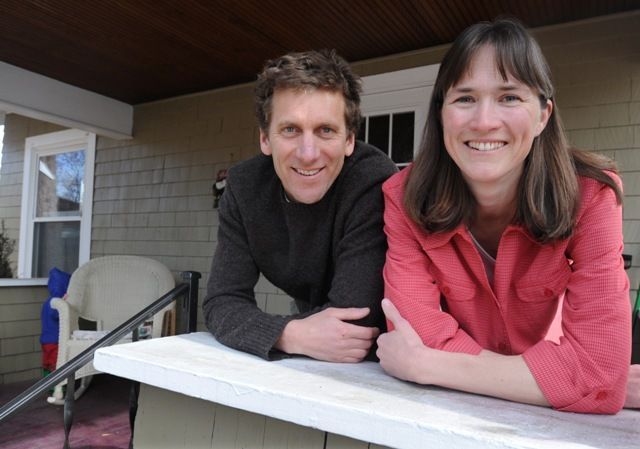
David Havlik and Marion Hourdequin (left to right) have been awarded a grant from the National Science Foundation. The husband and wife team will be studying the reclamation of former military sites that are now wildlife refuges. Photo by JERILEE BENNETT/The Gazette