






Northeast Notes: One person’s trash is another person’s treasure
As I headed to the back of the grocery store for a gallon of milk, I bypassed the shelves brimming with notebooks, lined paper, and multicolored folders. There were stacks of boxed pencils and pens alongside rows of backpacks in every size imaginable. This abundance of school supplies signals the start of another academic year for kids in K-12 in our community. As I walked through the aisles, I didn’t give it a second thought since it’s part of American life. It’s part of the routine between summer and fall, marking the time between hot weather and Halloween.
But in many parts of the world, this is hardly routine. In some countries, the opportunity to attend school is rare or non-existent. Malala Yousafsai revealed the difficulties facing girls in Pakistan where education isn’t approved of, expected, nor guaranteed. In remote rural areas of South America, Africa, and Asia, there’s an abundance of agriculture and an absence of infrastructure. Funds to build schools, hire teachers, and provide educational materials are scarce.
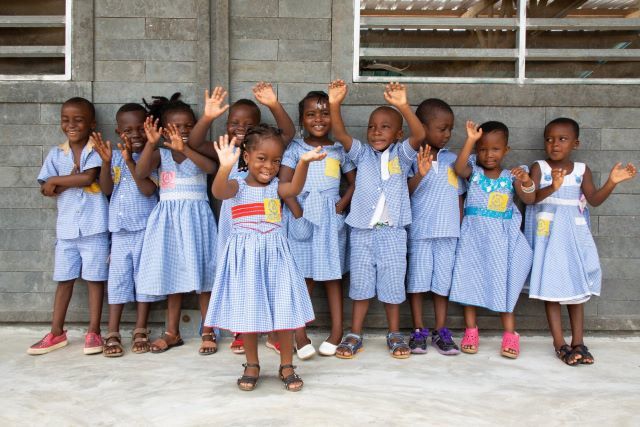
In the Ivory Coast, a unique effort is underway to open up educational opportunities for kids thanks to the ingenuity of a company in Colombia, and a women’s network in Abidjan, Ivory Coast’s largest city. In one of Abidjan’s poorest neighborhoods and in two farming villages, nine demonstration classrooms have been built out of recycled plastic bricks. The lego-like bricks are made by Conceptos Plasticos, a company based in Colombia. Inside their facilities, plastic water bottles, rubber pieces like discarded tires, and other recyclable trash are sorted and processed into a material which is formed into large, interlocking, stackable bricks. Although the bricks were exported to Abidjan, the strategy has been so successful that a factory is under construction in an industrial park to make the bricks locally. The manufactured bricks are fire-retardant, stay cool in hot weather, and interlock easily to build classroom walls. The factory will even utilize trash such as old cell phone parts and plastic snack packaging.
In countries such as the Ivory Coast, local production has several positive benefits. Women earn a wage by picking up trash which is then turned into bricks. Families benefit from the income which raises their standard of living and less trash ends up in landfills. The factory expects to buy collected trash from over 1,000 women and employ approximately 30 people.
Conceptos Plasticos was founded in 2010 with a mission to build housing and create jobs, improving the environment as well as the economic and social fabric of communities. Essentially, they’re turning trash into schools. The idea behind the company started with a handful of people. Initially, Aboupacar Campo, a physician with UNICEF who was working in Abidjan, arranged for Conceptos Plasticos to visit the Ivory Coast. The company’s founders, husband-and-wife team Isabel Christina Gamez and Oscar Andres Mendez, saw the critical need to build classrooms throughout the region. They were dismayed when they saw women carrying children while collecting trash in landfills where hazardous waste was dumped. Ultimately, Gamez and Mendez moved to Abidjan to launch the project.
At first, they focused on building classrooms in Abidjan, but they envision using the bricks for things such as latrines and housing for school teachers. Now, Conceptos Plasticos is working in partnership with UNICEF towards the goal of creating 528 classrooms for over 26,000 students in the Ivory Coast.
There are many needs and opportunities in the country. One of the needs? In Gonzagueville, there are only 14 latrines for 27,000 students and teachers. One of the opportunities? The raw materials are plentiful in Abidjan where an estimated 300 tons of plastic waste are sent to trash heaps and landfills every day. Why not turn this waste into something so desperately needed like schools?
That day, as I paid for milk at the grocery store, I thought of the blue recycling bin in our garage where the empty milk container would be tossed. I don’t know where that container ultimately ends up in our local recycling industry, but in my heart of hearts, I hope it’s turned into something useful somewhere.
Julie Richman is a freelance writer, project manager and consultant. She and her family have lived on Colorado Springs’ northeast side for 21 years. Contact Julie with comments or ideas for her column at woodmennotes@pikespeaknewspapers.com.
Conceptos Plasticos is working in partnership with UNICEF towards the goal of creating 528 classrooms for over 26,000 students in the Ivory Coast.
Conceptos Plasticos, based in Colombia, sorts and processes plastic water bottles, rubber pieces, and other recyclable trash into a material which is formed into large, interlocking, stackable bricks. The manufactured bricks are fire-retardant, stay cool in hot weather, and interlock easily to build classroom walls (pictured). The factory will even utilize trash such as old cell phone parts and plastic snack packaging.