






Youth Corrections chief leaves after alleged riot at Spring Creek facility
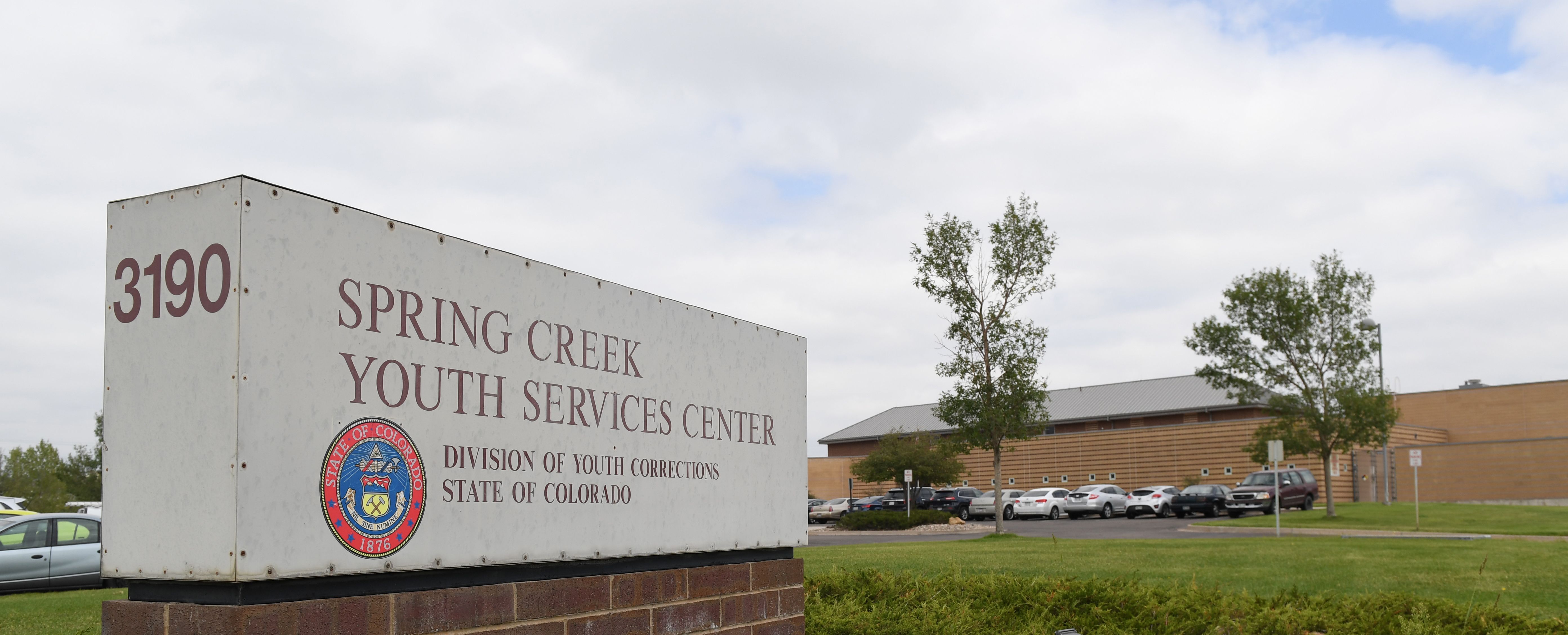
Charles “Chuck” Parkins is no longer director of the Colorado Division of Youth Corrections, and his abrupt departure comes as a whistleblower inside Spring Creek Youth Services Center in Colorado Springs is reporting to state officials riots, assaults on staff and students, and consensual sex acts among residents.
Parkins was gone as of Tuesday morning, according to Laura Morsch-Babu, communications director for the Department of Human Services. The new spokeswoman for DHS, which oversees the state’s juvenile detention facilities, said she couldn’t discuss the details of Parkins leaving because it was a personnel matter. Parkins, who as director oversaw all state youth corrections facilities, did not respond to a request for comment.
Morsch-Babu said Anders Jacobson, a long-time DYC employee and the assistant director, is taking over temporarily.
“We still have more challenges and dealing with a complex and difficult population, that is something that we will always be focused on dealing with to make sure that Spring Creek is safe for youth and staff,” Jacobson said.
Parkins was hired in March 2015 and pledged to help turn around the troubled division, which has been plagued by multiple problems for years. Things appeared to be improving at the facility and there was a drop in the number of violent incidents.
But a Spring Creek employee last month filed a complaint with Colorado’s Attorney General as a whistleblower, alleging that conditions were so bad at the center that it amounted to child abuse. The employee sought protected status for speaking out.
Spring Creek employees who spoke on the condition of anonymity said the inability to put juveniles in solitary confinement combined with limited physical restraining tools have left staff with little recourse against violent youth in the facility.
“These are kids who come to us having been pepper sprayed, tased and bitten by police dogs, but we can’t do much of anything to them,” said an employee. “There’s no real consequences. All day long, they’re calling the shots.”
What some Spring Creek staff described as a full-scale riot missing only “helicopters, the National Guard and trash cans on fire” happened inside the locked residential center on the evening of Aug. 28, a Sunday.
“They could have killed someone,” said a staff member who has been assaulted twice in the past year, both times receiving injuries. “Our safety wasn’t accounted for.”
Jacobson fundamentally disagreed with that depiction of the incident and said overall the facility is not unsafe for juveniles or staff.
“We spend a considerable amount of time there … On a daily, at least weekly, basis we are talking with staff, engaging with staff,” Jacobson said. “We are not hearing from the vast majority of employees at Spring Creek that they see their facility that way.”
Jacobson said staff responded swiftly and effectively to the event on Aug. 28 and that while “a planned assault of a youth” did take place the “staff had a tremendous response.”
Jacobson said they take all complaints seriously and will be looking into these and other incidents.
Colorado Springs Rep. Pete Lee, D-Colorado Springs, and Sen. Kent Lambert, R-Colorado Springs, passed a law in 2016 requiring better documentation of the use of solitary confinement and codifying a new policy adopted by DYC that limited the use of solitary confinement to less than eight hours within two days without an order from a judge and notifying parents.
Lambert has been working with the whistleblower to get job protection under a state law that he and Lee also passed in 2016 that allows state employees to obtain protected status when filing complaints.
The Spring Creek employee initially contacted Lambert with concerns, and he directed her to the Attorney General, who spent 30 days screening what the whistleblower was going to release.
Lambert and Lee have been following the problems at Spring Creek for more than three years.
“My general concern is a lot deeper and more systemic a problem than one person, as we’ve already seen this involves a culture of allowing state employees to be put in very dangerous situations, in some cases life-threatening situations,” Lambert said of the news that Parkins was gone. “We’ve got to really look at this workplace violence issue and do something different to protect our state employees and the youth that are at the facility.”
Lee said the solitary confinement bill was targeted at ending its use as punishment for prolonged periods of time.
“When you have that degree of apparent chaos within an institution, one needs to look at the leadership, and maybe it’s time for an outside agency to see exactly what’s going on within Spring Creek,” Lee said.
Call to Police delayed
Colorado Springs Police didn’t receive a report for service about the Aug. 28 event until the next morning, at 8:49 a.m., with the call log including the word “riot.”
Police would release little information this week to The Gazette, saying the case was “under investigation.”
The incident started when several juvenile residents ganged up on another teen and began hitting the boy repeatedly with plastic chairs, according to staff.
The state-run center houses up to 80 youth offenders, ages 10 to 20. Some have committed crimes and are serving sentences while receiving rehabilitation treatment; others are being detained pending court action on suspected criminal activity ranging from habitual truancy to murder.
A video an employee filmed of the riot “would blow your mind,” another employee said. “It’s like a bunch of jackals on a wildebeest.”
One teen was strong enough to stop staff who were trying to break up the fight, which spiraled out of control from there, according to eyewitness accounts.
“Staff were not prepared from a training perspective,” an employee said. “They had no idea what they were doing. You’re wrestling these kids that are adult size.”
In an adult prison, rubber bullets and tear gas would have been used during such a violent event, said a staff member who has worked in adult penal institutions.
While trying to handcuff some of the youth, Spring Creek employees were grabbed and put into headlocks by adolescents, one employee said.
Supervisors ordered personnel to pull back to avoid being injured, staff said.
The youth involved eventually were segregated in isolation cells.
Police arrested six or seven residents the next day, some minors and some over age 18, staff said. The injuries were not severe enough for anyone to need hospitalization, staff said.
A few days later, Sept. 30, Rep. Kit Roupe, R-Colorado Springs, toured Spring Creek. Some of the youth involved were still in isolation cells, and employees said they were directed to pull a few out for appearances’ sake.
Jacobson said that is flatly untrue and that juveniles are released from seclusion once the emergency ends.
“There’s great oversight of that process. I think that Colorado is very forward thinking,” Jacobson said. “I can assure you that the Spring Creek data demonstrates to me that the … seclusion is being utilized.”
Jacobson said the only difference is that now everything must be documented, a change that he said is for the better.
Staff blames new rules
The violence has been largely blamed by staff on a mandated softening of physical restraint techniques and a turn toward more verbal de-escalation in juvenile centers statewide. As a result, Spring Creek has experienced high staff turnover – up to 75 percent staff say – and a revolving door of leadership.
Colorado Springs Police field numerous calls for service to the facility at 3190 E. Las Vegas St., said Sgt. Jim Sokolik, a spokesman.
Police went to the center 16 times in August, 18 times in July and six times in June, he said. Reasons vary, however, from police needing to transport a juvenile to or from the facility, to reports of escape, sexual assault, a car being damaged on site and a juvenile slamming an employee’s hand in a door, for example.
“Whenever you have a facility like that, you’re going to have a lot of calls,” Sokolik said.
Jacobson said that while there continue to be incidents, things continue to improve.
He said five additional staff had been hired and the process of hiring 15 more is underway.
“We’re putting experienced staff and programing in place as well as extensive training,” he said. “
Spring Creek Youth Services Center Tuesday, September 13, 2016. Photo by Mark Reis, The Gazette
Spring Creek Youth Services Center Tuesday, September 13, 2016. Photo by Mark Reis, The Gazette
Spring Creek Youth Services Center Tuesday, September 13, 2016. Photo by Mark Reis, The Gazette
Spring Creek Youth Services Center Tuesday, September 13, 2016. Photo by Mark Reis, The Gazette