






Mayoral candidate Makepeace says collaboration, leadership key to improving Colorado Springs
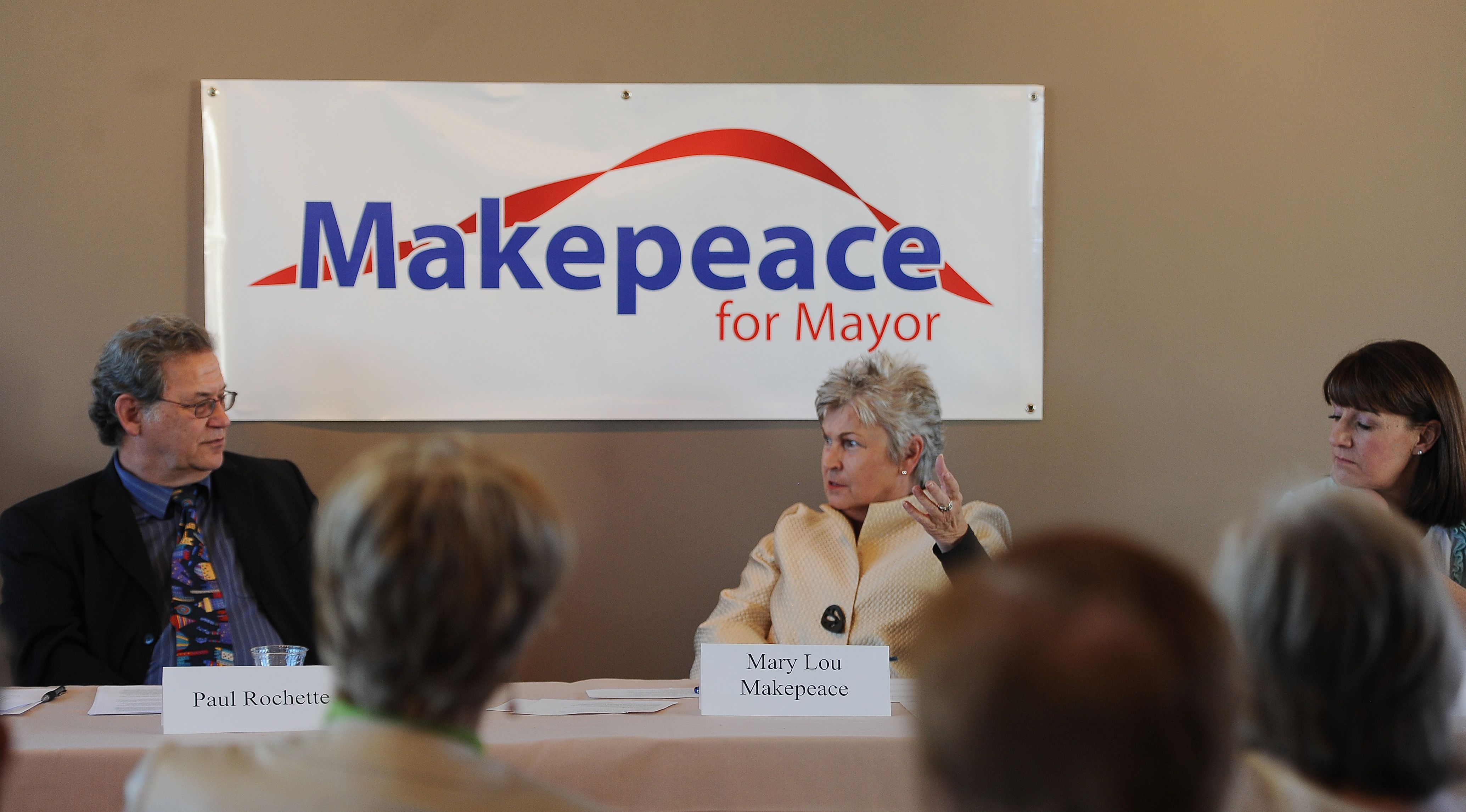
Mary Lou Makepeace hosted a series of roundtable discussions to talk with people about the issues important to them in Colorado Springs.
She did that when she was mayor in 1997. And she did that in recent weeks after she announced her intention to run for mayor again.
“I’m a very collaborative kind of person,” she said.
But don’t mistake good manners for weaknesses, she said.
“I don’t back down if I don’t think it’s an appropriate thing to do,” she said.
Makepeace broke the news in September to her political science class at the University of Colorado at Colorado Springs that she was running for mayor. There was an instant buzz and questions of would she or wouldn’t she. When she formally announced in November that she was in the race, the news exploded on social media.
“I would very much like to be mayor once again because I see there are things we need to deal with,” she said.
People may think they know Makepeace. She served on the City Council for 12 years before being elected the city’s first female mayor in 1997. She was re-elected in 1999.
But they might not know she has traveled to or lived in 30 countries including a stint at the American Embassy in Prague during the Soviet invasion.
She ran the Gill Foundation’s Gay and Lesbian Fund for Colorado, which gave millions to nonprofit organizations around the state.
She grew up during the civil rights era and believes in the fight for equality. She is a registered Republican, and at 73 years old, she appears to have attracted more young professionals to her camp than any other mayoral candidate.
“She talks about collaboration in a way that makes sense to us,” said 27-year-old Courtney Stone, a community organizer. “She talks about transportation, which is an issue that young people care about. We are feeling there is an actual interest about conversing with young people about the issues that are important to us.”
Makepeace was mayor under the old form of council-manager government. Things have changed. Now, the mayor is a full-time chief executive with a salary of $96,000 a year. Instead of sitting at the dais with the council, the mayor works from the City Administration Building overseeing the city’s 2,200 employees.
“I didn’t anticipate running,” she said. “Over the years, people have said, ‘why not run for something?’ Of late, I’ve been very concerned about this community that I love so much. It seems like the community is holding on low. There is nothing new and exciting. We are not attracting people, we are not attracting businesses, and it feels like government is closed and special interest groups have undo influence on matters in the city.”
Makepeace said she believes she has the experience, talent and skills to get the community back on track.
Among her top priorities are public services and capital projects.
“We look terrible; the city is run down,” she said. “It’s ridiculous; how did we let it get so bad? If we were selling a house, and we let it get deteriorated, who will buy it? We need to fix that right away.”
Makepeace says another priority is “people.” She has heard too many stories, she said, of people trying to get the city to be responsive. The lack of response and communication has resulted in a lack of trust in city government, she said.
“How well does city government serve the citizens of Colorado Springs?” she said. “When you don’t talk to people. When you don’t respond to people. All of those things make people think the city isn’t doing its job.”
It has been rough seas with the council and mayor over the past four years trying to navigate their way to a new council-mayor form of government, which voters approved in 2010 and then elected the city’s first strong mayor in 2011.
“I don’t want to jump into the strife,” Makepeace said. “Citizens voted overwhelmingly for a strong mayor form of government, so it’s really up to the people in those offices to make it work.”
By the end of November, Makepeace had set up meetings with council members to find out what they want from the mayor’s office.
Some might recall a less collaborative feeling among the council and the mayor in 2001 when the council voted down in a 5-4 split an urban renewal plan that Makepeace was pushing. One day after the vote, Makepeace told a gathering of 200 businesspeople that the council was entering into “a dangerous time of personal political agendas,” and she pointed to three newly elected council members as the culprits. Those council members told The Gazette then that Makepeace had welcomed them to the council by telling them to respect each other’s votes. They felt the public slam was far from respectful.
Downtown business owner Mike Trapp, whose property would have been affected by the urban renewal plan that called for the use of condemnation, doesn’t remember who voted which way, he said. But he does remember collaboration is not a word he would have used to describe the council and mayor.
“It was really contentious,” he said.
Trapp, who owns Olson Plumbing and Heating on West Cucharras Street, said that even when the City Council and mayor voted on a compromise for the urban renewal plan, nothing ever really happened in the southwest side of town.
“I look at Mary Lou, she was mayor two terms, and I really think she had her day,” he said. “I think we should be looking into the future. In her time, she did a good job. I just believe right now, we need new leadership, new ideas, new all of that stuff.”
A local mayoral candidates survey by Springs Unigroup, an advocacy group that formed in 2002, shows Makepeace trailing mayoral candidate John Suthers, with an average of 28 to 33 percent to Suthers’ 37 to 42 percent. Candidate Amy Lathen is at 17 percent, and candidate Joel Miller is at about 11 percent. Rick Wehner, who runs the survey, said that the Unigroup surveys have been 82 percent accurate in races and 91 percent accurate in issues.
When Unigroup combined its totals with The Gazette and KKTV online surveys – which ran on their websites Feb. 19 for 24 hours – the combined percentages shake out the same way.
El Paso County Commissioner Sallie Clark was on the council when Makepeace was mayor. The two got off to a frosty start over the proposed closure of Fire Station No. 3, which served the old Victorian homes in Old Colorado City. Clark was inspired to run against Makepeace for mayor; when she lost that bid, she ran for a council seat.
“She believes that she is collaborative, but I didn’t see that, at least from my personal perspective,” Clark said.
Clark said that over time she came to appreciate Makepeace and her work in downtown redevelopment. But now, she said, the next step for the city is a bigger vision of working with the county and state on regional projects.
“We are in a new place today, and we need new perspective and new vision,” Clark said.
“I don’t think we want to go back to that time – I know I don’t – it’s time to move us forward. We have an opportunity to wipe the slate clean and start with new leadership.”
Makepeace kicked off her campaign with a series of roundtable discussions.
In the first one, she talked about ways to fund the city’s $1 billion in capital needs. It’s how she approached developing the 1998 and 1999 Springs Community Improvement Program, voter- approved bonds to pay for capital needs. Makepeace said one the biggest achievements of that bond program was the input from about 300 citizens.
Jim Mullen, former Colorado Springs city manager, called the Makepeace era the best council he had ever worked with.
“We had a mayor who knew how to work with the council,” he said at the roundtable meeting.
The 1999 voter-approved SCIP bond, which paid for $88 million in capital projects, is about to be paid off.
The City Council did not put on the April ballot a recent proposal by Mayor Steve Bach to renew those bonds for $160 million to pay for capital improvement projects, including street improvement, parks, public safety and stormwater projects.
Makepeace said the plan’s flaw was that the city’s staff developed it with no input from citizens. She would run things differently, she said.
Longtime friend and Councilwoman Jan Martin, who attended the recent roundtable meeting to discuss capital needs, said that in recent years citizens had been cut out of the discussion on most things, including naming their funding priorities.
“Mary Lou respects the role of citizens in local government,” Martin said. “She really engages the public in the processes around the city, engages the public in decision- making and in determining where we go in the future – it’s a bottom up approach.”
Makepeace acknowledges the changes in the role of the mayor since she held the reins, but she sees the mayor’s chief of staff as the person who should deal with the nitty- gritty, in the way that the former city manager did.
“There is more nitty-gritty than previously for the mayor, but the mayor’s job is one of leadership, making things happen,” she said. “I think the last thing a mayor should be is a micromanager.”
–
Contact Monica Mendoza: 636-0187
Twitter @ Mendo1987
Mayoral candidate Mary Lou Makepeace hosted a forum at Gold Hill Community Center to address jobs in Colorado Springs on Tuesday, February 10, 2015. She was joined by joined by Paul Rochette (left) and Robin Roberts (right) on the panel. (JERILEE BENNETT/THE GAZETTE)
Mayoral candidate Mary Lou Makepeace hosted a forum at Gold Hill Community Center to address jobs in Colorado Springs on Tuesday, February 10, 2015. (JERILEE BENNETT/THE GAZETTE)