






Arlo Guthrie remembers India’s Kumbh Mela
The Kumbh Mela, a gathering of Hindu pilgrims to the holy rivers of India, draws ten of millions of people over 55 days to bathe and absolve their sins at the confluence of the Ganges, the Yamuna and the Sarasvati rivers.
The pilgrimage only happens once every 12 years at four locations.
When Colorado Springs residents Jacqueline Lundquist and Dick Celeste were living in India in 1999, during Celeste’s term as U.S. ambassador, fabled folk musician Arlo Guthrie, an old friend of Celeste’s, contacted them to ask whether he and his son, Abe, could spend a week with them.
Arlo and Abe were on their way to gigs in Australia but also wanted to attend the Kumbh Mela.
Now another gathering of the Kumbh is underway. It began a few weeks ago and will run through March 4.
At The Gazette’s request, Lundquist asked Guthrie about his remembrances of the Kumbh Mela, considered the world’s largest gathering of religious pilgrims.
Question: What drew you to the Kumbh Mela?
Answer: In April 1998 I was passing through India with my son, Abe, during a worldwide tour. We stayed with our friends at the American Embassy in New Delhi. It was during this time that the Kumbh Mela was taking place. My friend and guru, Ma Jaya Sat Bhagavati, asked me if I would go to the Ganges River and bring with me some ashes of her sister, who had recently passed away. And once there, I was to release them into the arms of the Ganga with a few prayers. I had no idea that the Kumbh Mela was happening at that time. It seemed we were there at the same time only by chance.
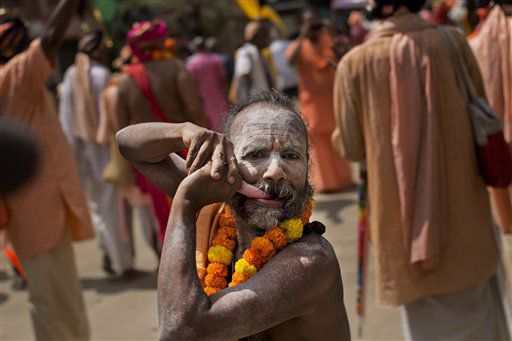
A Naga sadhu, or naked Hindu holy man, performs as he participates in a religious procession during Kumbh Mela, or Pitcher Festival, at Trimbakeshwar, India, in August 2015. Hindus take a dip in the waters of the holy river during the festival to cleanse them of their sins. The festival is held four times every 12 years.
Q: Did you and Abe consider yourselves observers or real participants?
A: We were in Hardwar only briefly, and at that time the Kumbh Mela was just beginning. People were streaming in from seemingly everywhere and setting up along the banks of the river. We stayed only long enough — several hours — to do what we had come to do. Naturally, I bathed in the river, and we collected some water that we would bring to the ashram in Florida, where my guru lived. So we weren’t really participants or observers, we were there doing our own thing at a very auspicious time.
Q: Was it overwhelming, or was that the point — to take you out of your comfort zone?
A: I was overwhelmed by almost everything in and about India. But we tried to just take it all in and sort it out later.
Q: What were your general impressions and descriptions?
A: What was truly amazing to me was the roads going into Hardwar. There were people walking, modern vehicles, animals pulling carts and everything in-between on the same road, and all having some degree of respect for each other. It was like being in the ancient world and the modern one all at the same time. To me it was crazy wonderful.
FILE – In this Sunday, Sept. 13, 2015 file photo, hundreds of thousands of Hindu devotees gather to take holy dips in the river Godavari, hoping to cleanse themselves of sin, on the second royal bathing date of the ongoing Kumbh Mela, or Pitcher Festival, in Nashik, India. A group of technology innovators has launched a digital information platform at the six-week Festival, that they say is helping to maintain order and calm among those camping near the river bank and piling into the water for one of humanity’s largest religious gatherings. The digital platform, accessible by a free Android cellphone app, allows authorities and festival-goers to collect, view and share data about festival food carts, traffic jams and the location of porta-potties or medical tents, giving users an up-to-date record of what’s happening and where. (AP Photo/Manish Swarup, File)
Q: What do you see as takeaways and relevance of such an event for you and for modern Americans in general? Were there many foreigners?
A: I didn’t see any foreigners there, but I wasn’t looking for them either, so I may have missed them. I saw a mass of humanity all gathering in small groups, with little or no direction needed. It reminded me of Woodstock. Everyone just went about their business as if no one else existed or was there. No one intruded on what we were doing, no one needed to. Everyone was polite, and most seemed very happy.
Like at Woodstock in 1969, experiencing it changes you. It can restore your faith in yourself and each other. When people are simply themselves, things work somehow. It requires a faith in the good will of others. Without that, laws and regulations become more important than they have to be.
Q: It seems like a thriving, ancient ritual in a modernizing, gentrifying country. How do you explain that paradox?
A: I’m not a professional explainer, so I leave that to others more qualified. My experience there reminded me that although times change, humanity is pretty much the same. No matter where you go, and no matter when, some things remain the same for very long periods of time. The goodness of people endures in every place and every time — if we are just able to trust each other. When that trust breaks down, bad things happen.
Lundquist is an author and vice president of Water Health International, which builds water projects In India and Africa.
An Indian woman devotee performs rituals as others take holy dips in the Godavari River during Kumbh Mela, or Pitcher Festival, in Nasik, India, Wednesday, Aug. 26, 2015. Thousands of devout Hindus began splashing into the west Indian river for the first official day Wednesday of bathing at one of the country’s largest festivals. (AP Photo/Tsering Topgyal)
Indian devotees perform rituals as they take holy dips in the Godavari River during Kumbh Mela, or Pitcher Festival, in Nasik, India in August 2015. Hindus believe taking a dip in the waters of a holy river during the festival will cleanse them of their sins. This was the first day of bathing for those attending this the 2015 festival on the banks of the Godavari River in Maharashtra state.
Indian pilgrims take holy dips in the Godavari River during Kumbh Mela, or Pitcher Festival, in Nasik, India, Wednesday, Aug. 26, 2015. Thousands of devout Hindus began splashing into the west Indian river for the first official day Wednesday of bathing at one of the country’s largest festivals. (AP Photo/Tsering Topgyal)
Naked Hindu holy men prepare to bath in the Godavari River during Kumbh Mela, or Pitcher Festival, at Trimbakeshwar in Nasik, India, Saturday, Aug. 29, 2015. Hindus believe taking a dip in the waters of a holy river during the festival, will cleanse them of their sins. According to Hindu mythology, the Kumbh Mela celebrates the victory of gods over demons in a furious battle over a nectar that would give them immortality. (AP Photo/Rajanish Kakade)
A Naga sadhu, or naked Hindu holy man, blows into a conch shell as he participates in a procession during Kumbh Mela, or Pitcher festival, at Trimbakeshwar in Nasik, India, Wednesday, Aug. 26, 2015. Millions are expected to attend this year’s two-month festival, which began in mid-July and runs until the end of September. (AP Photo/Rajanish Kakade)