






Aging pavement contributing to Colorado Springs’ pothole multitude
Her wheels in a pothole filled with slush, unable to get traction, Heather Sears was at a loss of how to move her van.
Just after the storm that slammed Colorado Springs in early February, Sears was visiting a friend on Meade Avenue, east of downtown. As she tried to turn her van around, the van fell through a thin layer of ice into a slush-filled pothole. She floored the gas. Nothing.
“Luckily, there were three people that came out with shovels,” she said. “The lady who helped me said the same thing had happened to her.”
After a few hours and eventually some wood placed under her tires for traction, Sears freed her van from the pothole that was, she estimates, a foot deep and 4 feet wide. Without the help of strangers, Sears could not have gotten out, she said.
“I’m a handicapped veteran, I don’t know how I would have been able to get out,” she said. “I looked at my insurance policy, and it doesn’t even cover that.”
The city’s pothole problem, Sears said, has gotten out of control.
Unfortunately, it’s not going to get better any time soon.
City officials expect even more potholes to open up in 2016 than in 2015. Even an influx in new sales tax money toward paving roads won’t do much to fix the problem.
Through February, city crews fixed 7,408 potholes – almost 550 more than during the same time period last year. Corey Farkas, city streets manager, said there are more potholes this year because pavement around the city continues to deteriorate.
Scroll to the bottom of story to see a map of the city’s potholes
“It’s all due to where our pavement’s life cycle is at,” Farkas said. “That was the whole mantra behind the movement that we needed to do something and why 2C came about.”
Voters approved measure 2C in November, a sales tax increase to raise $50 million a year for five years to rebuild or repair the city’s crumbling roads. With that incoming money, the city is accepting bids for 2016 for contractors to pave about 90 spots throughout the city.
That will cover about 200 lane miles.
Drop in the bucket
The amount of roadway to be paved will be an improvement on recent years, but it’s a drop in the bucket compared to the 5,600 lanes miles of roadway in Colorado Springs. The 2C money in 2016 will pave about 3½ percent of the city’s lane miles, leaving much of the rest still deteriorating and pothole-ridden.
“The last thing we want for people to expect is for paving to start in April or May, and all of a sudden the pothole issue will be erased,” Farkas said.
As of Thursday, the city had a list of 671 open resident requests to fix potholes dating to December. Of those, about half were on the east side of Colorado Springs, with 83 on the south side. That doesn’t mean the east side has the majority of the potholes, Farkas said.
The pothole problem is all around town, and many more potholes have not been reported.
“Our list is comprised of citizen calls, so I would venture to say that the folks on the east side of town are being a little more vocal at the moment,” Farkas said. “I have seen potholes all over. I think it would be impossible for us to quantify what area of town actually has more potholes.”
There are streets where residents are more likely to report potholes, indicating some roads are worse than others. On North Union Boulevard, the city’s list has 27 potholes that residents have complained about. Second highest is Dublin Boulevard, with 19 potholes reported.
To help with the fixes, the city’s eight pothole trucks have been working to fill as many potholes as possible, he said. Still, Farkas admits, fixing the potholes doesn’t mean the streets are much better.
“Those potholes are a symptom of a bigger issue. Fixing them is like trying to take Tylenol for a headache without figuring out what’s causing the headache in the first place,” he said. “How we take care of the larger issue is that we pave.”
Travis Easton, the city’s public works director, agrees.
“The best way to fix potholes is to repave the whole road, which is what we’ll do this spring,” he said.
Paving priority goes to busiest roads
However, roads are in such bad condition that it would be impossible to pave every road with potholes. Money from 2C will go to paving main roads and arterials that handle the bulk of the traffic, leaving residential roads – some in terrible repair – untouched.
Paving with 2C money is expected to begin when the weather warms in late April or early May, lasting through October. In city bid documents, contractors can start work on about a third of the roads as soon as weather allows. The start dates for the rest of the roads are spread through the spring and summer.
The streets that will be paved first aren’t necessarily those in the worst condition, Farkas said. The city has to coordinate with Colorado Springs Utilities, which is working to repair and replace its aging system of pipes buried beneath city roads. Since the city doesn’t want to repave a road only to have it soon dug up to fix a pipe, the two agencies have to work together to figure out plan to fix the pipes.
In some cases, the 2C paving could postpone high-quality repairs of potholes. If a street is slated to soon be paved over, the city will probably do quick fills of potholes, rather than high-quality, longer-lasting repairs, Farkas said. The paving will ultimately be the long-term repair the road needs, he said.
“We are beginning to pave to take care of the issue, but we can’t do that overnight,” he said. “As we move along 2C and we get into Year Five on our major roadways, we’ll see less and less potholes.”
For Sears, long-term solutions to the pothole problem can’t come fast enough. Every day, she feels like she’s dodging potholes and fears getting stuck again in a large one. What’s scary, she said, is when she sees cars veering into other lanes and almost swiping oncoming cars to dodge potholes.
“I get worried,” she said. “It can be dangerous out there.”
–
Contact Maria St. Louis-Sanchez: 636-0238
Twitter @mariastlouis
Facebook Gazette Maria St. Louis-Sanchez
Tim Gardener, right, and Steve Matthews repair potholes in the intersection of S. Carefree Circle and Oro Blanco Drive Thursday, March 3, 2016. Photo by Mark Reis, The Gazette
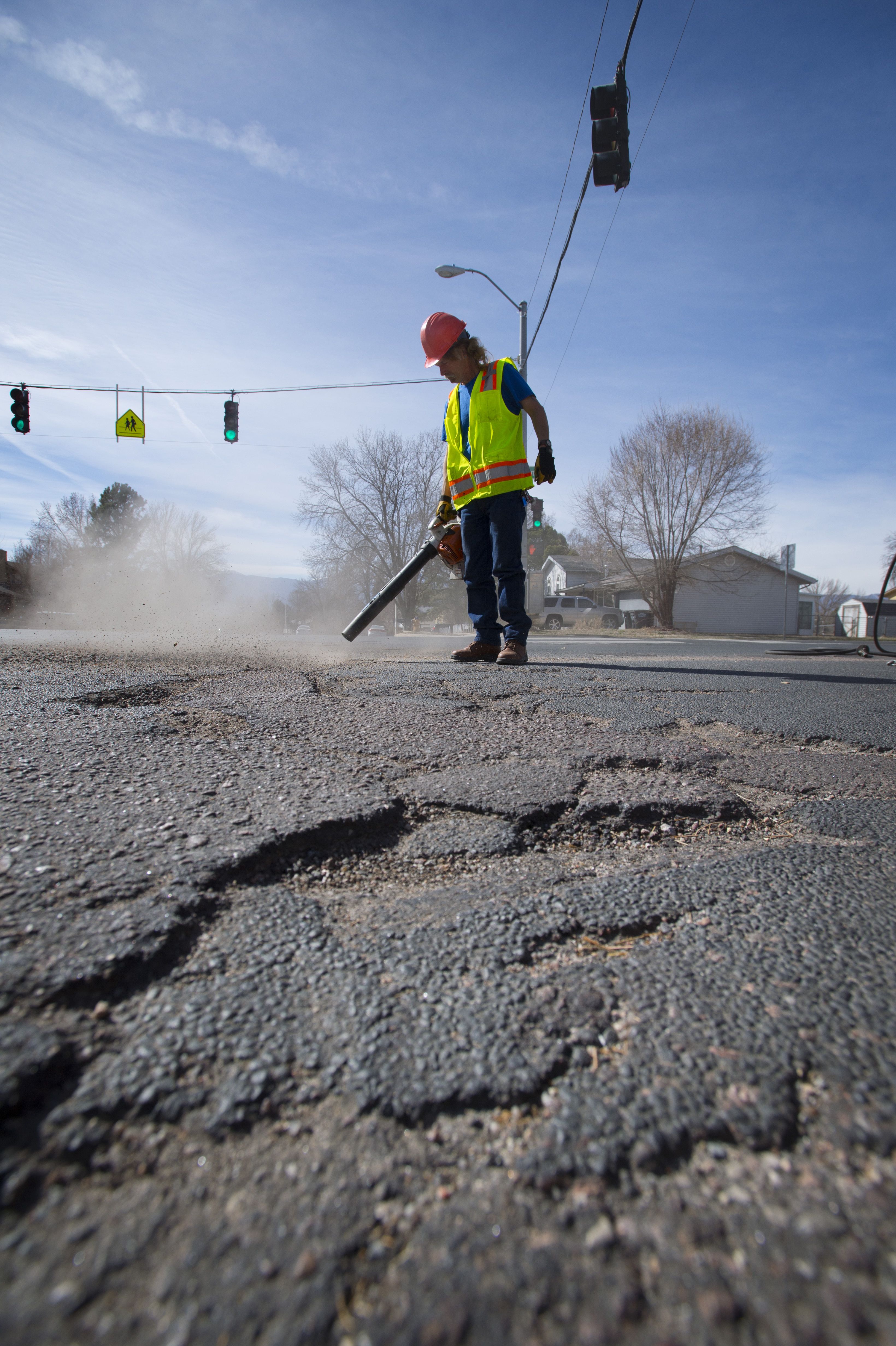
Tim Gardener blows debris from potholes in the intersection of S. Carefree Circle and Oro Blanco Drive before filling them Thursday, March 3, 2016. Photo by Mark Reis, The Gazette
Jason Rayfield repairs potholes in the intersection of S. Carefree Circle and Oro Blanco Drive Thursday, March 3, 2016. Photo by Mark Reis, The Gazette
Tim Gardener, right, and Steve Matthews repair potholes in the intersection of S. Carefree Circle and Oro Blanco Drive Thursday, March 3, 2016. Photo by Mark Reis, The Gazette
Steve Matthews, Jason Rayfield and Tim Gardener, repair potholes in the intersection of S. Carefree Circle and Oro Blanco Drive Thursday, March 3, 2016. Photo by Mark Reis, The Gazette
Steve Matthews repairs potholes in the intersection of S. Carefree Circle and Oro Blanco Drive Thursday, March 3, 2016. Photo by Mark Reis, The Gazette
4. Dodging potholes makes you look like a drunk driver – Or a stunt driver. Or a slalom skier in a car.