






Analysis: Obama’s crucial 2nd chance for 2nd term
WASHINGTON — Suddenly, the second presidential debate is Barack Obama’s second chance.
Obama the aggressor plans to show up in a race so close that style can leave just as much impression as substance. The president will give more respect this time to how his answers are playing on TV, knowing his first round appeared so passive that even supporters wondered whether he cared.
Riding high but still facing a harder state-by-state electoral path to victory, Republican Mitt Romney must now prove he can relate to voters spontaneously in a town-hall setting. He will have to do it right next to an incumbent who beats him on likability in opinion polls and who has a history of thriving when people count him down.
The burden, the anticipation, the opportunity — it all focused on Romney in the first debate because he was trailing and needing a breakthrough. Now Obama seems the principal actor, and not just because the political world wants to see how the president of the United States will do after a famously bad night.
Undecided voters need to hear how why they will be better off if they re-hire him.
There will be a room full of them in Hempstead, N.Y., and millions more watching at home.
That’s why the importance of the debate will extend beyond who wins the night. It will establish whether Obama can make a compelling case of how to improve people’s lives, whether he can capture their concerns without repeating the wonky language of Washington.
That, in turn, will affect the mood and momentum of a campaign that has just 21 days to go.
“People across this country aren’t voting on who is the better salesman-in-chief,” said Obama campaign spokeswoman Jen Psaki. “They’re looking for who is going to represent them better in the White House.”
On debate night, however, voters tend to look for both. Presentation and policy are not mutually exclusive. People need to be won over.
In the hours after Obama lost the first debate, his campaign derisively referred to Romney as “theatrically aggressive.” Since then, Obama himself has conceded he appeared too polite and restrained on television, and that he would compensate this time.
That means he plans to contrast himself with Romney by confronting him, not by limiting his direct engagement with him, his failed strategy of last time.
It is a debate, after all.
Both men remain supremely confident in their ideas, so no changes are expected there.
The first debate reset the race to its current place: deadlocked nationally and extremely close in the states that will decide it.
Romney still has the more difficult path to victory because of the math of the map. On the path to 270 Electoral College votes, Obama is presumed to start with 237 compared to Romney’s 191 based on the political leanings of individual states. So Romney must win more of the nine states up for grabs, particularly Ohio.
___
EDITOR’S NOTE — Ben Feller has covered the presidencies of Barack Obama and George W. Bush. Follow him on Twitter at www.twitter.com/benfellerdc
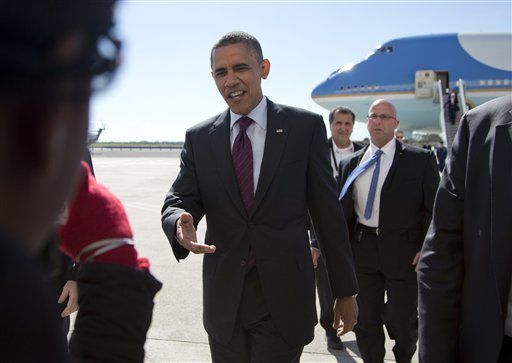
President Barack Obama greets people as he arrives at John F. Kennedy International Airport, Tuesday, Oct. 16, 2012, in New York, en rout to Hempstead, N.Y. and a presidential debate. (AP Photo/Carolyn Kaster) Photo by
Republican presidential candidate, former Massachusetts Gov. Mitt Romney smiles as he gets out of his vehicle before he boarding his campaign plane in Bedford, Mass., Tuesday, Oct. 16, 2012. (AP Photo/Charles Dharapak) Photo by
President Barack Obama, accompanied by debate prep adviser Anita Dunn, right, and senior White House adviser David Plouffe, leave the Kingsmill Resort, Tuesday, Oct. 16, 2012, in Williamsburg, Va., for New York and the presidential debate. (AP Photo/Carol Photo by