






Proposed city land swap near planned U.S. Olympic Museum angers some Colorado Springs Council members
Some Colorado Springs City Council members are peeved that they only got to peek at documents they need to decide on a proposed swap of city property for a developer’s land in southwest downtown, near the planned U.S. Olympic Museum.
They’re upset, too, that a vote on the swap was stripped from this week’s agenda and pushed to April 25, after the Tuesday election in which four members are seeking re-election.
City Attorney Wynetta Massey and Chief of Staff Jeff Greene said the vote was delayed to address council members’ questions about the swap.
Council members were told Wednesday that they can examine the land parcels’ appraisals at the city’s Real Estate Services office but can’t take notes.
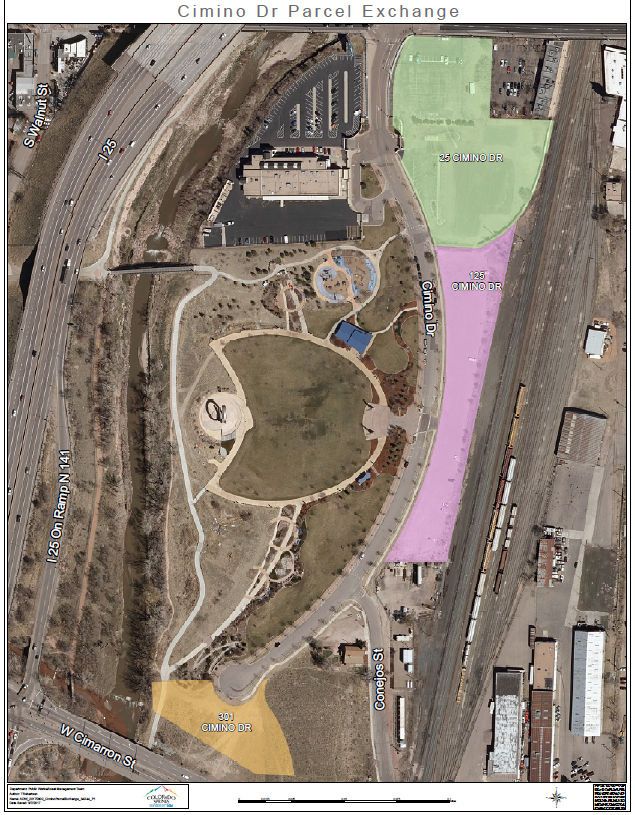
At issue is the proposed trade of two city parcels totaling slightly more than 5-1/2 acres for 1.12 acres owned by subsidiaries of Nor’wood Development Group, specifically CSJ No. 7 LLC and Urban Enterprises LLC.
“We don’t have to trade,” said Councilman Bill Murray. “We don’t have to have that (Nor’wood) land. It should be put out to competitive bid. That property is going to be extremely valuable once the Olympic Museum is built. This is a sweetheart deal.”
“It’s infuriating,” said Council President Pro Tem Jill Gaebler. “This entire land swap has been very nontransparent. … We’re the land-use body of this city. We need the information to do our job.”
Chief of staff Greene said he and Mayor John Suthers see the land exchange as a big boost to urban renewal in southwest downtown.
“And of course we’re unloading $4 million worth of environmental obligations … And we’re helping to further the master plan to redevelop that area and help the city’s downtown economy,” Greene said.
The city’s current parcels are contaminated. A coal gasification plant operated there from 1890 to 1931 and left residual coal tar, which can contain carcinogenic agents.
Kathleen Krager, city traffic engineer, said the trade is needed for the city to meet its obligations to the Colorado Department of Transportation, which is building the massive interchange nearby at Cimarron Street and Interstate 25.
Krager did disclose some land values during a March 13 council work session.
The city parcels are worth $360,400, she said, later explaining that the cost to clean up contamination was factored in and reduced the value.
The private parcel is valued at $904,000, Krager said, and the developer would donate the $543,600 difference to use as a tax deduction.
The El Paso County Assessor’s Office lists 2016 market values that are higher for the city land and lower for the Nor’wood property.
The assessor’s website shows market values of:
◘ $763,081 for the city’s 3.35 acres at 25 Cimino Drive
◘ $456,549 for the city’s 2.23 acres at 125 Cimino Drive.
◘ $270,007 for the private 1.12 acres at 300 Cimino Drive.
The disparity puts the city land value at $1.2 million, more than triple the sum Krager cited. The $4 million cleanup cost accounts for that difference.
The assessor’s value for the private land is less than one-third of the amount Krager gave. Assessor’s market values typically are lower than actual values.
During the March 13 work session, Councilmen Don Knight and Keith King said they want the city indemnified from any cleanup if the land is traded.
City Attorney Massey said: “Once you’re in the chain of title, you’re responsible for the environmental cleanup. As long as they can prove contamination existed when you owned it.”
During a Tuesday mayor-council planning session, though, Massey said she will rewrite the real estate contract to include indemnification of the city for the contamination. “This is part of the reason we wanted to delay (the vote),” the city attorney said.
Nor’wood President Chris Jenkins couldn’t be reached for comment.
Krager said the land swap would “complete the (city’s) obligation to CDOT.”
“The reason why we need to do this land exchange for CDOT is, CDOT has six criteria that they looked at in our governmental agreement … trail access and water quality come into play here.
“They also need that land to provide water quality to meet MS4 requirements. They need a water quality pond, and this is the location chosen.”
CDOT does plan to connect the city’s trail north of Cimarron to the pedestrian bridge the city is providing for the project, agency spokeswoman Michelle Peulen said.
“It is less than ideal due to the extensive curves within that (the city’s right-of-way) property,” Peulen said by email. “If the City is successful in obtaining an easement from Nor’wood Development for property it owns in that area, CDOT has a design that will make for a much improved trail connection.”
CDOT also is obligated to ameliorate water quality, given the amount of impermeable surface its concrete is introducing to the area, said Project Manager Dave Watt.
“That’s our responsibility for the project,” Watt said.
If the city obtains the Nor’wood land, he said, CDOT will create a water quality detention pond there.
If it doesn’t, the state agency will create a water vault.
That subterranean structure often is used to manage stormwater runoff on developed sites in cities when adequate space isn’t available for a detention basin.
Said Knight, “On this package, my impression was, if we don’t have the land, we don’t have a trail connection. Period. Now I’m finding out there are other ways to do the trail. As a decision-maker, that is something that’s owed to the nine of us so we can make fully intelligent decisions and not just be a rubber stamp on what’s presented to us.”
Southwest downtown was designated an Urban Renewal Area in August 2001. Projects were proposed and foundered several times over the years. Now, with that quadrant set to become home to the $75 million U.S. Olympic Museum, development of the area is expected to take off.
U.S. Olympic Museum backers are all but ruling out a February 2018 opening to coincide with that year’s Winter Olympics. Image courtesy of Diller, Scofido & Renfro via usolympicmuseum.org.
An artist’s rendering of the new U.S. Olympic Museum. Design Architect: Diller Scofidio + Renfro; New York, NY.