






GO! COVER STORY: TheatreWorks undertakes important journey with ‘Joe Turner’
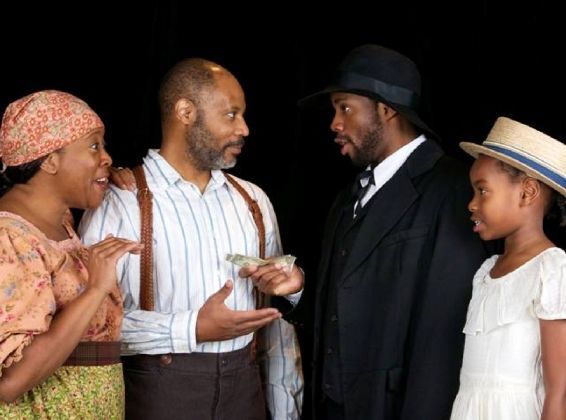
The producers at TheatreWorks are putting their money where their mouths are.
In recent months, they have talked about trying to cast more minorities and about upgrading to the region’s first union theater house.
August Wilson’s classic drama “Joe Turner’s Come and Gone” represents their words in action, a big-budget work featuring more black actors than any local production in decades.
To fill a cast roster that required 10 black actors and two white ones, TheatreWorks held auditions in Los Angeles, New York and Denver as well as the Springs.
“It’s an amazing production,” said Drew Martorella, executive director at TheatreWorks, a company that works out of University of Colorado at Colorado Springs. “It’s probably as expensive as the Shakespeare in the summer.”
In addition to flying in Equity union actors from bigger cities, TheatreWorks also contracted one of the foremost August Wilson experts to direct.
They saved money on airfare on this one, though. Director Clinton Turner Davis happens to be a professor at Colorado College. Davis has directed “Joe Turner” many times, including a 1993 production for the Oregon Shakespeare Festival. It was the first time the festival had featured an African-American play, Davis said, and it broke records and required an extended run.
But his fondest memories aren’t just about the production. That was where he first met Wilson, the legendary playwright.
“He was a very approachable, very giving, amazingly sincere — a wonderful, wonderful man,” Davis said.
The admiration seems to have been mutual because three years later, when a producer asked Wilson for the rights to stage the first off-Broadway production of “Joe Turner,” Wilson asked who was directing. When told it was Davis, he gave a hearty thumbs-up.
“Joe Turner’s Come and Gone” is the second in Wilson’s 10-play “Pittsburgh Cycle,” whose plays depict African-American struggles throughout the 20th century. TheatreWorks has produced others in the cycle, including “Fences” and “Ma Rainey’s Black Bottom.”
Davis respects the entire cycle of work but says “Joe Turner” is his favorite.
“He touched on something in this play that resonates through all the other plays in the cycle, and that’s a profound understanding of the African-American condition. It really examined what it meant to be a hyphenated American,” Davis said.
Set in 1911, the play focuses on Harold Loomis, a black man who arrives at a Pittsburgh boarding house with his young daughter in search of his missing wife. But in a larger way, it’s about African-Americans’ migration north, looking for their place in the new world.
Davis believes its a piece that speaks to everyone, not just African-Americans. That’s because it’s about not just a physical journey, but a spiritual one.
“It is high-water deep in terms of spirituality,” he said. “But it’s something that encompasses a broad section of people — Christian, Jewish, Muslim, even atheists, I feel. That’s because it’s a transcendent experience. It transcends religion.”
Davis was proud of TheatreWorks for its commitment to bring works like this to the stage, and he appreciates the extraordinary casting measures.
Still, he wishes there were a larger pool of local black actors auditioning for these productions.
“It speaks to the fact that we need to examine the type of works we’re presenting and whether those works are being conceptualized with the greatest possibility of inclusion of all members of the community,” Davis said.
That conceptualizing means nontraditional casting: putting racial or ethnic minorities, women or disabled actors in roles where race, ethnicity, gender or physical capability are not necessary to the characters’ or play’s development.
That this community and others are still struggling with issues of inclusion might suggest that the journey of “Joe Turner” isn’t over yet.
Lynne Hastings (Bertha), Cris Davenport (Seth), Calvin Thompson (Loomis) and Sanaa Ford (Zonia) Photo by Isaiah Downing/TheatreWorks