






Aim of Rampart tough talk is to save lives during prom season
It’s prom season – time to shop for dresses and tuxes, make dinner reservations, and look at gory pictures of blood on the highway.
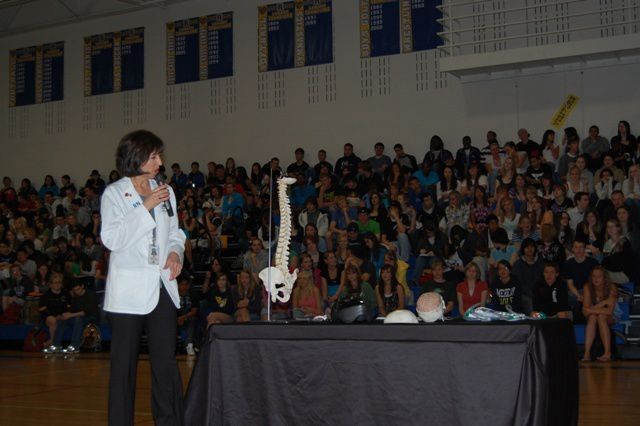
The “Trauma Nurses Talk Tough” program was at Rampart High School on Tuesday morning, with straightforward information presented by someone who has seen the worst – Sally Duncan, a trauma nurse and paramedic at Memorial Health System.
“We have all of our kids going to prom on Saturday and most of them drive to and from prom, so there’s a chance of bad decisions,” said math teacher Meghan Schlicht, who brought the program to Rampart. “This is a nice shocker before they go, to maybe change decisions.”
Duncan came armed with a model of a skull, a spinal cord and a graphic film. She didn’t bother talking about rules, laws or morals. Even death, she said, can seem abstract to teens.
“There are worse things than death,” said Duncan, the hospital’s injury prevention specialist. “That is what I’ve learned.”
So, she skipped straight to the consequences of bad decisions such as drinking and driving, not wearing a seat belt or speeding. Her lessons were simple and concrete.
A brain injury, she calmly explained, may force a doctor to “pop the top” of your skull until brain swelling recedes. She pulled out a catheter to talk about how paralysis can cause loss of bladder and bowel control. And — hitting them where it hurts – she said that sexual function also goes, so a man might have to use a pump to have sex.
“Seat belt or catheter, is it a tough decision? I don’t think so,” Duncan said. “Seat belt or (penis) pump?”
The information was intense, with no hint of condescension.
“The No. 1 cause of injury at your age is car accident,” Duncan said, explaining the way the brain develops. “Your ability to learn is at the best it’s ever going to be in your life, but your ability to predict the outcomes of your actions is at its worst.”
The “Trauma Nurses Talk Tough” program began in 1987, Duncan said, but added another tool to its arsenal in 2009, when Memorial made the movie “Choices” with the help of a local TV station. The movie features local teens who have suffered major injuries or lost friends in car crashes. She estimates 10,000 local teens have seen it.
It was halfway through that movie, as a pretty girl explained how her eyeball popped out and rested on her cheekbone after a drunken driving crash, that a boy in the crowd started feeling faint. Duncan wasn’t surprised – she ran up the bleachers, helped him lie down and put his feet above his head.
“It’s usually a boy, usually a muscular athlete (who faints),” Duncan said. “And it’s usually that part of the movie.”
The kids had been chatty when they walked in for the assembly, but grew quiet when they began to hear the real stories of people their age.
“Usually assemblies are lame, but this wasn’t,” said Ambur Jensen, 17, a junior. It was really powerful.”
“It definitely makes me want to be more careful driving,” said Mark Montoya, 18, a senior.
That’s what Duncan likes to hear.
To find out more or schedule a presentation, call Sally Duncan at Memorial Health System at 365-6978.
Sally Duncan, trauma nurse and injury prevention specialist at Memorial Health System, talks about brain injuries with students at Rampart High School on Tuesday. Photo by BILL REED, THE GAZETTE
Sally Duncan, trauma nurse and injury prevention specialist at Memorial Health System, talks about spine injuries with students at Rampart High School on Tuesday. Photo by BILL REED, THE GAZETTE
