






Subhead
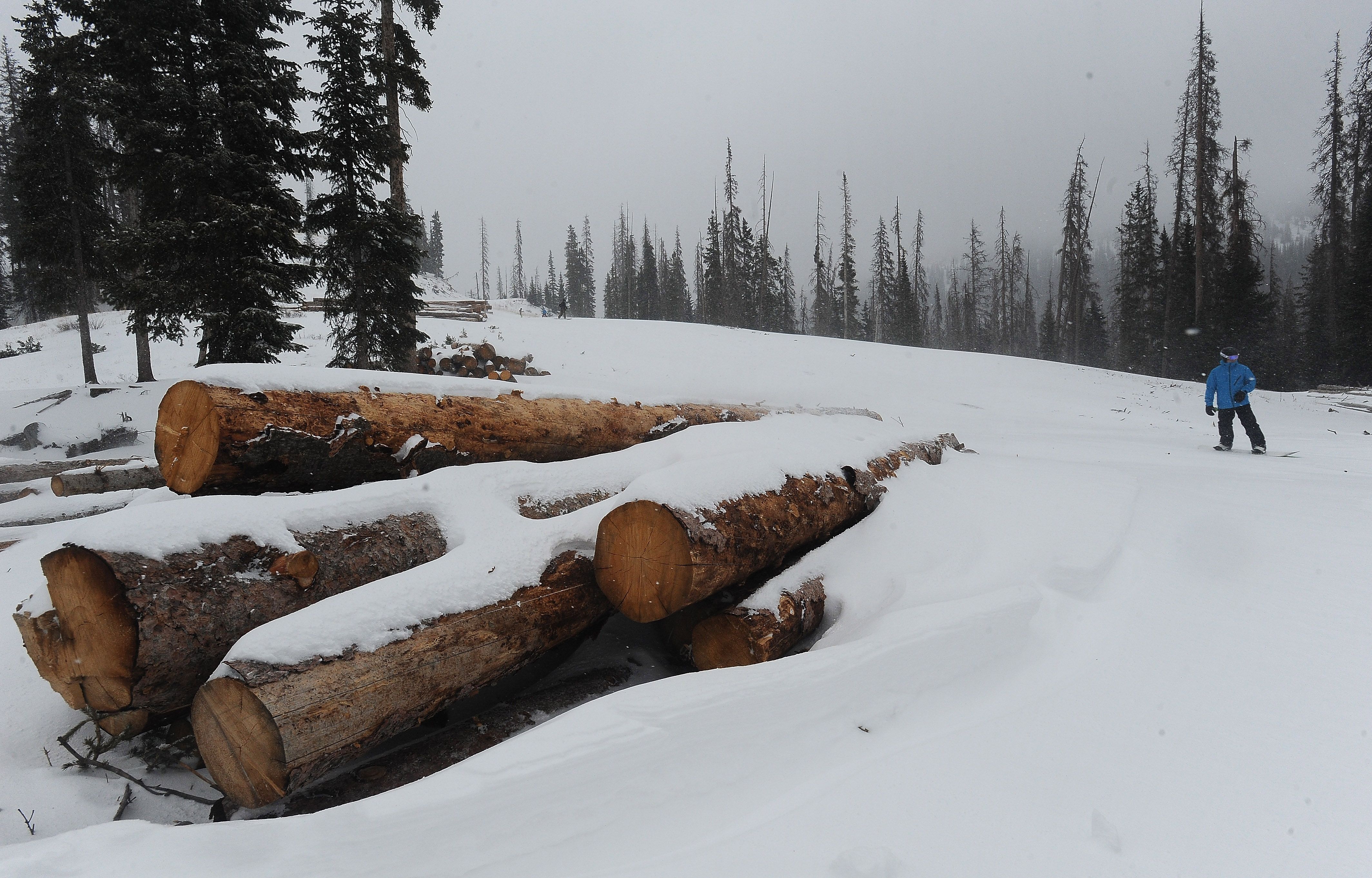
WOLF CREEK SKI AREA? – It was a typical mid-November day high in the San Juan Mountains of southern Colorado.
Brutal winds, white-out conditions and deep snow. While many ski areas were operating with a handful of runs on machine-made snow, Wolf Creek was 93 percent open, with twice the snow base of most others.
“You can hardly see the lift from right here because it’s hammering. It’s hammering all the time here,” said Jeremy King, of Pagosa Springs, taking a break in the ski lodge Saturday. “It’s the best snow in the world man.”
What a difference a few months make high on the Continental Divide.
In June, this ski area nearly was engulfed in the firestorm of the West Fork Complex, the official name for the collection of lightning-sparked fires that scorched 110,000 acres of national forest, terrain that had been transformed into a sea of dead trees by spruce beetles.
Before the smoke drifted north and choked the cities of the Front Range, many in Colorado weren’t even aware of the spruce beetle epidemic that has ravaged this part of the San Juans.
Wolf Creek owner Davey Pitcher has been fighting this battle for more than a decade. And he is losing. Though a timely change in the wind during the fires saved Wolf Creek, the number of dead trees grows each year, and Pitcher is facing the reality that each summer, each monsoon lightning storm, could bring the next inferno.
“If you had said 15 years ago Wolf Creek was in eminent danger of fire, I don’t think I would have believed it,” Pitcher said.
‘It is a natural process’
On June 19, Pitcher stood calmly at the ski area’s base, watching as smoke drifted over a ridge line and the hot wind delivered dangerous embers from the burning forest.
The family-owned ski area is high on Wolf Creek Pass, surrounded by national forest, with no hotels, condos or boutiques found at larger resorts.
“While it’s a little disconcerting to see big fires, in the long run, it’s probably good for the forest’s health. The spruce beetle was a slow death,” he told The Durango Herald that day.
He still feels that way. Beetles are a natural part of the environment here, and Pitcher said science shows these forests are hit by beetles, then wildfires, every 75 to 125 years. The beetles have infested 1,400 square miles of forest, much of it in Mineral County where Wolf Creek is located.
“It is a natural process. You’ve got to let it do what it’s going to do,” he said.
Pitcher gave up trying to keep the beetles out of the ski area several years ago. Now crews only remove dead trees that threaten the chair lifts, at a cost of $100,000 a year.
“The last three or four years have been the worst. There’s not much we can do,” he said.
‘We’re not giving up on it’
Farther west in the San Juans, Jerry Gray also is dealing with the inevitability of fire in the dead and dying forest.
As operator of the Hinsdale Haute Route, a system of backcountry yurts in the mountains above Lake City, he is only able to open two of the yurts for rent this winter, because he fears the loss of trees at another location means it will be too windy to set up the yurt. The system is run by a nonprofit with limited resources, and Gray doesn’t know what the continuing epidemic means for its future.
“We’ve been struggling along for decades anyway, and I just don’t know what the implications are going forward,” Gray said. “But we’re not giving up on it.”
He also has reasons to be optimistic. He sees more green in the beetle-stricken forests each year.
“A lot of stuff is coming back. In the long run, this is just going to be a major thinning, because I’m seeing a lot of young trees that are surviving it,” he said.
And, he said, if wide swaths of forest are denuded of trees, that means more terrain for backcountry skiers.
Proactive approach urged
In the worst days of the West Fork fires, fire engines were stationed at every major building in the ski area, ready to repel the flames.
But the chairlifts were Pitcher’s main concern. Lifts strung across forests would be next to impossible to protect, and it wouldn’t take much heat to snap the cables and send all the chairs crashing to the ground.
As for the trees, they’re much more than something pretty to look at while riding the lifts. They block the wind and collect snow, and Wolf Creek is well-known for its tree skiing. Much of the mountain consists of ski runs through trees.
Despite the ongoing fire risk, Pitcher said Wolf Creek is moving forward with a major expansion. A new lift was built this summer – crews were putting it in when the fires broke out – and there are plans for another new lift to make it easier for skiers and snowboarders to get back to the base area from the more remote southern end of the area.
Pitcher also has plans for a new lift on the western side of the Divide, which would provide 2,400 vertical feet of skiing in the Silver Creek drainage.
With no end in sight to the beetle epidemic, he wants to see the U.S. Forest Service take a more proactive approach. He testified this month before the U.S. Senate Conservation, Forestry and Natural Resources subcommittee, urging the agency to streamline the environmental study needed for forest thinning projects around resources such as watersheds and ski areas.
“Classic timber sales take an environmental assessment. You end up with two or three years of (National Environmental Policy Act) work, and by then either the fire’s hit or the spruce beetle has hit,” he said.
Whether the trees are dead or not, he said that won’t change the fact Wolf Creek still gets amazing amounts of snow, an average or 465 inches a year. “I think we’re still going to have tree runs, but they’ll probably be gray tree runs,” he said.
Back at the ski lodge, King said the fire was on everybody’s minds in Pagosa Springs, as people fretted about the future of their beloved Wolf Creek.
But at the same time, he shares Pitcher’s respect for uncontrollable natural forces.
“If nature’s going to take it, nature’s going to take it. What can you do?” he said. “I do believe enough people love this place, this community would have rallied and gotten it back together.”
A snowboarder rides past some of the beetle-killed trees on the Bunny Hop run Saturday, Nov. 16, 2013, at Wolf Creek Ski Area. (The Gazette, Christian Murdock)
A snowboarder rides past some of the beetle-killed trees on the Bunny Hop run Saturday, Nov. 16, 2013, at Wolf Creek Ski Area. (The Gazette, Christian Murdock)
Skiers leave the lodge for the Treasure Stoke chairlift as heavy snow hits Saturday, Nov. 16, 2013, at Wolf Creek Ski Area. The ski area replaced the old chairllift with a new high-speed, three- person chairlift. (The Gazette, Christian Murdock)
Snowboarders ride the new Treasure Stoke chairlift as heavy snow hits Saturday, Nov. 16, 2013, at Wolf Creek Ski Area. The ski area replaced the old chairlift with a new high-speed, three- person chairlift. (The Gazette, Christian Murdock)