






Trump federal budget 2018: Massive cuts to the arts, science and the poor
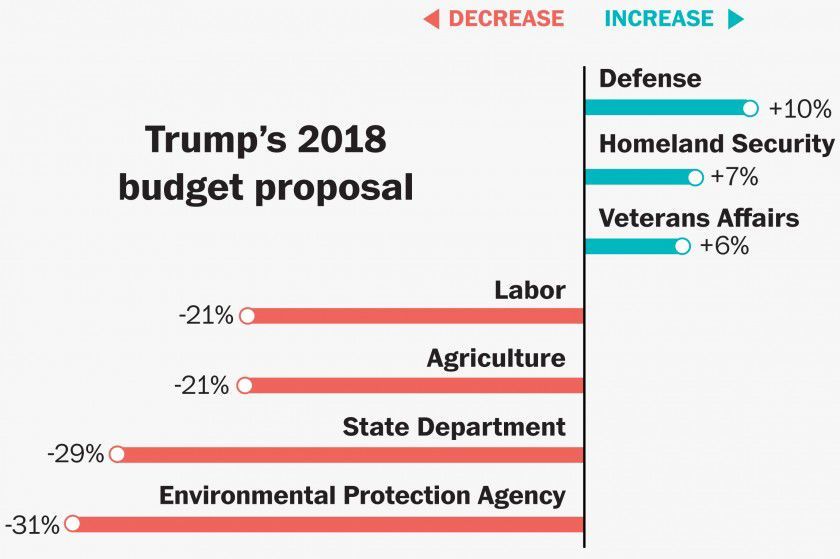
President Trump on Thursday will unveil a budget plan that calls for a sharp increase in military spending and stark cuts across much of the rest of the government including the elimination of dozens of long-standing federal programs that assist the poor, fund scientific research and aid America’s allies abroad.
Trump’s first budget proposal, which he named “America First: A Budget Blueprint to Make America Great Again,” would increase defense spending by $54 billion and then offset that by stripping money from more than 18 other agencies. Some would be hit particularly hard, with reductions of more than 20 percent at the Agriculture, Labor and State departments and of more than 30 percent at the Environmental Protection Agency.
It would also propose eliminating future federal support for the National Endowment for the Arts, the National Endowment for the Humanities and the Corporation for Public Broadcasting. Within EPA alone, 50 programs and 3,200 positions would be eliminated.
The cuts could represent the widest swath of reductions in federal programs since the drawdown after World War II, probably leading to a sizable cutback in the federal non-military workforce, something White House officials said was one of their goals.
“You can’t drain the swamp and leave all the people in it,” White House Office of Management and Budget Director Mick Mulvaney told reporters.
Many of Trump’s budget proposals are likely to run into stiff resistance from lawmakers on Capitol Hill, even from Republicans, whose support is crucial because they must vote to authorize government appropriations. Republicans have objected, for example, to the large cuts in foreign aid and diplomacy that Trump has foreshadowed, and his budget whacks foreign aid programs run by the Education, State and Treasury departments, among others.
“The administration’s budget isn’t going to be the budget,” said Sen. Marco Rubio (R-Fla.). “We do the budget here. The administration makes recommendations, but Congress does budgets.”
Trump’s budget would not take effect until the new fiscal year on Oct. 1, but the president must still reach a separate agreement with Congress by the end of April, when a temporary funding bill expires. If they can’t reach an agreement, and if Trump’s new budget plan widens fault lines, then the chances would increase for a partial government shutdown starting on April 29.
The president and Congress must also raise the debt ceiling, which has become a politically fraught ritual. Although the ceiling was extended until March 15, budget experts say the government should be able to continue borrowing money by suspending or stretching out payments through August or September.
White House budget proposals are often changed by lawmakers, but they serve as a marker for how the president plans to govern and as an opening bid on budget talks. Mulvaney said the White House was open to negotiation, but he was unapologetic about the size and scope of the reductions.
“This budget represents a president who is beholden to nobody but the voters,” Mulvaney said. “He is following through on his promises. We did not consult with special interests on how to write this budget. We did not consult with lobbyists on how to write this budget. The president’s team wrote this budget and that’s what you’ll see in the numbers.”
The 53-page budget plan offers the clearest snapshot yet of Trump’s priorities. Yet it is also far shorter and vaguer than White House budget plans normally are. One of the missing details is precisely where and how many jobs would be eliminated across the federal government.
Parts of the budget proposal also appear to contradict Trump’s agenda. Trump has said he wants to eliminate all disease, but the budget chops funding for the National Institutes of Health by $5.8 billion, or close to 20 percent. He has said he wants to create a $1 trillion infrastructure program, but the proposal would eliminate a Transportation Department program that funds nearly $500 million in road projects. It does not include new funding amounts or a tax mechanism for Trump’s infrastructure program, postponing those decisions.
And the Trump administration proposed to eliminate a number of other programs, particularly those that serve low-income Americans and minorities, because it questioned their effectiveness. This included the Low-Income Home Energy Assistance Program, which disburses more than $3 billion annually to help heat homes in the winter. It also proposed abolishing the Community Development Block Grant program, which provides roughly $3 billion for targeted projects related to affordable housing, community development and homelessness programs, among other things.
The budget was stuffed with other cuts and reductions. It calls for privatizing the Federal Aviation Administration’s air traffic control function, cutting all funding for long-distance Amtrak train services and eliminating EPA funding for the restoration of Chesapeake Bay. Job training programs would also be cut, pushing more responsibility for this onto the states and employers.
Many Republicans have criticized these programs in the past as wasteful and ineffective, but supporters have said the programs are vital for communities in need.
Read the full story at The Washington Post.