






Changes coming for El Paso County voters
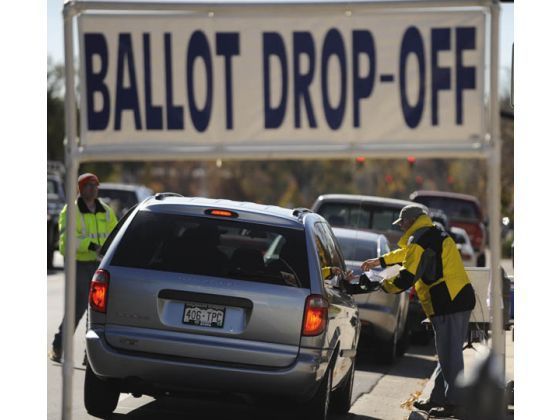
Big changes are in store for El Paso County voters this year. Every precinct now has a new number, and many voters will be casting ballots in a different state Senate or House district.
When new Colorado house and senate districts were approved in late 2011, the boundaries for all state Legislative seats changed. Based on those boundaries, the El Paso County Clerk and Recorder’s Office also changed the precincts in the county, cutting the number of precincts in half and giving them all a new number.
“There are some pretty drastic changes,” said Alissa Vander Veen, chief deputy for the clerk’s office.
She said the office will mail voter information cards to all registered voters to inform them of their precincts and voting districts. Interactive maps of El Paso County precincts and state Senate and House districts are available with this story at gazettedev.gazette.com.
The new districts were required after the 2010 Census detailed population changes in Colorado. A bi-partisan committee was appointed to select new maps and several potential boundary changes were proposed. Ultimately, a Democrat-made map was approved by the majority of the committee.
Bob Loevy, a political science professor at Colorado College and a Republican appointee to the committee, called the system flawed. After the committee debated for months, the maps that were drawn by Democrats and ultimately chosen were available for inspection for only a day before the vote.
The changes mean that at least two Republican incumbents from El Paso County won’t be in office in 2013, but the distribution of power between Republicans and Democrats will be about the same.
Here are some of the major differences El Paso County voters can expect:
• The number of precincts have been cut roughly in half from 404 to 199 and all were given a new number, based on the school district the precinct is in. Vander Veen said the number of precincts was cut because it is no longer necessary to have such small precincts — most voters now use mail-in ballots or vote early, so there’s little threat they will overwhelm polls on election day.
Also, she said, the smaller number of precincts means fewer polling places to rent and fewer precinct captains for political parties to find. She said that the precincts were drawn to fit to the new district boundaries and were carved out to have roughly equal populations in each precinct.
“When almost 70 percent of people are casting their ballot before election day, it doesn’t make sense to have these tiny precincts,” she said.
• While all of the state House of Representatives boundaries changed, the biggest impact is likely to be in north El Paso County, where the lines were redrawn for Districts 19 and 20, held now by Republican Marsha Looper and Republican House Majority Leader Amy Stephens. With the new boundaries, the representatives find themselves both in District 19 and will face off in the June 26 Republican primary.
“I don’t think anyone can tell who will win that one,” Loevy said. “As the Democrats intended, they’re going to sit back and enjoy the battle.”
In Republican caucuses earlier this year, Looper had out a four-point victory over Stephens.
• In the state Senate, Minority Leader Bill Cadman and Sen. Keith King, both Republicans, are now in Senate District 12. King has opted not to run for the new seat.Also, Senate District 2, which previously was not in El Paso County, now takes up a huge swath of the county, running from the entire eastern boundary into a horseshoe shape down through Fort Carson and back up north again toward Cascade. The change means that Canon City Sen. Kevin Grantham will have a district roughly ranging from his city to Ramah.
Loevy called the Republican leadership shakeup “decapitating gerrymandering” — referring to the term used when district boundaries are drawn to give preference to the party that drew them.
“It’s the worst form of gerrymandering because you attempt to knock people out of office by the way you draw the district lines,” he said.
Still, Republicans rule in El Paso County, accounting for 42 percent of registered voters, according to the clerk’s office. Unaffiliated voters make up 35 percent, and Democrats 22 percent of registered voters.
Even with the changes, House District 18, which includes downtown Colorado Springs, the westside and Manitou Springs, will keep its Democrat majority, but that is still the only district that has a Democrat majority.
“There wasn’t much they could to do to improve their situation,” Loevy said of the Democrats.
—Contact Maria St. Louis-Sanchez: 636-0274Twitter @mariastlouis Facebook Gazette Maria St. Louis-Sanchez
— Contact Maria St. Louis-Sanchez: 636-0274
Twitter @mariastlouis
Facebook Gazette Maria St. Louis-Sanchez
Click here for a larger version of the map below
Photo by The Gazette file