






Avalanche trying to buck Stanley Cup trend with ‘unconventional’ goaltending rotation | 2026 Avalanche Playoffs Preview

Scott Wedgewood or Mackenzie Blackwood?
Why not both?
Jared Bednar is leaning toward doing exactly that.
Whether that’s the correct call may have a significant impact on the Stanley Cup hopes of the Colorado Avalanche.
It’s been a healthy rotation between Blackwood and Wedgewood in the Colorado net this season. Combined, the two won the William Jennings Trophy by allowing the fewest number of goals in the NHL. Wedgewood started 43 games; Blackwood started 36. Teams have shown they can win in the regular season when they rotate their goaltenders.
The playoffs are a different story.
Sure, teams have won a Stanley Cup using two goaltenders in the postseason. But that usually has been out of necessity, not by choice. The Avalanche used two goaltenders in 2022, but they did so because Darcy Kuemper couldn’t see out of one of his eyes for a period of time. When he returned, he was back to being the starter.
Pittsburgh’s 2016 Stanley Cup came when they used both Marc-Andre Fleury and Matt Murray, but that was because Murray got injured right before the playoffs. The second Murray got healthy and the Penguins had a reason to put him in, they did and never looked back.
Rotating goaltenders, historically, has not worked out very well in the playoffs.
Why can it work for the Avalanche?
“Because it’s exactly how we played all year,” Bednar said. “Our goalies have known all year that they’re going in for a game or two and the next guy’s taking over. Then it’s going back and forth and they’ve both had success that way. It’s a completely different animal for me to just say, ‘(Blackwood), now you’re going to play every game for two months.’ Or ‘(Wedgewood), you’re going to play every game for two months.’ That can get to guys.
“It’s hard to sustain a high level of performance when you do that. It’s just a totally different ball game than what we’ve been doing all year. We’ve done it all year because we’re confident in both guys.”
“It’s unconventional, but I think there’s more teams going toward that sort of plan, and we’re definitely going to be one of them.”
When Wedgewood, who could be making his first career playoff start on Sunday for Game 1, was posed with that same question, he responded with a question of his own.
“What’s the rhythm of our team?” Wedgewood told The Denver Gazette. “The rhythm of our team has been almost every-other game for your goalies. Maybe two for a guy, then one (for the other). (The team) are almost ready for a different approach.”
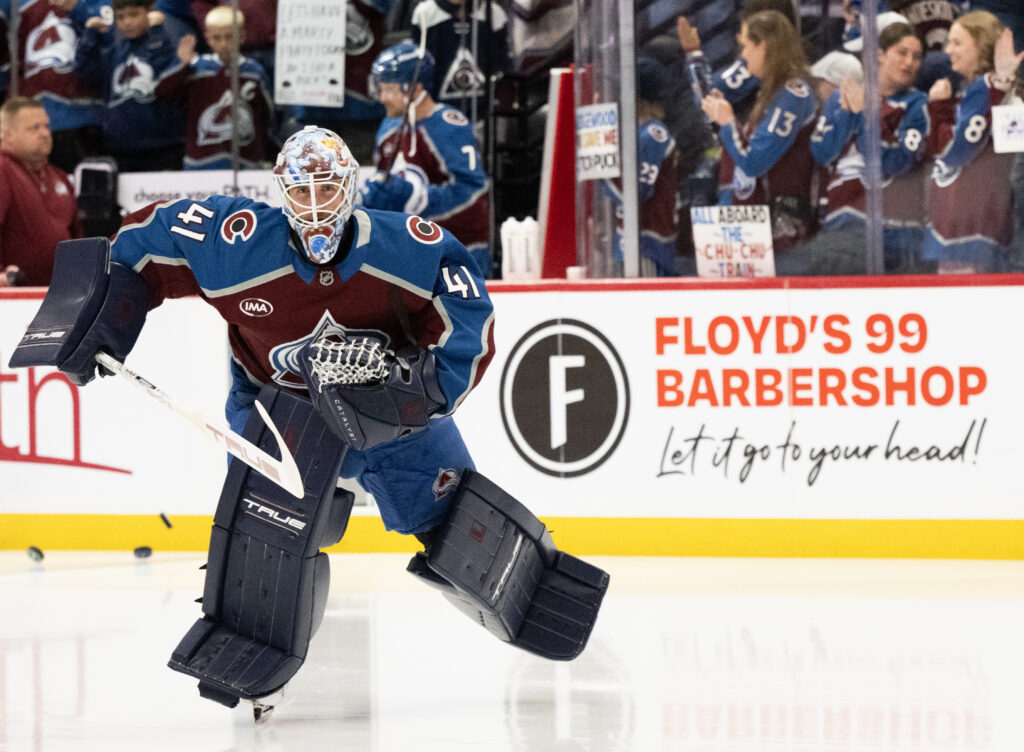
Wedgewood just capped off the best regular season of his career. He had career highs in starts and wins and led the NHL with a .921 save percentage. He told The Denver Gazette he physically “feels awesome” because he’s consistently been able to play as opposed to waiting weeks for his turn in net. Many believe he should be the starter for Game 1, but Bednar hasn’t tipped his hand.
For Blackwood, most would have assumed months ago there would be no question he’d be the starter heading into the playoffs. He hasn’t had a bad season by any means, winning 23 games and finishing in the top 15 in goals saved above expected per 60, but it hasn’t felt like the Blackwood the Avalanche saw after acquiring him in a trade halfway through last season.
Bednar said this rotation, particularly the “mental grind” of it, has been a bigger adjustment for Blackwood.
Inside that room, there’s a lot of confidence a rotation can work.
“I understand (one goalie) has worked. (Sergei) Bobrovsky, (Andrei) Vasilevskiy, they’ve done it, but why change (what we’re doing) all of the sudden because it’s the playoffs if it’s worked?” Wedgewood said. “You got two guys that both want to play, both want to help, both are energized, and I don’t feel like you’re getting a crazy difference in performance. … It’s just going to be what the guys expect.”

Outside of the locker room, there’s skepticism a goaltender rotation can get the job done in the playoffs, because, well, it rarely does. And the Avalanche are not the only team that may be employing this “unconventional” tactic this postseason.
Minnesota has two very good goaltenders, both of whom will likely get their opportunity against the Dallas Stars. Carolina has done this song and dance for years, and will likely do it again with Frederik Andersen and Brandon Bussi. A few other teams like Pittsburgh and Buffalo may also dabble with rotating netminders, so it does appear philosophies around the league are changing.
One team still has to prove it can win a Stanley Cup doing it, though.
Mike Rupp, who works for NHL Network, won a Stanley Cup in 2003 with the New Jersey Devils. He came close again in 2012 playing for the New York Rangers. Both those teams had Hall of Fame goaltenders in Martin Brodeur and Henrik Lundqvist who knew that if they had an off night, they were still going to be back in net the next game. A rotation might mean an off night sees the other goalie playing the next game.
Because multiple teams might be going down the rotation route this postseason, Rupp picked the brain of former NHL goalie Devan Dubnyk on this subject.
“If you’re fortunate to have two options as a team, then I would assume that makes your leash a little shorter as the starter,” Rupp said. “If (the starter) just looks OK, does he feel more pressure than what the playoffs already provide? Is it already, ‘I got to be sharp because it’s win and I’m in, or lose and I’m out?’ (Dubnyk’s) thing was there’s got to be some great communication, whether from the goaltending coach or head coach. … I don’t love it, but it is what it is and it’s up to those teams to have that line of communication inside the room.”
Rupp, like many others, isn’t sure it can work.
“If you’re going to announce back-and-forth, it could probably work in a series like this (against the Kings), but generally we don’t see that working long-term,” Rupp said.
Whether a rotation will work remains to be seen for the Avalanche and could be the biggest question mark facing the team entering the postseason. At some point, they may need to adjust and roll with one goaltender.
One thing does seem certain. There will be no in fighting between Colorado’s goaltenders if they do have to share the net this playoff run.
“With our friendship and the way that we understand the game, it’s not a ‘damn you’ if you play or a ‘damn me’ if you play better than I do. It hasn’t felt that way at all,” Wedgewood said. “It’s just been awesome to be like, ‘I’m going and I got this guy in my corner’ and that means he’s going next game and I can give it everything I got and then have a break and reset and go. … The way it’s worked and supporting each other, it’s been nice. There hasn’t been any of that feeling of if I go in there, this guy’s not talking to me. It’s been, ‘you’re in, light them up and shut them out.’ It’s just been a friendship in that sense.”