






Simulation center helps prepare Colorado Springs nursing students

The simulation is fake. but the tears are real.
The grief is palpable in the faux hospital room at the Johnson Beth-El College of Nursing and Health Sciences Simulation Learning Center at University of Colorado Colorado Springs.
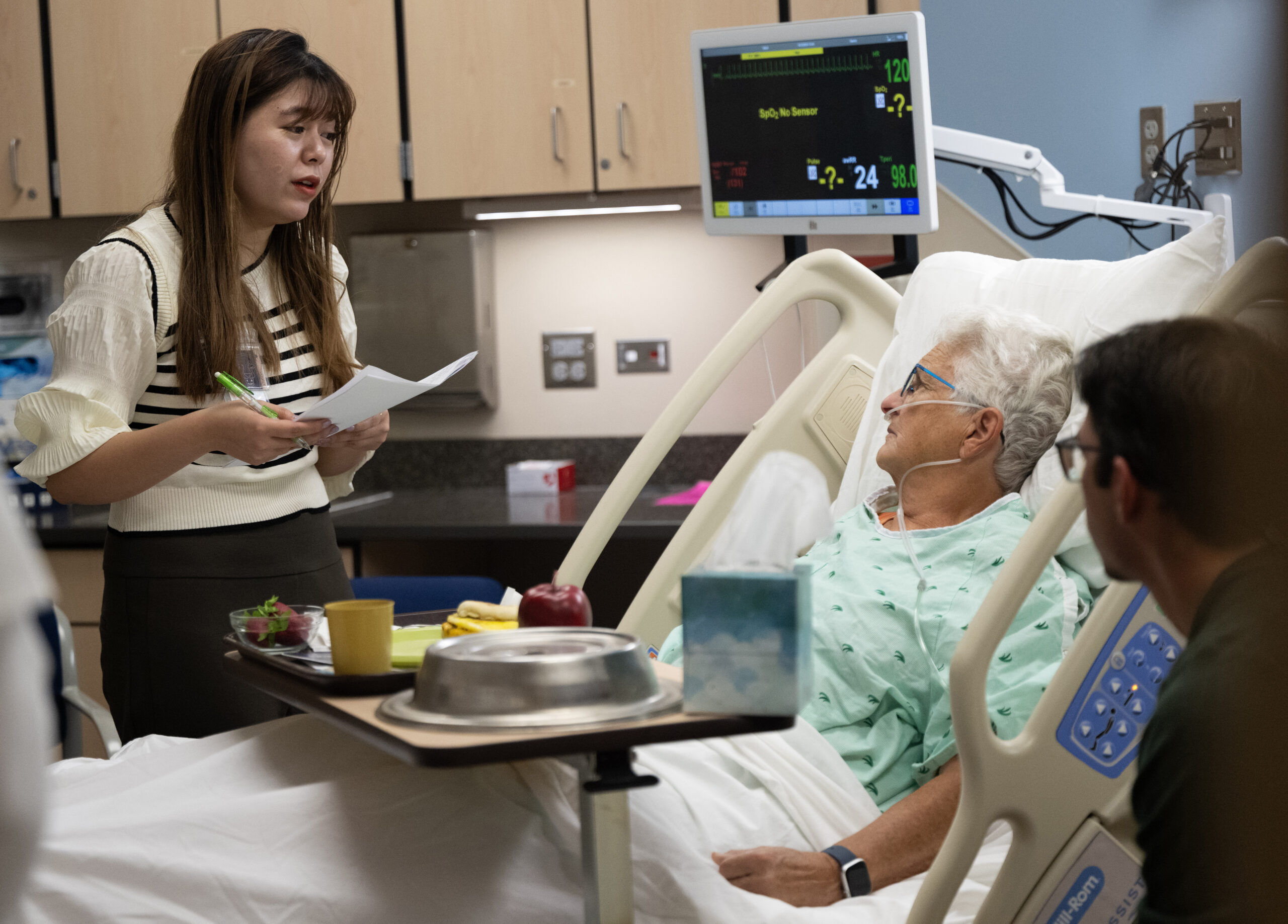
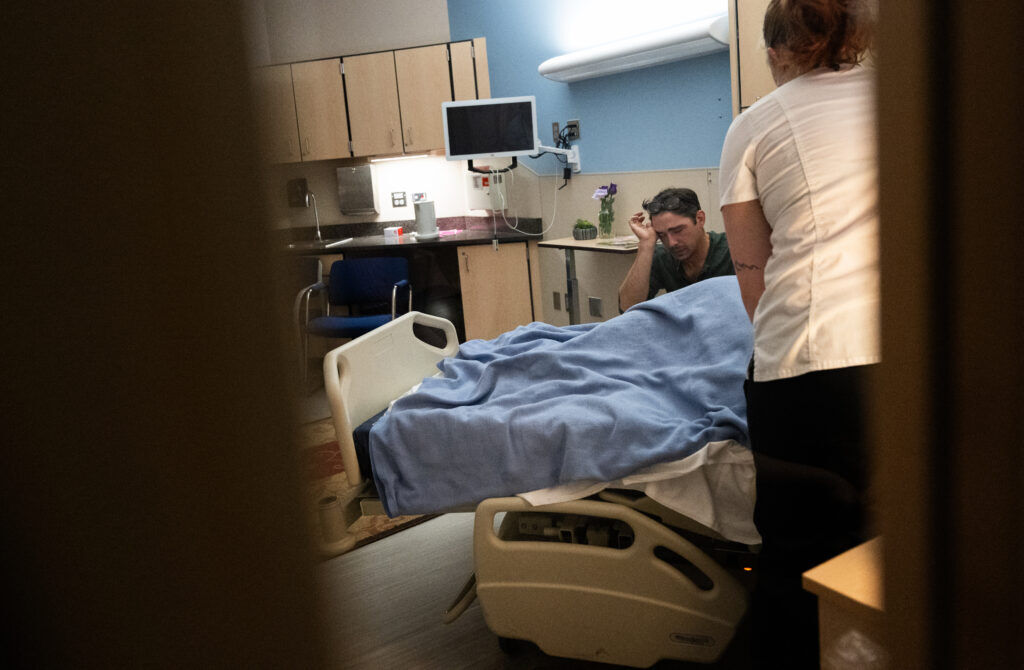
Two nursing students comfort Jacob Hacker, a local actor playing the role of Eric, and his mother, Sophia, played by Ruth Olson, who’s dying in hospice after deciding to discontinue dialysis.
While the actors have memorized the scene, the students improv their way through, responding as they might in a real-life situation. It’s practice for when they go out into a real clinical setting, either during their schooling or after they graduate, and meet real patients going through real medical issues.
“Everyone knows what they’re supposed to do, but they don’t know exactly how it will play out until they go into the room for the simulation,” said Simulation Program Manager Julie Sweum. “When the sim is over they talk about it — what went right, what went wrong. It’s a time of reflection. A critical part of the sim process is breaking apart and seeing what worked and what didn’t.”
In the room, Sophia dies, curled up on her side, facing her son, who sits hunched over in his chair as the student nurses console him.
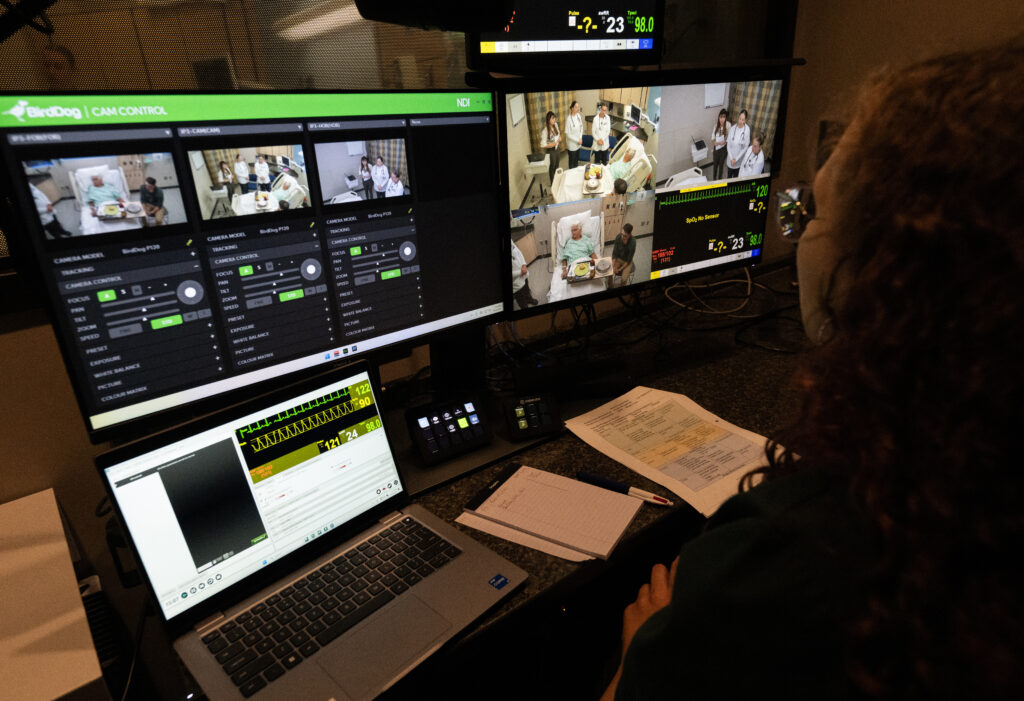
“We’re going to end the scenario,” UCCS junior Mica Law pipes in over the room’s intercom. Law, a sim tech and occasional actor, is in the control room on the other side of the wall from the simulation room, where she and faculty members have watched the simulation unfold on monitors.
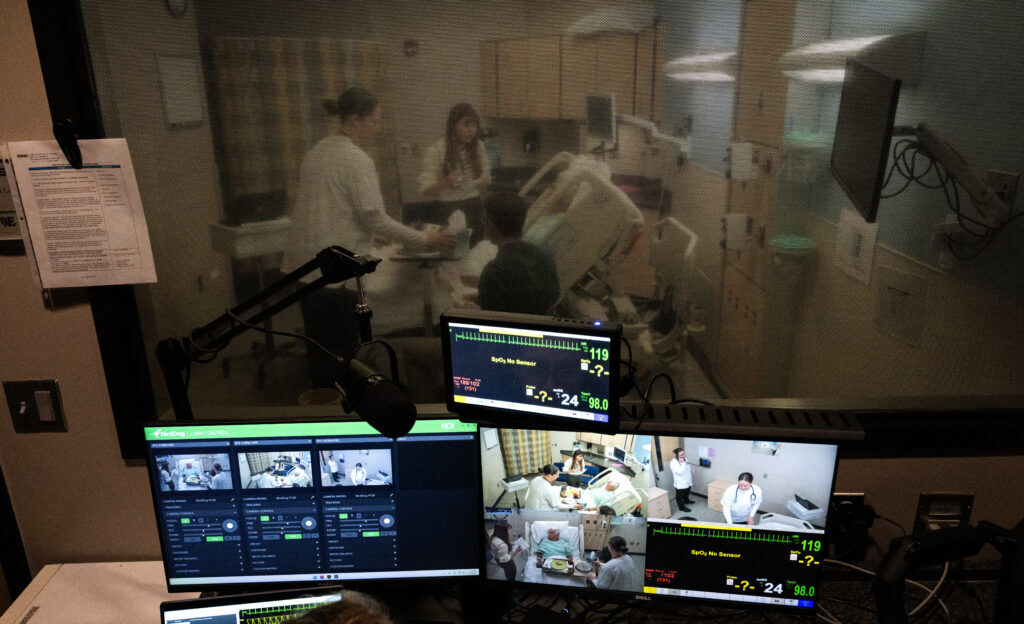
The students leave the room and Sweum enters to check on the actors, known as standardized patients in health care simulation, or SPs. Hacker rises to grab a tissue to wipe his leaky eyes.
“It is emotional. It’s also an actor thing where you’re able to dip into it and come back out of it,” said the semi-professional actor. He and Olson have both been SPs for three years.
“There’s not a lot of emotional, dramatic roles out there so this is a good way to hone those emotions,” Hacker said. “At the same time it’s in a realm of learning so we’re putting forth effort for a higher purpose.”
Becoming an SP is competitive, says Sweum, who started with the learning center as an SP three years ago before managing the program. Applicants go through two rounds of interviews and a final audition to become part of the 10-person team and a paid UCCS employee.
“For actors, it’s such rewarding work,” Sweum said. “It’s putting their acting skills to use for education to help the future of healthcare. We get a lot of applicants. We’re never short of SPs.”
The roots of health care simulation go back to 1963, when neurologist Dr. Howard Barrows changed health care training through SP methodology. SPs helped students develop their clinical skills, safely practice communication, and do physical exams and diagnostics.
The program at Johnson Beth-El College of Nursing and Health Sciences has existed since 2009, but the simulation center didn’t open until 2012. Undergraduates are required to attend sims during every clinical course. Some additional courses also require sims. Students must take care of patients in sim before doing similar work in a clinical setting. By the time they graduate as general nurses, students have done about three dozen sims.
“If they’re going to go take care of a pediatric patient they come do a patient here, with a family, and get those skills,” said associate professor and Simulation Learning Center Director Lynn Phillips. “And when they get to our hospital partners, they can hone their skills and fine-tune them, but they’re not starting from ground zero.”
Simulated hospital life
Walking through the door and into the learning center inside University Hall is like teleporting to the lobby of a real hospital. Charting stations are set up outside three patient suites for students to look through their patients’ information before knocking on the door and entering through privacy curtains. Off the lobby is another small room that houses instruments and medications a nurse might need, as well as a crash cart for a possible Code Blue.
“With health care sim you want to simulate environments that feel and look like the real thing,” Sweum said. “That way students can practice in a safe environment. That’s something we stress.”
One hospital room holds a surprise and another key feature of the program: a manikin, which is just how it sounds — a uber-realistic robot that can cough, watch you move around the room, vomit, accept IV lines and blood draws, and even give birth so students can practice delivering a baby.
A pregnant manikin named Lucina, the name given to her by the manufacturer, is lying on a hospital bed. There’s no baby inside her round belly today, as the manikin is currently being used by Rosalind Franklin University, whose students have been practicing their anesthesia skills on her.
During a sim, sim techs in the control room can manage the rate of Lucina’s contractions, change the amount she’s dilated, and all of her vitals. A sim tech also can voice act, providing the moans and screams that emit from Lucina as she labors and delivers a baby.
“We load a baby in her and there’s a placenta and umbilical cord, everything,” Sweum said. “We can control how fast it comes out depending on the level of the student and the faculty in back, saying let’s give them more of a challenge or have them go into cardiac arrest or whatever. They can completely control that learning experience for the student.”
Downstairs from the hospital rooms are other environment staged to look like outpatient offices and someone’s apartment or house. For Law’s first time as an SP, she played an overweight 10-year-old at home with her mom, played by Sweum.
“It (the sim) was on nutrition,” Law said. “They had to educate my mom and me because I was bullied for my weight, and had to tell me it’s OK you’re overweight, but you also need to be healthy. Be confident in yourself and also better yourself.”
Sims range in emotional intensity, from the high-stakes end of life sim to lesser-stakes scenarios, like broken bones, respiratory illnesses and physical therapy, which once worked too well for Hacker. His nursing student detected an actual SLAP tear in his shoulder that his SP persona wasn’t supposed to have.
“We had to give that in feedback, like you’re doing your job so well you found something real,” he said.
And then there are sims like domestic violence, mental health issues and lifestyle issues, including two SPs who play a pregnant woman and her partner who smoke and drink.
“They do a good job of strengthening what I learn in the classroom and letting me know what to expect in the hospital and what to do,” said nursing student Albert Trollope.
The junior most recently did the end of life sim. It was challenging but not as hard as the head-to-toe assessment sim he did as a final exam his first year.
“You’ve got to stay professional during it,” Trollope said. “Those are really good actors in there. They do a good job and you feel like it’s actually happening. It made me feel really sad. But you have to experience that. It’s a common thing in the nursing field to experience that, but I was glad to experience it first here in sim before out in the real world where I don’t know what to do.”
