






Air Force Reserve says goodbye to weather satellite operations

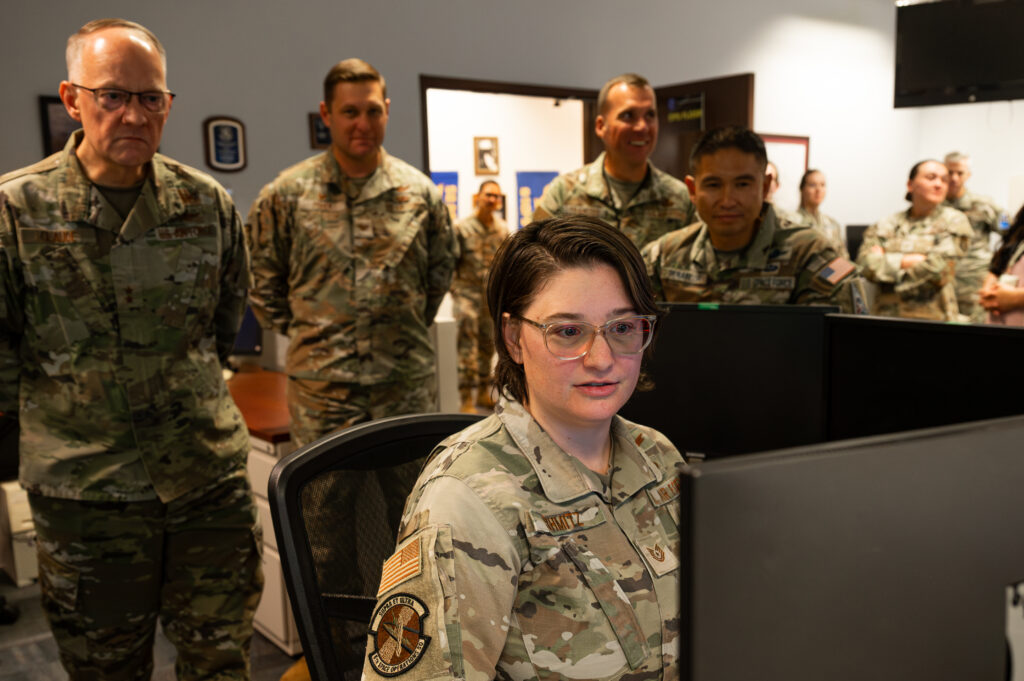
For decades, Air Force reservists at Schriever Space Force Base have helped fly weather satellites that have guided global military operations. On Tuesday, the airmen connected to school-bus-sized satellites for the final time and honored their long history.
The small ceremony marked the last time an Air Force Reserve unit will operate satellites, said Col. Adam Fisher, commander of the 310th Space Wing. Reservists will continue to work with active-duty units focused on satellites, but no other unit focused on satellites remain, as space-focused programs in the Air Force Reserve transfer into the active-duty Space Force.
At the center of the celebrations were three aging satellites, the last in a line of satellites stretching back to 1963 that are now headed for replacement.
Most of the 31 people who helped operate them in the 6th Space Operations Squadron plan to transfer into the active-duty Space Force, said Maj. Scott Hollister.
At full strength, about 48 operators in the squadron shared the task of helping the National Oceanic and Atmospheric Administration run the satellites in the Defense Meteorological Satellite Program, flying in a north-south orbit crossing over the poles and collecting images of the Earth.
In one case, a satellite in the system collected a picture of Hurricane Andrew headed toward Florida in 1992, which Maj. Gen. Robert Claude recalled as the depiction of the perfect storm.
“It looked like a painting,” said Claude, who was among the first people to see the image. One of his first assignments was leading airmen who run the satellites and he is now the mobilization assistant to the chief of space operations.
Decades later, the satellites still provide critical hurricane prediction information to NOAA, the agency that operates the satellites most of the time.
The 6th Space Operations Squadron at Schriever provided a backup site for NOAA when operators needed help, said Retired Col. Keith Amburgey, who stood up the reserve unit in 1998.
In one case, a burst pipe kept NOAA operators away from their terminals. Reservists ensured the data collected during critical 15-minute windows got to the Air Force’s weather service at Offutt Air Force Base in Nebraska. During the short windows, numerous glitches were possible, and had to be fixed quickly to ensure the data couldstill be collected, Amburgey explained. He worked to ensure reservists were ready.
“We would make those guys sweat in the simulator,” he said.
After waiting in silence to make sure reservists could connect with the satellites almost 30 years ago, it was important for him to come back and see them link back up for the last time, Amburgey said. It was a moment marked with cheers and cake.
NOAA will run the satellites until they are decommissioned next year, said Gordan Mack, site director for environmental monitoring for the Space Force.
The current satellites in the system were launched in the early 2000s, making them old by modern standards and, Mack said, new satellites are expected to take over similar roles.
The first satellite of the Weather System Follow-on-Microwave was accepted by Space Operations Command earlier this year. The system is expected to be affordable, scalable and resilient, the Space Force said.
The new weather satellite system also is expected to be more automated than those run by the reservists, Mack said.
The Space Force also has contracted with General Atomics for two new weather satellites, a news release said. The company will operate the satellites.
