






How do local schools ‘turn around’ after years of poor performance?

To ensure success for every student in Colorado schools, the state’s accountability system gives underperforming schools the chance to address their shortcomings before intervention. How exactly a school achieves this transformation can depend on a myriad of conditions.
In Harrison D-2, El Paso County’s most racially and economically diverse school district, the road to school improvement is unique to the region, given the higher rates of crime and poverty in the area of Colorado Springs.
The state’s frameworks and accreditation levels are calculated by combining student academic achievement, along with postsecondary and workforce readiness data like graduation, dropout and college matriculation rates. Schools with the two lowest levels are then given five years to improve before the Colorado Department of Education (CDE) intervenes.
Over the years, D-2 has had various schools on the CDE’s “watchlist,” but is now in the midst of adjustments throughout the district.
Revised approaches to math, English and writing instruction, along with a new system for student discipline and increased staff training, are among the wholesale changes currently underway.
“It was challenging in the beginning because the culture was not great when we got started,” said D-2’s Chief Communications Officer Christine O’Brien.
“I would say that we’re in a much better place (now). We have lower teacher turnover, staff want to be here, and I think, when we see the challenges and the things we don’t have quite right, we’re all excited to dive in together and figure it out. Because it can be done.”
Upon Wendy Birhanzel assuming her role as the district’s sole superintendent in 2020, following two years in an interim co-superintendent role, O’Brien said she began implementing study-driven approaches to address the district’s various challenges.
Recognizing students’ lagging literacy throughout the district, a literacy committee was formed to determine structural and systemic shifts in 2019. The following year, D-2 applied for the U.S. Department of Education’s Comprehensive Literacy State Development Grant to improve outcomes for children living in poverty, English learning students and students with disabilities.
Complementing state funding for K-3 literacy plans, the grant funding assisted in district efforts in the secondary grades through professional learning opportunities for teachers and on-site instructional leaders assisting in implementing evidence-based methods. This year, D-2 was awarded a new round of funding through the grant that will span through 2029.
D-2’s curriculum assessment and instruction coordinator, Laura Spruce, explained that the first round of grant funds focused on K-12 reading comprehension and the next round will focus on writing practices across the district. She added that, because reading and writing improvements remain the district’s biggest focus, these practices will also be incorporated into other subjects and lessons.
“We know what our end goal is, but our end goal is not our first goal,” Spruce said. “We also have small goals in the very beginning, which is: ‘Can you write a really good sentence?’ And that’s at every single grade level.”
The biggest hurdle with these adjustments was the time needed to successfully implement them, between initial training, class time and follow-up coaching support, according to secondary literacy coordinator Kasey Andrade Smith. Growing pains in the early years didn’t yield immediate improvements, but those pains have lessened.
With the model and instructional training method now established, the district looks to expand on the work that began four years ago.
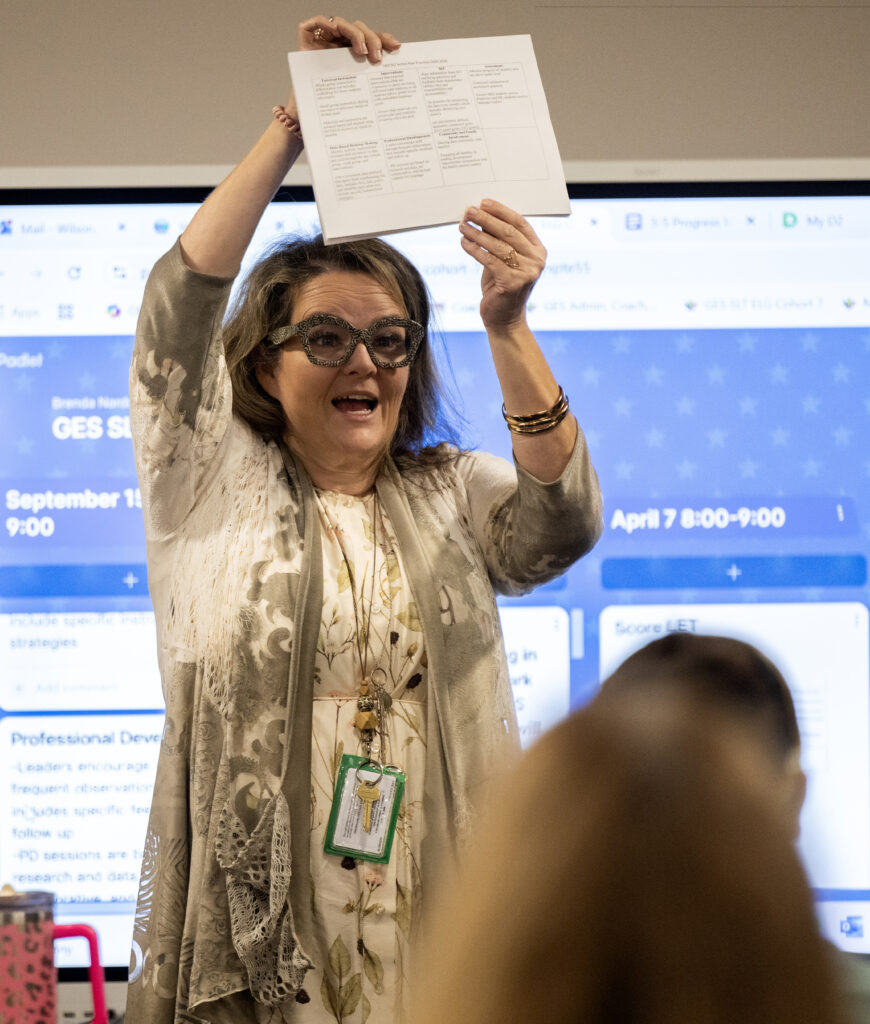
“It takes a long time to train staff and to shift mindsets, and we had some culture shifts we needed to go through, too, to make sure we’re all on the same page on what high-impact literacy looks like in classrooms,” Smith said. “And how do we build a system of accountability while also supporting our people?”
The additional investments and time allotted for training have aided new and veteran teachers in mastering the new instructional approaches while also encouraging them to collaborate towards overall improvement.
Giberson Elementary School Principal Tanya Young explained that their professional coaching sessions are intended to “remediate, support or to elevate” and have helped her teachers “be heard.”
“And so, with the veteran teachers, they already know ‘If I’m doing well in this area, it’s an opportunity for me to support my colleagues or it’s an opportunity to support my district,’” she said.
Elsewhere in Colorado Springs, D-11 has taken similar approaches to improve its own watchlist schools. This year, Galileo Middle School was approved by the state board of education to become a community school and provide additional resources to serve the overall needs of the community. Mitchell High School was also state-approved this year to implement a new turnaround plan to improve PSAT and SAT performances through the educational improvement service, Instructional Empowerment.
The additional training hasn’t been limited to instructional adjustments. To better address student behavior concerns and discipline, D-2 recently implemented a restorative justice model of intervention with a differentiated behavior matrix. Popular in larger school districts with diverse student populations across the country, the approach equips teachers and staff to meet troubled students through dialogue and healing rather than immediate punishment.
After an initial implementation in 13 schools in 2018 and 2019 through a Transforming Safety grant, D-2 schools like Giberson Elementary now have their own restorative systems in place. Teachers and staff are now trained to encourage student belonging and best utilize class time.
“So often, we send a student home, but they’re not learning a new behavior by being suspended or out of class,” O’Brien said.
“They’re falling behind, and they still don’t have the skillset to deal with their frustration or behavior.”
Additionally, regular connection circles give students the opportunity to express their thoughts and feelings to prevent conflicts and empathize with each other and their teachers.
These initiatives’ success, while not overnight, is showing promising signs.
One year after getting placed on the state’s accountability clock, Giberson improved from “turnaround” — the state’s lowest rating — to a “priority improvement” school in 2025. While the school ranked at the bottom in the Pikes Peak region in English and math achievement this past year, improvements in other metrics improved its overall rating.
Over the same span of time, Harrison High School’s rating increased from “priority improvement” to “improvement” after three years on the watchlist.
Birhanzel was named the Colorado Superintendent of the Year in 2023 because of D-2’s efforts in reducing out-of-school suspensions by 38%, and the dropout rate to 1.2% since 2020.
Along with performance improvements, staff have pointed to the literacy supports and the restorative approach in improving students’ communication skills and class participation.
Among the work in D-2 that still needs to be done is improving reading proficiency in target schools’ Colorado Measures of Academic Success scores to 80% and the “priority improvement” frameworks for the district’s remaining six schools.
As the next phase of improvement begins, Smith is stressing a message of “stay the course” as minor goals continue to be reached.
“We know that we’ve been building systems that are very supportive of the right work. We had one of our middle schools miss the mark by .3% this year … And we have to acknowledge what is working and we have to be patient because change really does take time,” she said.
How do local schools ‘turn around’ after years of poor performance?

To ensure success for every student in Colorado schools, the state’s accountability system gives underperforming schools the chance to address their shortcomings before intervention. How exactly a school achieves this transformation can depend on a myriad of conditions.
In Harrison D-2, El Paso County’s most racially and economically diverse school district, the road to school improvement is unique to the region, given the higher rates of crime and poverty in the area of Colorado Springs.
The state’s frameworks and accreditation levels are calculated by combining student academic achievement, along with postsecondary and workforce readiness data like graduation, dropout and college matriculation rates. Schools with the two lowest levels are then given five years to improve before the Colorado Department of Education (CDE) intervenes.
Over the years, D-2 has had various schools on the CDE’s “watchlist,” but is now in the midst of adjustments throughout the district.
Revised approaches to math, English and writing instruction, along with a new system for student discipline and increased staff training, are among the wholesale changes currently underway.
“It was challenging in the beginning because the culture was not great when we got started,” said D-2’s Chief Communications Officer Christine O’Brien.
“I would say that we’re in a much better place (now). We have lower teacher turnover, staff want to be here, and I think, when we see the challenges and the things we don’t have quite right, we’re all excited to dive in together and figure it out. Because it can be done.”
Upon Wendy Birhanzel assuming her role as the district’s sole superintendent in 2020, following two years in an interim co-superintendent role, O’Brien said she began implementing study-driven approaches to address the district’s various challenges.
Recognizing students’ lagging literacy throughout the district, a literacy committee was formed to determine structural and systemic shifts in 2019. The following year, D-2 applied for the U.S. Department of Education’s Comprehensive Literacy State Development Grant to improve outcomes for children living in poverty, English learning students and students with disabilities.
Complementing state funding for K-3 literacy plans, the grant funding assisted in district efforts in the secondary grades through professional learning opportunities for teachers and on-site instructional leaders assisting in implementing evidence-based methods. This year, D-2 was awarded a new round of funding through the grant that will span through 2029.
D-2’s curriculum assessment and instruction coordinator, Laura Spruce, explained that the first round of grant funds focused on K-12 reading comprehension and the next round will focus on writing practices across the district. She added that, because reading and writing improvements remain the district’s biggest focus, these practices will also be incorporated into other subjects and lessons.
“We know what our end goal is, but our end goal is not our first goal,” Spruce said. “We also have small goals in the very beginning, which is: ‘Can you write a really good sentence?’ And that’s at every single grade level.”
The biggest hurdle with these adjustments was the time needed to successfully implement them, between initial training, class time and follow-up coaching support, according to secondary literacy coordinator Kasey Andrade Smith. Growing pains in the early years didn’t yield immediate improvements, but those pains have lessened.
With the model and instructional training method now established, the district looks to expand on the work that began four years ago.
“It takes a long time to train staff and to shift mindsets, and we had some culture shifts we needed to go through, too, to make sure we’re all on the same page on what high-impact literacy looks like in classrooms,” Smith said. “And how do we build a system of accountability while also supporting our people?”
The additional investments and time allotted for training have aided new and veteran teachers in mastering the new instructional approaches while also encouraging them to collaborate towards overall improvement.
Giberson Elementary School Principal Tanya Young explained that their professional coaching sessions are intended to “remediate, support or to elevate” and have helped her teachers “be heard.”
“And so, with the veteran teachers, they already know ‘If I’m doing well in this area, it’s an opportunity for me to support my colleagues or it’s an opportunity to support my district,’” she said.
Elsewhere in Colorado Springs, D-11 has taken similar approaches to improve its own watchlist schools. This year, Galileo Middle School was approved by the state board of education to become a community school and provide additional resources to serve the overall needs of the community. Mitchell High School was also state-approved this year to implement a new turnaround plan to improve PSAT and SAT performances through the educational improvement service, Instructional Empowerment.
The additional training hasn’t been limited to instructional adjustments. To better address student behavior concerns and discipline, D-2 recently implemented a restorative justice model of intervention with a differentiated behavior matrix. Popular in larger school districts with diverse student populations across the country, the approach equips teachers and staff to meet troubled students through dialogue and healing rather than immediate punishment.
After an initial implementation in 13 schools in 2018 and 2019 through a Transforming Safety grant, D-2 schools like Giberson Elementary now have their own restorative systems in place. Teachers and staff are now trained to encourage student belonging and best utilize class time.
“So often, we send a student home, but they’re not learning a new behavior by being suspended or out of class,” O’Brien said.
“They’re falling behind, and they still don’t have the skillset to deal with their frustration or behavior.”
Additionally, regular connection circles give students the opportunity to express their thoughts and feelings to prevent conflicts and empathize with each other and their teachers.
These initiatives’ success, while not overnight, is showing promising signs.
One year after getting placed on the state’s accountability clock, Giberson improved from “turnaround” — the state’s lowest rating — to a “priority improvement” school in 2025. While the school ranked at the bottom in the Pikes Peak region in English and math achievement this past year, improvements in other metrics improved its overall rating.
Over the same span of time, Harrison High School’s rating increased from “priority improvement” to “improvement” after three years on the watchlist.
Birhanzel was named the Colorado Superintendent of the Year in 2023 because of D-2’s efforts in reducing out-of-school suspensions by 38%, and the dropout rate to 1.2% since 2020.
Along with performance improvements, staff have pointed to the literacy supports and the restorative approach in improving students’ communication skills and class participation.
Among the work in D-2 that still needs to be done is improving reading proficiency in target schools’ Colorado Measures of Academic Success scores to 80% and the “priority improvement” frameworks for the district’s remaining six schools.
As the next phase of improvement begins, Smith is stressing a message of “stay the course” as minor goals continue to be reached.
“We know that we’ve been building systems that are very supportive of the right work. We had one of our middle schools miss the mark by .3% this year … And we have to acknowledge what is working and we have to be patient because change really does take time,” she said.