






Field of dreams: High tech diagnoses, surgeries a game changer for young athletes in Colorado

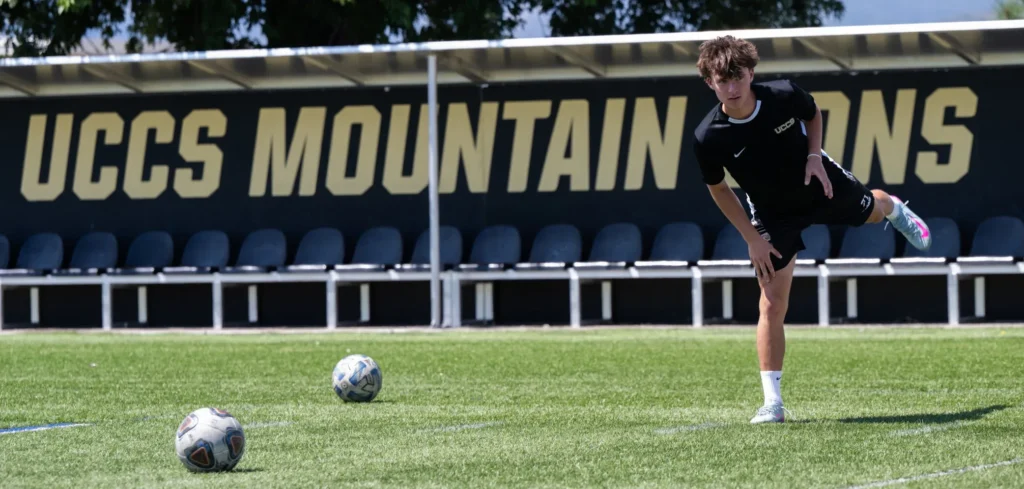
If walking is a series of controlled, false falls, 18-year-old Aidan Harris moves in precision plunges and pivots so smooth he sometimes seems to float — all while snapping ball after ball after ball exactly where he wants it to go.
Kid’s got better aim with his leg than most people do with their arm, acknowledged his father, Scott Harris, with a smile that was part pride and all awe.
“It’s amazing what he’s been able to do. A lot of it’s mental when you have an injury, because you don’t want to re-hurt it,” said Scott, on an afternoon in late July, as he helped his son get in some one-on-one training at an otherwise empty Mountain Lion Stadium at the University of Colorado Colorado Springs. He tossed another ball down the turf, calling out at the last moment to which of four widely spaced mini-soccer goals Aidan should send it slamming. Aidan swiftly obliged, gesturing for Dad to “keep ‘em coming.”
Being able to watch his son do what he loves, without pain, is a blessing and hard-won gift — of cutting-edge tech, dedicated docs and pure teenage grit, Scott said.
“He’s had to really work to get the mental part aligned with the physical part. But he’s a hard worker and he creates opportunity just from the work he puts in,” Scott said. “As a dad, I’m just … so proud of him.”
A generation ago, the hip injury Aidan suffered might have sidelined him for far longer than an off-season. And as things turned out, a quick recovery was more integral to keeping his soccer dreams on track than anyone imagined.
Both Aidan’s passion and his natural skill for the game were clear at an early age. He rose quickly through the levels of rec teams in Colorado Springs, and by 16, was accepted into the competitive arm of the Real Colorado program, a nonprofit youth soccer organization in the Denver area.
It was during his time with Real that he first felt the pain, like “pins and needles” slicing down the back of his right thigh, in his dominant kicking leg.
“For the longest time, they thought it was my hamstring, so I went through several weeks of physical therapy, being in and out of training,” said Aidan. When the pain returned, his physical therapist knew something else must be to blame. He recommended an MRI, which could reveal potential damage to the soft tissue surrounding the bones.
That test showed Aidan had a tear in his acetabular labrum, the ring of soft cartilage that surrounds the hip socket and seals in the ball of the femur, stabilizing and cushioning the joint while allowing for a range of complex movements.
Labral tears can be caused by injuries and congenital issues such as dysplasia (an unusually shallow socket), as well as the wear of repetitive motion — a lifetime of walking, say, or just a few years of rigorous training and use on a soccer field.
“Kids with mild to moderate hip dysplasia, if they happen to be much more active and athletic, they can bring about pain even at an early age,” said Dr. Curtis VandenBerg, a surgeon who specializes in Orthopaedic Sports Medicine at Children’s Hospital Colorado in Aurora.
As more young people pursue high-impact sports and physically demanding lifestyles, younger and younger patients are suffering the physical slings and arrows one might expect to see in their parents or grandparents.
“From a population standpoint, hip pain in athletes and young athletes is still relatively uncommon — there’s more shoulder and knee issues — but we are seeing more young kids develop hip pain from being really active,” said VandenBerg. “That’s something we’re seeing on a weekly basis.”
Fortunately, such young athletes are suffering at a time when advancements in diagnostics, repairs and recovery can meet them more than halfway, and help them over the finish line.
The hip is the body’s primary fulcrum, a marvel of design and a complex hub of tissues and nerves that can confound easy pain diagnoses.
Without a window into what’s actually going on under the skin, hip pain and how best to treat it, especially in young people, is often a mystery wrapped in an hormonal enigma, wrapped in some of the densest web of connective and cushioning tissue found in the human body.
Imaging tech including X-rays and MRIs remain “good tools.” More modern options such as dynamic ultrasound go further, providing a live view of an individual’s internal hip components interacting, while in motion — allowing for more bespoke diagnoses, and treatments, VandenBerg said.
The technology continues to advance, in leaps and bounds.
“One of the preoperative tools we now use for hip arthroscopy is a 3D mapping software of the hip, which currently requires a low-radiation CT scan,” VandenBerg said, of a tool which creates a three-dimensional map of the interior of the hip, and helps surgeons identify any areas with signs of impingement. Before such tech, often, the true nature and extent of damage might be unknown prior to the operating table.
“That really gives us a very clear preoperative plan versus traditionally. It’s just another tool in the toolbox to help make the surgery more precise and more reliable,” he said. “This is where you know it’s, it’s kind of, let’s get all the information on the table and really understand what’s causing the issue, what’s causing the pain. Can we address that arthroscopically or not?”
Used both to diagnose and treat, hip arthroscopy is a minimally invasive procedure in which a tiny camera and surgical instruments are inserted via scope into the affected joint, and the surgery completed using intraoperative image guidance.
In Aidan’s case, during surgery the torn labrum was repaired and re-attached to the socket with a series of tiny suture anchors. VandenBerg said that imaging also had revealed that the head of his femoral bone was slightly misshapen, potentially predisposing him to future hip pain.
“So we recontoured the femoral head and neck to a more spherical shape, so that in the future, he’s not getting that impingement when he moves,” VandenBerg said.
“We’re not quite doing robotic-assisted surgery for this yet,” VandenBerg said. But “I think we’re in a really interesting phase of the evolution of hip arthroscopy, where we have really high-quality studies demonstrating the effectiveness of the surgery for specific diagnoses and patients.”
The impact of a shortened healing time, on both body and mind, can’t be underestimated.
“Post-op, we have patients begin physical therapy, actually right away,” VandenBerg said. “Within three to five days post-op, they’re in physical therapy, moving their hip.”
When, suddenly, the only thing between you and your dreams is recovery, you want that recovery to happen as quickly as possible.
Around the time Aidan learned he would need surgery, Switchbacks assistant coach (and Aidan’s former private trainer) Johnny Oceguera called with an opportunity to join the Colorado Springs Switchbacks’ development team of talented and promising youth players.
“It was really unfortunate timing …” Aidan said. Oceguera was understanding, though, and offered to put him on the injured reserve list. They could wait.
After the surgery, Aidan said, “I did everything I could to get better in the game without touching the ball … whether that was watching and analyzing film, going through specific mental training.”
VandenBerg wasn’t the only member of Aidan’s medical team impressed with his dedication to regaining his edge, inside and out.
“He’s such a great kid, and he’s so motivated and he’s such a hard worker,” VandenBerg said. “We met him when he was really struggling to be able to advance in soccer the way he wanted to do because of his hip pain, so it’s really rewarding to see him go through this process and succeed.”
Once Aidan was cleared to return to the field, he started training with Oceguera and the team, quickly drawing the attention of the “right people.”
On July 30, 2024, he signed an academy contract with the Switchbacks FC, making his debut in a pre-season “friendly.” He went on to spend a season traveling and training as a member of the team’s roster — a contract that ended when he committed to attend UCCS this fall, joining the university’s soccer team as a midfielder.
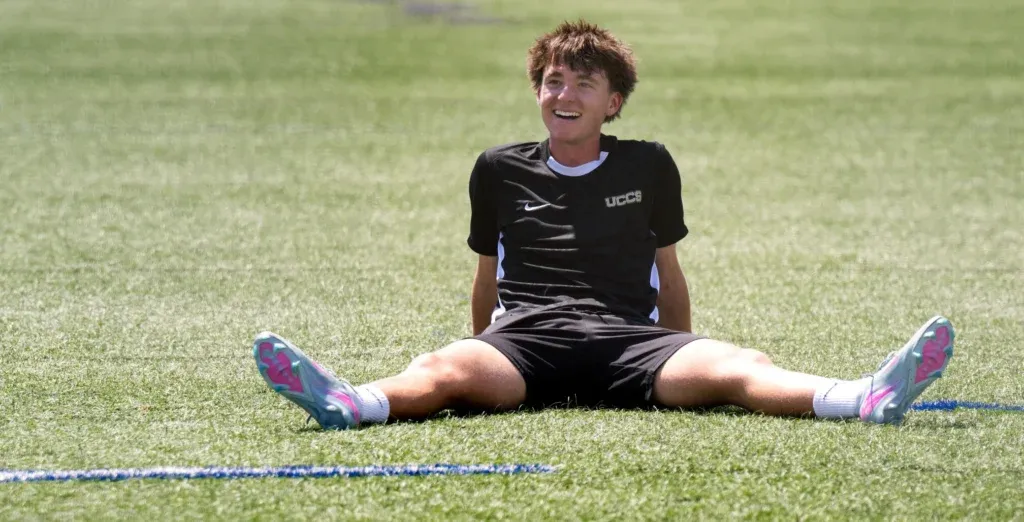
Now he said he’s at the top of his game, maybe better than before. The scars on his skin are tiny, and fading. The scars from a future he might have been denied? That’s something he doesn’t have to worry about.
“Deciding to get surgery, it wasn’t easy, but it helped me be able to trust my body and be able to trust my instincts again,” he said.
“I feel good. I feel great. I feel like a kid again.”
Field of dreams: High tech diagnoses, surgeries a game changer for young athletes in Colorado

If walking is a series of controlled, false falls, 18-year-old Aidan Harris moves in precision plunges and pivots so smooth he sometimes seems to float — all while snapping ball after ball after ball exactly where he wants it to go.
Kid’s got better aim with his leg than most people do with their arm, acknowledged his father, Scott Harris, with a smile that was part pride and all awe.
“It’s amazing what he’s been able to do. A lot of it’s mental when you have an injury, because you don’t want to re-hurt it,” said Scott, on an afternoon in late July, as he helped his son get in some one-on-one training at an otherwise empty Mountain Lion Stadium at the University of Colorado Colorado Springs. He tossed another ball down the turf, calling out at the last moment to which of four widely spaced mini-soccer goals Aidan should send it slamming. Aidan swiftly obliged, gesturing for Dad to “keep ‘em coming.”
Being able to watch his son do what he loves, without pain, is a blessing and hard-won gift — of cutting-edge tech, dedicated docs and pure teenage grit, Scott said.
“He’s had to really work to get the mental part aligned with the physical part. But he’s a hard worker and he creates opportunity just from the work he puts in,” Scott said. “As a dad, I’m just … so proud of him.”
A generation ago, the hip injury Aidan suffered might have sidelined him for far longer than an off-season. And as things turned out, a quick recovery was more integral to keeping his soccer dreams on track than anyone imagined.
Both Aidan’s passion and his natural skill for the game were clear at an early age. He rose quickly through the levels of rec teams in Colorado Springs, and by 16, was accepted into the competitive arm of the Real Colorado program, a nonprofit youth soccer organization in the Denver area.
It was during his time with Real that he first felt the pain, like “pins and needles” slicing down the back of his right thigh, in his dominant kicking leg.
“For the longest time, they thought it was my hamstring, so I went through several weeks of physical therapy, being in and out of training,” said Aidan. When the pain returned, his physical therapist knew something else must be to blame. He recommended an MRI, which could reveal potential damage to the soft tissue surrounding the bones.
That test showed Aidan had a tear in his acetabular labrum, the ring of soft cartilage that surrounds the hip socket and seals in the ball of the femur, stabilizing and cushioning the joint while allowing for a range of complex movements.
Labral tears can be caused by injuries and congenital issues such as dysplasia (an unusually shallow socket), as well as the wear of repetitive motion — a lifetime of walking, say, or just a few years of rigorous training and use on a soccer field.
“Kids with mild to moderate hip dysplasia, if they happen to be much more active and athletic, they can bring about pain even at an early age,” said Dr. Curtis VandenBerg, a surgeon who specializes in Orthopaedic Sports Medicine at Children’s Hospital Colorado in Aurora.
As more young people pursue high-impact sports and physically demanding lifestyles, younger and younger patients are suffering the physical slings and arrows one might expect to see in their parents or grandparents.
“From a population standpoint, hip pain in athletes and young athletes is still relatively uncommon — there’s more shoulder and knee issues — but we are seeing more young kids develop hip pain from being really active,” said VandenBerg. “That’s something we’re seeing on a weekly basis.”
Fortunately, such young athletes are suffering at a time when advancements in diagnostics, repairs and recovery can meet them more than halfway, and help them over the finish line.
The hip is the body’s primary fulcrum, a marvel of design and a complex hub of tissues and nerves that can confound easy pain diagnoses.
Without a window into what’s actually going on under the skin, hip pain and how best to treat it, especially in young people, is often a mystery wrapped in an hormonal enigma, wrapped in some of the densest web of connective and cushioning tissue found in the human body.
Imaging tech including X-rays and MRIs remain “good tools.” More modern options such as dynamic ultrasound go further, providing a live view of an individual’s internal hip components interacting, while in motion — allowing for more bespoke diagnoses, and treatments, VandenBerg said.
The technology continues to advance, in leaps and bounds.
“One of the preoperative tools we now use for hip arthroscopy is a 3D mapping software of the hip, which currently requires a low-radiation CT scan,” VandenBerg said, of a tool which creates a three-dimensional map of the interior of the hip, and helps surgeons identify any areas with signs of impingement. Before such tech, often, the true nature and extent of damage might be unknown prior to the operating table.
“That really gives us a very clear preoperative plan versus traditionally. It’s just another tool in the toolbox to help make the surgery more precise and more reliable,” he said. “This is where you know it’s, it’s kind of, let’s get all the information on the table and really understand what’s causing the issue, what’s causing the pain. Can we address that arthroscopically or not?”
Used both to diagnose and treat, hip arthroscopy is a minimally invasive procedure in which a tiny camera and surgical instruments are inserted via scope into the affected joint, and the surgery completed using intraoperative image guidance.
In Aidan’s case, during surgery the torn labrum was repaired and re-attached to the socket with a series of tiny suture anchors. VandenBerg said that imaging also had revealed that the head of his femoral bone was slightly misshapen, potentially predisposing him to future hip pain.
“So we recontoured the femoral head and neck to a more spherical shape, so that in the future, he’s not getting that impingement when he moves,” VandenBerg said.
“We’re not quite doing robotic-assisted surgery for this yet,” VandenBerg said. But “I think we’re in a really interesting phase of the evolution of hip arthroscopy, where we have really high-quality studies demonstrating the effectiveness of the surgery for specific diagnoses and patients.”
The impact of a shortened healing time, on both body and mind, can’t be underestimated.
“Post-op, we have patients begin physical therapy, actually right away,” VandenBerg said. “Within three to five days post-op, they’re in physical therapy, moving their hip.”
When, suddenly, the only thing between you and your dreams is recovery, you want that recovery to happen as quickly as possible.
Around the time Aidan learned he would need surgery, Switchbacks assistant coach (and Aidan’s former private trainer) Johnny Oceguera called with an opportunity to join the Colorado Springs Switchbacks’ development team of talented and promising youth players.
“It was really unfortunate timing …” Aidan said. Oceguera was understanding, though, and offered to put him on the injured reserve list. They could wait.
After the surgery, Aidan said, “I did everything I could to get better in the game without touching the ball … whether that was watching and analyzing film, going through specific mental training.”
VandenBerg wasn’t the only member of Aidan’s medical team impressed with his dedication to regaining his edge, inside and out.
“He’s such a great kid, and he’s so motivated and he’s such a hard worker,” VandenBerg said. “We met him when he was really struggling to be able to advance in soccer the way he wanted to do because of his hip pain, so it’s really rewarding to see him go through this process and succeed.”
Once Aidan was cleared to return to the field, he started training with Oceguera and the team, quickly drawing the attention of the “right people.”
On July 30, 2024, he signed an academy contract with the Switchbacks FC, making his debut in a pre-season “friendly.” He went on to spend a season traveling and training as a member of the team’s roster — a contract that ended when he committed to attend UCCS this fall, joining the university’s soccer team as a midfielder.

Now he said he’s at the top of his game, maybe better than before. The scars on his skin are tiny, and fading. The scars from a future he might have been denied? That’s something he doesn’t have to worry about.
“Deciding to get surgery, it wasn’t easy, but it helped me be able to trust my body and be able to trust my instincts again,” he said.
“I feel good. I feel great. I feel like a kid again.”
Field of dreams: High tech diagnoses, surgeries a game changer for young athletes in Colorado
If walking is a series of controlled, false falls, 18-year-old Aidan Harris moves in precision plunges and pivots so smooth he sometimes seems to float — all while snapping ball after ball after ball exactly where he wants it to go.
Kid’s got better aim with his leg than most people do with their arm, acknowledged his father, Scott Harris, with a smile that was part pride and all awe.
“It’s amazing what he’s been able to do. A lot of it’s mental when you have an injury, because you don’t want to re-hurt it,” said Scott, on an afternoon in late July, as he helped his son get in some one-on-one training at an otherwise empty Mountain Lion Stadium at the University of Colorado Colorado Springs. He tossed another ball down the turf, calling out at the last moment to which of four widely spaced mini-soccer goals Aidan should send it slamming. Aidan swiftly obliged, gesturing for Dad to “keep ‘em coming.”
Being able to watch his son do what he loves, without pain, is a blessing and hard-won gift — of cutting-edge tech, dedicated docs and pure teenage grit, Scott said.
“He’s had to really work to get the mental part aligned with the physical part. But he’s a hard worker and he creates opportunity just from the work he puts in,” Scott said. “As a dad, I’m just … so proud of him.”
A generation ago, the hip injury Aidan suffered might have sidelined him for far longer than an off-season. And as things turned out, a quick recovery was more integral to keeping his soccer dreams on track than anyone imagined.
Both Aidan’s passion and his natural skill for the game were clear at an early age. He rose quickly through the levels of rec teams in Colorado Springs, and by 16, was accepted into the competitive arm of the Real Colorado program, a nonprofit youth soccer organization in the Denver area.
It was during his time with Real that he first felt the pain, like “pins and needles” slicing down the back of his right thigh, in his dominant kicking leg.
“For the longest time, they thought it was my hamstring, so I went through several weeks of physical therapy, being in and out of training,” said Aidan. When the pain returned, his physical therapist knew something else must be to blame. He recommended an MRI, which could reveal potential damage to the soft tissue surrounding the bones.
That test showed Aidan had a tear in his acetabular labrum, the ring of soft cartilage that surrounds the hip socket and seals in the ball of the femur, stabilizing and cushioning the joint while allowing for a range of complex movements.
Labral tears can be caused by injuries and congenital issues such as dysplasia (an unusually shallow socket), as well as the wear of repetitive motion — a lifetime of walking, say, or just a few years of rigorous training and use on a soccer field.
“Kids with mild to moderate hip dysplasia, if they happen to be much more active and athletic, they can bring about pain even at an early age,” said Dr. Curtis VandenBerg, a surgeon who specializes in Orthopaedic Sports Medicine at Children’s Hospital Colorado in Aurora.
As more young people pursue high-impact sports and physically demanding lifestyles, younger and younger patients are suffering the physical slings and arrows one might expect to see in their parents or grandparents.
“From a population standpoint, hip pain in athletes and young athletes is still relatively uncommon — there’s more shoulder and knee issues — but we are seeing more young kids develop hip pain from being really active,” said VandenBerg. “That’s something we’re seeing on a weekly basis.”
Fortunately, such young athletes are suffering at a time when advancements in diagnostics, repairs and recovery can meet them more than halfway, and help them over the finish line.
The hip is the body’s primary fulcrum, a marvel of design and a complex hub of tissues and nerves that can confound easy pain diagnoses.
Without a window into what’s actually going on under the skin, hip pain and how best to treat it, especially in young people, is often a mystery wrapped in an hormonal enigma, wrapped in some of the densest web of connective and cushioning tissue found in the human body.
Imaging tech including X-rays and MRIs remain “good tools.” More modern options such as dynamic ultrasound go further, providing a live view of an individual’s internal hip components interacting, while in motion — allowing for more bespoke diagnoses, and treatments, VandenBerg said.
The technology continues to advance, in leaps and bounds.
“One of the preoperative tools we now use for hip arthroscopy is a 3D mapping software of the hip, which currently requires a low-radiation CT scan,” VandenBerg said, of a tool which creates a three-dimensional map of the interior of the hip, and helps surgeons identify any areas with signs of impingement. Before such tech, often, the true nature and extent of damage might be unknown prior to the operating table.
“That really gives us a very clear preoperative plan versus traditionally. It’s just another tool in the toolbox to help make the surgery more precise and more reliable,” he said. “This is where you know it’s, it’s kind of, let’s get all the information on the table and really understand what’s causing the issue, what’s causing the pain. Can we address that arthroscopically or not?”
Used both to diagnose and treat, hip arthroscopy is a minimally invasive procedure in which a tiny camera and surgical instruments are inserted via scope into the affected joint, and the surgery completed using intraoperative image guidance.
In Aidan’s case, during surgery the torn labrum was repaired and re-attached to the socket with a series of tiny suture anchors. VandenBerg said that imaging also had revealed that the head of his femoral bone was slightly misshapen, potentially predisposing him to future hip pain.
“So we recontoured the femoral head and neck to a more spherical shape, so that in the future, he’s not getting that impingement when he moves,” VandenBerg said.
“We’re not quite doing robotic-assisted surgery for this yet,” VandenBerg said. But “I think we’re in a really interesting phase of the evolution of hip arthroscopy, where we have really high-quality studies demonstrating the effectiveness of the surgery for specific diagnoses and patients.”
The impact of a shortened healing time, on both body and mind, can’t be underestimated.
“Post-op, we have patients begin physical therapy, actually right away,” VandenBerg said. “Within three to five days post-op, they’re in physical therapy, moving their hip.”
When, suddenly, the only thing between you and your dreams is recovery, you want that recovery to happen as quickly as possible.
Around the time Aidan learned he would need surgery, Switchbacks assistant coach (and Aidan’s former private trainer) Johnny Oceguera called with an opportunity to join the Colorado Springs Switchbacks’ development team of talented and promising youth players.
“It was really unfortunate timing …” Aidan said. Oceguera was understanding, though, and offered to put him on the injured reserve list. They could wait.
After the surgery, Aidan said, “I did everything I could to get better in the game without touching the ball … whether that was watching and analyzing film, going through specific mental training.”
VandenBerg wasn’t the only member of Aidan’s medical team impressed with his dedication to regaining his edge, inside and out.
“He’s such a great kid, and he’s so motivated and he’s such a hard worker,” VandenBerg said. “We met him when he was really struggling to be able to advance in soccer the way he wanted to do because of his hip pain, so it’s really rewarding to see him go through this process and succeed.”
Once Aidan was cleared to return to the field, he started training with Oceguera and the team, quickly drawing the attention of the “right people.”
On July 30, 2024, he signed an academy contract with the Switchbacks FC, making his debut in a pre-season “friendly.” He went on to spend a season traveling and training as a member of the team’s roster — a contract that ended when he committed to attend UCCS this fall, joining the university’s soccer team as a midfielder.
Now he said he’s at the top of his game, maybe better than before. The scars on his skin are tiny, and fading. The scars from a future he might have been denied? That’s something he doesn’t have to worry about.
“Deciding to get surgery, it wasn’t easy, but it helped me be able to trust my body and be able to trust my instincts again,” he said.
“I feel good. I feel great. I feel like a kid again.”
Field of dreams: High tech diagnoses, surgeries a game changer for young athletes in Colorado

If walking is a series of controlled, false falls, 18-year-old Aidan Harris moves in precision plunges and pivots so smooth he sometimes seems to float — all while snapping ball after ball after ball exactly where he wants it to go.
Kid’s got better aim with his leg than most people do with their arm, acknowledged his father, Scott Harris, with a smile that was part pride and all awe.
“It’s amazing what he’s been able to do. A lot of it’s mental when you have an injury, because you don’t want to re-hurt it,” said Scott, on an afternoon in late July, as he helped his son get in some one-on-one training at an otherwise empty Mountain Lion Stadium at the University of Colorado Colorado Springs. He tossed another ball down the turf, calling out at the last moment to which of four widely spaced mini-soccer goals Aidan should send it slamming. Aidan swiftly obliged, gesturing for Dad to “keep ’em coming.”
Being able to watch his son do what he loves, without pain, is a blessing and hard-won gift — of cutting-edge tech, dedicated docs and pure teenage grit, Scott said.
“He’s had to really work to get the mental part aligned with the physical part. But he’s a hard worker and he creates opportunity just from the work he puts in,” Scott said. “As a dad, I’m just … so proud of him.”
A generation ago, the hip injury Aidan suffered might have sidelined him for far longer than an off-season. And as things turned out, a quick recovery was more integral to keeping his soccer dreams on track than anyone imagined.
Both Aidan’s passion and his natural skill for the game were clear at an early age. He rose quickly through the levels of rec teams in Colorado Springs, and by 16, was accepted into the competitive arm of the Real Colorado program, a nonprofit youth soccer organization in the Denver area.
It was during his time with Real that he first felt the pain, like “pins and needles” slicing down the back of his right thigh, in his dominant kicking leg.
“For the longest time, they thought it was my hamstring, so I went through several weeks of physical therapy, being in and out of training,” said Aidan. When the pain returned, his physical therapist knew something else must be to blame. He recommended an MRI, which could reveal potential damage to the soft tissue surrounding the bones.
That test showed Aidan had a tear in his acetabular labrum, the ring of soft cartilage that surrounds the hip socket and seals in the ball of the femur, stabilizing and cushioning the joint while allowing for a range of complex movements.
Labral tears can be caused by injuries and congenital issues such as dysplasia (an unusually shallow socket), as well as the wear of repetitive motion — a lifetime of walking, say, or just a few years of rigorous training and use on a soccer field.
“Kids with mild to moderate hip dysplasia, if they happen to be much more active and athletic, they can bring about pain even at an early age,” said Dr. Curtis VandenBerg, a surgeon who specializes in Orthopaedic Sports Medicine at Children’s Hospital Colorado in Aurora.
As more young people pursue high-impact sports and physically demanding lifestyles, younger and younger patients are suffering the physical slings and arrows one might expect to see in their parents or grandparents.
“From a population standpoint, hip pain in athletes and young athletes is still relatively uncommon — there’s more shoulder and knee issues — but we are seeing more young kids develop hip pain from being really active,” said VandenBerg. “That’s something we’re seeing on a weekly basis.”
Fortunately, such young athletes are suffering at a time when advancements in diagnostics, repairs and recovery can meet them more than halfway, and help them over the finish line.
The hip is the body’s primary fulcrum, a marvel of design and a complex hub of tissues and nerves that can confound easy pain diagnoses.
Without a window into what’s actually going on under the skin, hip pain and how best to treat it, especially in young people, is often a mystery wrapped in an hormonal enigma, wrapped in some of the densest web of connective and cushioning tissue found in the human body.
Imaging tech, including X-rays and MRIs, remain “good tools.” More modern options, such as dynamic ultrasound, go further, providing a live view of an individual’s internal hip components interacting, while in motion — allowing for more bespoke diagnoses and treatments, VandenBerg said.
The technology continues to advance in leaps and bounds.
“One of the preoperative tools we now use for hip arthroscopy is a 3D mapping software of the hip, which currently requires a low-radiation CT scan,” VandenBerg said, of a tool that creates a three-dimensional map of the interior of the hip, and helps surgeons identify any areas with signs of impingement. Before such tech, often, the true nature and extent of damage might be unknown prior to the operating table.
“That really gives us a very clear preoperative plan versus traditionally. It’s just another tool in the toolbox to help make the surgery more precise and more reliable,” he said. “This is where you know it’s, it’s kind of, let’s get all the information on the table and really understand what’s causing the issue, what’s causing the pain. Can we address that arthroscopically or not?”
Used both to diagnose and treat, hip arthroscopy is a minimally invasive procedure in which a tiny camera and surgical instruments are inserted via scope into the affected joint, and the surgery is completed using intraoperative image guidance.
In Aidan’s case, during surgery, the torn labrum was repaired and reattached to the socket with a series of tiny suture anchors. VandenBerg said that imaging also had revealed that the head of his femoral bone was slightly misshapen, potentially predisposing him to future hip pain.
“So we recontoured the femoral head and neck to a more spherical shape, so that in the future, he’s not getting that impingement when he moves,” VandenBerg said.
“We’re not quite doing robotic-assisted surgery for this yet,” VandenBerg said. But “I think we’re in a really interesting phase of the evolution of hip arthroscopy, where we have really high-quality studies demonstrating the effectiveness of the surgery for specific diagnoses and patients.”
The impact of a shortened healing time on both body and mind can’t be underestimated.
“Post-op, we have patients begin physical therapy, actually right away,” VandenBerg said. “Within three to five days post-op, they’re in physical therapy, moving their hip.”
When, suddenly, the only thing between you and your dreams is healing time, you want that recovery to happen as quickly as possible.
Around the time Aidan learned he would need surgery, Switchbacks assistant coach (and Aidan’s former private trainer) Johnny Oceguera called with an opportunity to join the Colorado Springs Switchbacks’ development team of talented and promising youth players.
“It was really unfortunate timing …” Aidan said. Oceguera was understanding, though, and offered to put him on the injured reserve list. They could wait.
After the surgery, Aidan said, “I did everything I could to get better in the game without touching the ball … whether that was watching and analyzing film, going through specific mental training.”
VandenBerg wasn’t the only member of Aidan’s medical team impressed with his dedication to regaining his edge, inside and out.
“He’s such a great kid, and he’s so motivated and he’s such a hard worker,” VandenBerg said. “We met him when he was really struggling to be able to advance in soccer the way he wanted to do because of his hip pain, so it’s really rewarding to see him go through this process and succeed.”
Once Aidan was cleared to return to the field, he started training with Oceguera and the team, quickly drawing the attention of the “right people.”
On July 30, 2024, he signed an academy contract with the Switchbacks FC, making his debut in a pre-season “friendly.” He went on to spend a season traveling and training as a member of the team’s roster — a contract that ended when he committed to attend UCCS this fall, joining the university’s soccer team as a midfielder.
Now he said he’s at the top of his game, maybe better than before. The scars on his skin are tiny and fading. The scars from a future he might have been denied? That’s something he doesn’t have to worry about.
“Deciding to get surgery, it wasn’t easy, but it helped me be able to trust my body and be able to trust my instincts again,” he said.
“I feel good. I feel great. I feel like a kid again.”


