






Colorado photographers offer tips and places for fall colors
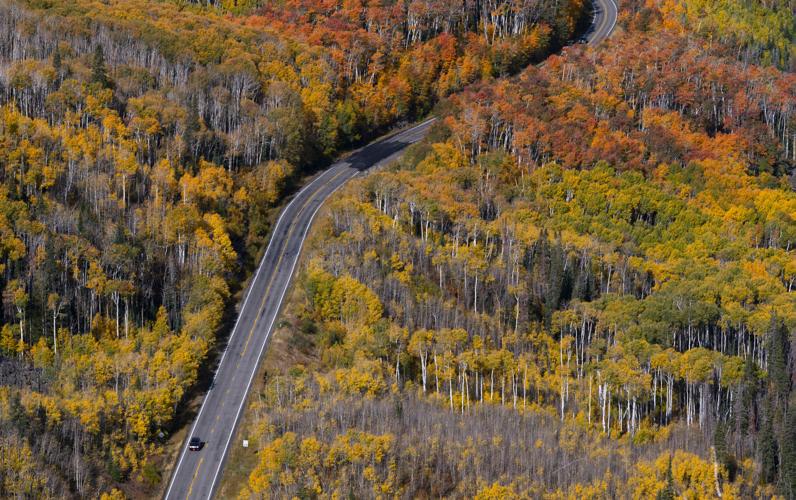
Photos by Christian Murdock, The Gazette
Matt Payne is a fifth-generation Colorado native who knows very well the beauty of this state. He knows, having climbed the state’s highest 100 peaks between 2008 and 2018. That’s when he got serious about photography, inspiring his full-time profession today.
Nothing inspires him quite like fall.
“It’s far and away my favorite time,” says Payne, who grew up in Colorado Springs and now lives in Durango.
For the aspen colors, yes. And also for the weather — these warm days and cool nights that spur the leaves’ green-to-gold transformation. Payne loves fall for the blue skies or, perhaps even better for photography, the cloudy skies from which the season’s first snow falls. Indeed, he loves that vibrant color set against snow-capped mountains.
And the smell.
“The smell of decaying leaves,” says Kane Engelbert, another longtime landscape photographer based in Elizabeth. “That’s something that a lot of people don’t really take in is as much as others.”
As much as photographers, who know how best to take in the season.
“My only wish is that it lasted a little bit longer,” says Mike Pach of 3 Peaks Photography and Design.
There’s no time to waste. How best to spend it?
We asked photographers, of course.
Approaching the season
“It’s unpredictable what’s gonna happen, even though all the news channels put out their maps of when things are gonna change,” Pach says.
Those maps always show a range of dates in descending order: Leaves in the northern part of the state around Steamboat Springs are said to start turning mid-September, followed closely by the central part of the state including Summit County, followed by areas around Crested Butte and the southwest San Juan Mountains around late September and early October.
But leaf-stripping winds and cold snaps are but some important factors, not to mention an area’s previous snowpack and summer rain, or lack thereof. In drought, aspen might turn earlier.
Look around social media to see what other people are seeing out there, Pach suggests.
More importantly? “Just go and appreciate it,” Payne says.
“As a photographer, I’ve learned how to become super flexible and go with whatever I find and make the best of it,” he says. “Honestly, that’s when the best photography happens, when you let yourself become more flexible and relinquish expectations of what you may or may not find and tap into your creativity.”
Don’t be too tied to the “romanticized” idea of peak color, Payne adds. Engelbert even prefers later with fellow photographers.
“We often start our trips around the fourth of October, because we appreciate stands of aspen trees that are partially stripped and not full of leaves,” he says. “They’re absolutely beautiful in my opinion. It provides a lot of texture and interest to the scene.”
As does light.
“I like the morning and evening for the quality of light,” says Gazette Photo Editor Christian Murdock, who has been shooting aspen for 25 years. He likes the afternoon, too: “That’s when I will go under the canopies and shoot the light blowing through the trees.”
And he likes other subjects. Maybe it’s one of the state’s historic, scenic trains touring aspen; the Durango and Silverton Narrow Gauge Railroad and Cumbres and Toltec Railroad come to mind. Or maybe a ghost town like Animas Forks outside Silverton, with idyllic structures in the foreground.
“Or people hiking or various things like that,” Murdock says. “That makes it more active than just a static landscape.”
Where to go
Payne charts a course to somewhere new every fall. “Chasing new areas, that’s part of the thrill,” Engelbert agrees.
“Colorado is huge; there are a lot of places that still haven’t been discovered,” he says. “At the same time, I do visit areas that are highly visited, but some of those are big and expansive so you can get lost in the trees.”
A prime example: Kebler Pass near Crested Butte, with endless trails and connecting drives like McClure and Ohio passes.
Kebler Pass has been a longtime favorite of Murdock’s. As has Independence Pass; he recommends stopping around Lincoln Creek. A newer favorite: Grand Mesa Scenic Byway, traveling the iconic flattop mountain in far western Colorado.
Closer to Pach’s home of Colorado Springs is Gold Camp Road and Mueller State Park in Teller County, with 50-plus miles of trail through aspen groves. Pach is also partial to the Collegiate Peaks overlooking Buena Vista; Cottonwood Pass is an option. And later in the season, he loves driving south for the Highway of Legends between Trinidad and La Veta.
In southwest Colorado, Silver Jack Reservoir along Owl Creek Pass is a go-to for Payne. The Maroon Bells is a go-to for the masses — “but maybe keep hiking up the trail a little bit further and see what you can find,” Payne suggests.
Payne prefers the photo less taken, found on paths less taken. “I might just find a weird Forest Service road and hike up it,” he says.
While you’re there
If one is hiking, one might want to carry less equipment. “I say if you’re gonna be driving around, bring everything that will fit in your vehicle,” Pach says.
He’ll bring a tripod and various lenses. “My general approach is to first look at the big picture, take some wide shots, maybe do some panoramas, and then I start looking for details.”
Details like raindrops or colors reflecting on puddles, creeks, ponds and lakes. Or maybe it’s the lines on the bark — “intimate landscapes, where you’re zooming in on smaller vignettes of nature,” Payne says.
“I think sometimes people get overwhelmed with trying to put everything in the photo and shooting a super wide angle,” he says. “Often times what that can do is introduce a lot of distractions.”
Think single leaves, Engelbert says. “Often we’ll walk around camp in the morning after our sunrise photography sessions and we’ll just look for the most beautiful leaves,” he says. “Just collect them and arrange them the way you want. It can create a really cool scene.”
Think “less busy” foregrounds, he adds: “You’re not gonna want a lot of tall grass or tall foreground distractions. For me, the best scenes are where you can see the trunks go straight down into the ground.”
And maybe, just maybe, think less. “We get really caught up in trying to get photos right and the technical aspects of working with our cameras,” Pach says. “But just take some time away from your camera to take it all in. You don’t have to photograph anything. You can just sit and enjoy where you are.”
