






Calm in a storm: Memorial Hospital’s forensic nursing center is a one-of-a-kind resource
Jerilee Bennett, The Gazette
Steps away from the clamor of one of the country’s busiest emergency departments, a first-of-its-kind, 24-hour medical unit in Colorado Springs strives for serenity in the treatment of patients whose physical injuries only hint at the horrors they’ve survived.
A security badge is flashed and the doors just beyond the ER check-in desk at UCHealth Memorial Hospital Central whoosh open, then shut, sealing off the world outside the Forensic Center of Excellence as effectively as a spaceship airlock.
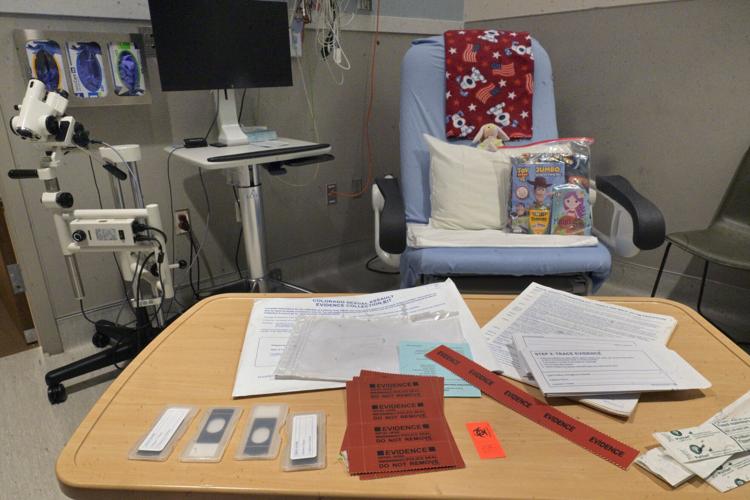
Within this sanctum, victims of abuse and intimate partner violence can access emergent medical care, trauma support and services — and begin the fight for justice, if that’s what they choose — in as non-triggering an environment as a hospital could hope to provide: private exam rooms with real doors, textural and “biophilic” elements of wood, stone and paper art, mid-century decor that evokes a sense of hominess, even in the waiting room.
“People who come here have been hurt, violated and they’re already in sensory overload. Our goal is to have this be a more calm, healing space, where they are 100% in control of what happens next,” said registered nurse Sarah Hagedorn, who manages the unit and its clinical team of 20 forensic nurse examiners and two dedicated EMTs. “Calmness and healing … that is not easy to do when you’re next door to a noisy emergency department.”
The whisper of the HVAC unit on one mid-August morning was like the purr of a sound machine. Even at busy times, which this morning was not, directional speakers above the beds in each exam room let patients choose their form of auditory distraction, whatever that might be, without impact on the greater calm.
“We want to get them back here from the main ED as quickly as possible so the trauma they’ve experienced isn’t compounded … and get them that medical care and the resources they need,” said Hagedorn, whose unit also houses an office of TESSA (Trust, Education, Safety, Support and Action), a Colorado Springs-based group that supports the victims of domestic violence and sexual assault.
Proximity to that busy Memorial ER is key — especially at a time when an increasing number of people, and an increasingly youthful subset, are seeking out care and services after an intimate encounter that was unwanted or turned violent.
In August, the forensic nurse unit at Memorial Central saw a record 335 patients, the most of any month since it opened almost 2½ years ago, according to the hospital.
“It’s hard to gauge, because most communities don’t have a team like ours … and not all the patients we interact with choose to interact with law enforcement … (but) there is a profound increase, unfortunately, in interpersonal violence,” Hagedorn said. “And an increased number of sexual assaults in adolescents have some sort of involvement with a dating app or chat.
“That’s definitely something we’re seeing that’s kind of on the rise.”
Gold standard staff
Highly trained nurses have been performing forensic exams and providing treatment at Memorial Central, in private rooms away from the main ER, since the 1990s. A one-time grant of $3 million from the Colorado Division of Criminal Justice financed the creation and buildout of the Forensic Center of Excellence, which opened in April 2023, as a unique resource in the state, and nationwide. Thus it remains: a forensic nurse unit inside a hospital, next to an ER, staffed by professionals at the pinnacle of their craft.
Hagedorn said a number of her nurses are maxed out on credentials and certifications in the field of sexual assault forensic care. Others are on their way.
“Ten of our nurses are dual certified. That’s a big deal,” said Hagedorn, a fellow dual-certified sexual assault forensic examiner and sexual assault nurse examiner. “There’s something like 500 nurses in the whole world who carry the dual certification … and we have 10.”
Certified SAFE/SANE nurses not only can conduct exams that include the collection of evidence, but also testify as expert witnesses if a case goes to trial.
“These nurses take what they do very, very seriously. Being at the top of their practice is something that’s very important to them,” she said.
Expanding the reach of forensic nursing care to patients and providers well beyond the downtown Springs campus is also a driving force.
For rape and assault survivors in remote communities with no resources, accessing care might entail hours-long drives or rides, sometimes chauffeured by law enforcement, UCHealth SAFE/SANE nurse Kim Reese told The Gazette in 2023.
“When I was first doing it in this (Chaffee) county, we did not have any telehealth, there were times when if I wasn’t in town, victims were having to be driven in the back of a police car to Colorado Springs or Pueblo to get their exams, so that is definitely not trauma-informed care,” Reese said.
“Now, they can get that help hopefully into or very close to their own communities.”
Outreach and access
More than two years on, UCHealth’s forensic nurse team has an even greater purview, through telemedicine at clinics and offices far removed from the Springs, and on-site and virtually at locations including UCHealth Memorial Hospital North, UCHealth Grandview, and in recent months at Pikes Peak Region Hospital in Woodland Park.
“Our goal is to support the community up in Teller County as much as possible,” said Hagedorn.
Program awareness
Sexual assault is historically one of the most underreported crimes, according to an analysis by the Justice Department, which has estimated as many as two-thirds of cases may go unreported.
Studies and anecdotal evidence also show that the more barriers between a victim and care, the less likely they are to seek out treatment of any kind after a crime that not only traumatizes body, mind and spirit, but puts them at risk of sexually transmitted diseases and, for some, unwanted pregnancy.
Hagedorn’s team also helps provide training and guidance for nurses who want to become certified SAFE/SANE providers, including practical teaching on how to perform a pelvic exam, a skill not covered in standard nursing school education.
Forensic nurses also speak at middle schools schools, and to other groups, to help spread awareness of the resources the program provides, and steps that can be taken to minimize risk — especially younger people naive to the dangers of social media and the connections they make virtually.
Intimate violence arising from virtual matches changes the dynamic of the crime, into what essentially is “a stranger assault,” Hagedorn said.
“Most patients who experience sexual assault know the person who has assaulted them,” she said. “With dating apps, they may think that they know that person … and the assault oftentimes is taking place the first time they ever meet in real life.”
Victim-status challenges
In June, Colorado passed a law forcing dating app companies to report to the state attorney general what measures they’ve adopted to protect users from predators on their tech, but the law doesn’t require companies to disclose how many people are victimized after engaging with their platforms.
Other legislation has led to changes with more tangible outcomes, allowing victims who pursue a legal case against their attacker to follow the progress of their “rape kit” through the system.
Prior to the implementation of the tracking system, on June 30, patients who had biological evidence collected had to rely on law enforcement for updates as to the status of their kit, Hagedorn said.
“It was a pretty big dissatisfier for patients.”
Kits now bear a unique number and barcode identifier that can be tracked, anonymously, online.
“That’s one of the things that we’re really excited about,” she said.
Playing a critical role in a patient’s journey, whether or not it leads to a courtroom, is a driving motivation for Wendy Stone, who spent 20 years as a cardiovascular intensive-care nurse in California before moving with her family to Colorado, training as a SAFE/SANE, and joining the forensic nurse team at UCHealth.
“For me, it’s the adolescents. To be able to be there for that adolescent and kind of help them through a very nitty-gritty situation … and have them at the end feel better than they did when they came in, and feel like maybe they’ve started their journey towards getting better …” said Stone.
Sometimes she can glean that change from the look in their eyes or the sound of their voice.
“Every once in a while, they give you a hug,” she said. “And that’s a big deal.”
