






Lost POW/MIA bracelet finds its way home after 50 years
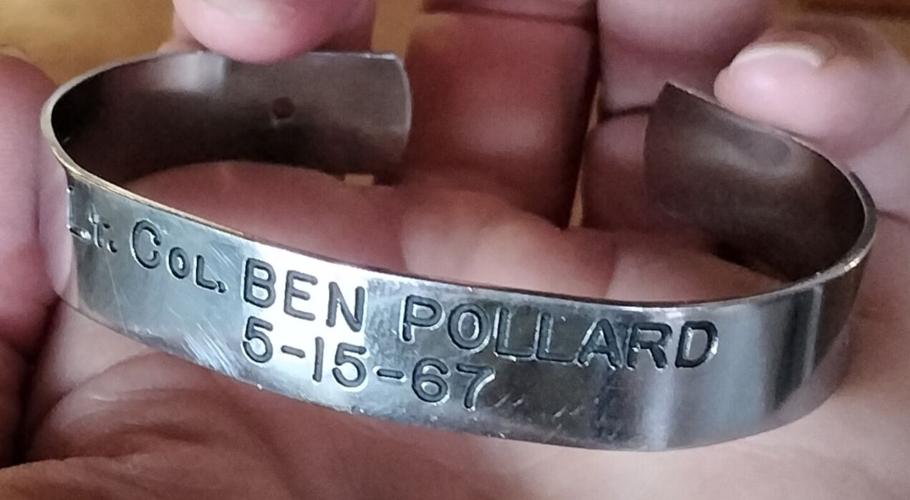
Stephanie Earls/The Gazette
A Vietnam-era POW/MIA bracelet long lost, then found, inspires a mission to set things right after half a century.
A cold call to a mostly forgotten landline finally makes it through, leading to a full-circle moment more complete than anyone imagined.
Is it serendipity? Fate? Luck?
“Use whatever flowery, psychic, cosmic words you would choose,” said Dan Rector, his awe palpable through the phone on this early August call. “I’m just amazed at how it worked out.”
This is where he reiterates, again, that the story is and never was his.
But the truth is, it is his story — just not his alone.
And that was kind of the point of the POW/MIA bracelets, simple metal bands inscribed with the name of a Vietnam service member who was missing in action or a known prisoner of war:
The who is the what.
Unexpected ties
Conceived by student activists in California and launched in the early 1970s, the bracelet campaign engaged an increasingly aware society not only in the growing anti-war movement but in the individual lives lost and in limbo in the jungles of South Asia.
Rector was an undergrad at UC-Boulder when he paid several dollars for a bracelet bearing the name of Lt. Col. Ben Pollard, an Air Force officer who was shot down and taken captive by North Vietnamese forces on May 15, 1967.
Like many students at the time, Rector was against the Vietnam War but wanted to show his support for the troops, many of whom were conscripted into service and all facing unfathomable risks.
“The myth is that Americans had contempt for the soldiers,” Rector said. “The fact is that they very much admired the soldiers. They had contempt for the war.”
At the time he bought the bracelet, Rector wasn’t aware of Lt. Col. Pollard’s deep ties to Colorado Springs — the city where the future lawyer had grown up and later would return to open a practice.
Born in Shelbyville, Ky., Ben Pollard was the son of a farmer, who encouraged his son to follow in his footsteps — which he did, at first.
After earning his undergraduate degree in agricultural engineering at Purdue University, Ben Pollard joined the Air Force in 1955, with an initial three-year ROTC commitment. After flight training and four years as a flight instructor and test pilot, he returned to Purdue for his master’s degree in mechanical engineering, with a focus on fluid dynamics. That’s when Mark Pollard said his father was recruited by the recently opened U.S. Air Force Academy to help bolster its faculty ranks.
Lt. Col. Ben Pollard was a married father of two, teaching at the Air Force Academy, when he was tapped to return to the skies as a member of the first crew in Ryan’s Raiders, the legendary Air Force outfit that flew the “Thuds,” the F-105 Thunderchief.
He was shot down during a night bombing campaign north of Hanoi and taken captive by troops in North Vietnam, where he spent almost six years as a prisoner of war, much of it in the infamous Hanoi Hilton.
“For three years, we didn’t hear anything, and we didn’t know if he was alive or dead,” said Mark Pollard.


In this photo, taken soon before he left to fight in Vietnam, U.S. Air Force Lt. Col. Ben Pollard is shown boarding his beloved F-105 Thunderchief. Pollard was shot down while flying his 11th mission, in spring 1967, and held for almost six years in the infamous “Hanoi Hilton,” where he survived torture, starvation and unfathomable treatment that left him with severe injuries, but failed to break his will.
Fate takes over
In 1970, the family received a handwritten letter, confirming Ben was alive and being held as a prisoner of the North Vietnamese.
“My mother, she always assumed — and we always acted like — he was alive, even though we didn’t know,” Mark Pollard said. “She was always in overdrive, but after that letter … she was going to get him back, no matter what.”
Pollard was among 591 U.S. prisoners of war released as part of Operation Homecoming in February and March of 1973.


Lt. Col. Ben Pollard is welcomed home as part of Operation Homecoming in March 1973, after almost six years as a prisoner of war of the North Vietnamese. Pollard survived torture, starvation and unfathomable treatment that left him with severe injuries, but failed to break his will. During captivity, and covertly under the noses of their captors, Pollard — an instructor at the U.S. Air Force Academy in Colorado Springs before heading to Vietnam — taught engineering to his fellow prisoners, using a slide rule and crude writing implements fashioned from “whatever they had available,” said Ben Pollard’s son, Mark, adding that the men his father taught received college course credits, after their release.
After his release, he returned to Colorado Springs to assume roles of increasing responsibility at the Air Force Academy, ultimately serving as commander of the prep school in 1976, a tenure during which he is credited with helping lead the academy’s first class of female graduates.
Col. Pollard died on Veterans Day, 2016. Both he and his wife, Joan, are buried in the Air Force Academy Cemetery.
Rector carried Ben Pollard’s name on his wrist for years as a young man, and then on his conscience for decades after the bracelet went missing sometime between cross-country moves as he pursued his education.
“We were supposed to wear them and not take them off until our person came home,” Rector said in April, tearing up at the perceived failure of civilian duty. “But I lost mine.”
His rediscovery of the bracelet while going through boxes of college artifacts in his Monument home, and his desire to make right with the family of Ben Pollard, were featured in a May story in The Gazette.
That’s where fortune — or serendipity, or cosmic whatever — took over.
A bracelet’s legacy
Mark Pollard was 8 years old when his father was taken prisoner.
Like many military families, the Pollards had bounced around the country, but they spent significant time in Colorado Springs, long enough to plant deep roots. Mark’s younger sister, Ginny Lorenc, had been born during their father’s pre-war tenure at the Air Force Academy. Mark graduated from Air Academy High School, and after college, returned to the Springs to launch his career in the tech industry.
Both Mark and Ginny remember the important role the POW/MIA bracelets played in their lives and in their home during the years their father was a prisoner of war, and after he came home.
Despite the division over the war playing out in headlines nationwide, the bracelets were a tangible reminder that such news wasn’t the whole truth.
“It was a hard time for our country, and I think that’s what made the POWs unique in their return,” Ginny said. “It was one of the things that made our country sort of come together again.”
At a time when stranger feedback came at a snail’s pace, and only with extreme effort, the fact that it arrived in droves spoke volumes, Ginny said.
“Because people’s addresses were more readily available in phone books back then, we got probably thousands (of bracelets) … returned from people who discovered that dad was on the return list (of POWs),” she said. “They were sent to us, mainly to our home, but I think being near the Air Force Academy, and living in Colorado Springs — and also with Mom being involved with women leadership in helping provide visibility for POWs — that probably helped us get so many more.”


Because of their mother’s activism, as an Air Force wife fighting to bring her husband home from captivity in North Vietnam, the Pollard family received “probably” thousands of POW/MIA bracelets from individuals who’d purchased them and wanted to return them to family after then-Lt. Col. Ben Pollard’s release in March 1973. The bracelet he recently received, from Dan Rector, will always hold a special place in his heart, and the collection, he said, adding that his “long-term goal” is to donate the bracelets to a museum: “We just think it’s an important thing to carry on. It’s part of our history, and the story that our children and our grandchildren should know.”
During her husband’s captivity, Joan Pollard became an outspoken voice keeping attention on missing and captive service members, as well as the vicious treatment many were facing as captives of the North Vietnamese. Joan Pollard continued her activism after her husband’s release, said Ginny, adding that both she and her brother believe her mother’s activism during the time of their father’s captivity helped keep the issue on the radar and facilitate their return.
They also have no doubt the bracelet campaign contributed to the effort and pressure on the government, which ultimately led to Operation Homecoming and the return of almost 600 POWs in 1973, Ginny said.
In the Pollard home, returned POW/MIA bracelets hung from stair banisters like Christmas ornaments, bearing year-round tidings of goodwill.
“You walked into our house and there were hundreds and hundreds of those memories of dad’s presence, and all the people that supported him indirectly,” she said.
Mark Pollard said that knowing their father was supported meant “more than anyone could know.”
“My family and myself — we can never thank people enough.”
A lasting connection
Col. Ben Pollard retired from the Air Force Academy in 1981, finally settling in California after a U.S. military career awash with service decorations, including two Silver Star and two Purple Heart awards.
Mark Pollard ultimately settled in Ohio, and Ginny moved to Utah.
“In many ways, though, Colorado Springs will always feel like home,” Mark said.
After the family’s Colorado Springs connections alerted them to The Gazette story about Dan Rector and their dad, both Mark and Ginny vowed to track down the man with the bracelet, whatever it took.
Mark said he was prepared to walk the streets of the Springs, knocking on doors, but an internet search kicked up a potential direct source.
“I don’t even know this is the right guy, but I found a number and called a number of times, and they just weren’t picking up,” Mark said.
During a visit to the Springs in late May, he tried a final time.
Dan Rector’s wife, Terri, happened to glance at the readout when the call came through on the landline, a number that, in modern times, had become a repository for spam calls. She saw the name, “Pollard,” and answered the phone.
“Dan couldn’t come to the phone right then, but he called me back within minutes,” Mark said. “We were both just kind of amazed at how this was able to work out, how we were able to connect….”
A meetup at a coffee shop in Monument was planned for the following day.


Dan Rector wears a POW/MIA bracelet he got in college in the early 1970s at his home in Monument. The bracelets were created by a student group, to help bring attention to the young service members missing or taken captive during the Vietnam War. Lt. Col. Ben Pollard survived capture, and became a teacher later at the Air Force Academy. Pollard is buried at the Air Force Academy Cemetery.
The POW/MIA bracelet for Lt. Col. Ben Pollard was returned to the family: a circle complete, and a new story line begun.
“What can I say? We became fast friends,” Rector said.
The rest, he added, is history.


Dan Rector (left) and Mark Pollard met for the first time, in person, at a coffee shop in Monument, in early June. Pollard’s father, Col. Ben Pollard, was a POW in North Vietnam during the Vietnam War. Rector was a college student in Boulder in the early 1970s, when he purchased a POW/MIA bracelet honoring Lt. Col. Ben Pollard. The bracelet was lost for years, but recently rediscovered by Rector at his home in Monument. A story about Rector and the POW/MIA bracelet, which can be seen on the table between the two men, ran in The Gazette in May. “Both my sister and I now consider him a long-term family friend, because of what he did,” Mark said.
