






On a cruise through the Galapagos Islands, you’ll see too many animals to count
Seth Singer, Special to The Gazette
“Octopus — there’s an octopus!”
I quickly splash back into the water from the edge of the panga (or dinghy) where I was taking a break from snorkeling. My wetsuit is only half-zipped, but I quickly swim the 30 or so feet to where my brother is floating. Below us, a purple octopus curves its tentacles into the coral. It moves slowly, its skin shifting to appear sky blue and then pink as it slinks along the rock.
Blue and yellow boxfish, neon parrotfish and a hieroglyphic hawkfish, identifiable through the organic-shaped, golden-brown markings across its body, swim by, unmoved. This is a sight they’re privy to every day, I imagine.
Not me. Even as a scuba diver, I’ve only seen one other octopus in the wild.
But here, in the crystal-clear waters of Bartolomé Island — one of 20 that constitute the Galápagos Archipelago off the coast of Ecuador — new-to-me animals are being checked off with impressive regularity.
Four days into our weeklong cruise, my brother and I have already seen marine iguanas, blue-footed boobies, sea turtles, sharks, rays and even something called a chocolate chip starfish. Just before I flung myself back into the sea, I had been watching a pint-sized Galapagos penguin sunbathe on a rock.
Our adventure started a week earlier, in Quito, Ecuador. At over 9,000 feet in elevation, the verdant valley sits in the shadow of the volcanic peaks of the Andes. We took a walking tour of Centro Historico, a UNESCO World Heritage Site, the Mercado San Francisco (where we discovered naranjilla, a native, orangelike tropical fruit), churches and generations-old family shops. We strolled the cobblestone streets, lined with yellow trumpet trees, and ate bean-to-bar chocolate at Chez Tiff and modern interpretations of Ecuador’s cultural traditions at Nuema. And we hired a cab to drive us to the equator, where we stood at the center of the world.
But our destination had always been the Galapagos Islands, a collection of wild marine landscapes that inspired Charles Darwin’s theory of evolution and where many species are endemic, meaning they aren’t found anywhere else on the planet. Nearly the entire archipelago was named a national park in 1959 and established as a marine reserve in 1998.
My husband had visited the province, so my brother and I decided to plan our adventure to the bucket-list setting. Nine years older, he’s a talented photographer who’s infatuated with capturing images of wildlife on land, in the sky and underwater, and we have a penchant for adventurous travel.
There is always a give-and-take when traveling with others, and the two of us had never taken a vacation as a pair. I wasn’t sure how it would go.
As it happens, traveling with a sibling (at least, one that you get along with) is liberating. There’s less of an expectation to be on your best behavior or to cater to each other’s whims. There’s a directness that exists that allowed us to, respectfully, lean into our own interests and needs. For my brother, that meant waking up in the wee hours to catch the sunrise from our 192-foot yacht (Quasar’s Evolution) each morning and participating in every activity. I, 12 weeks pregnant, opted to sleep in and to skip a couple of long, hot walks. Our twin room had its own bathroom so we could get ready in private — and had enough space for my brother to have his messy piles and for me to keep things organized in the closet.
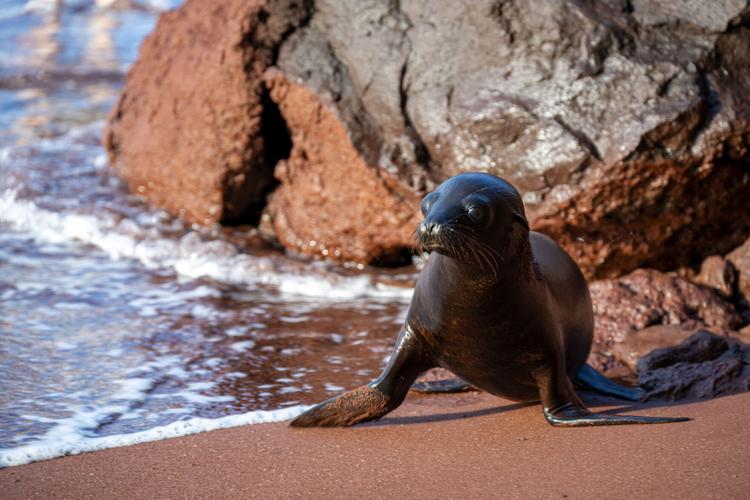
Most days were spent together, though. On our first afternoon — after journeying to the boat via a two-hour flight, short bus drive and panga ride — we watched hammerhead and blacktip reef shark pups swim through a mangrove inlet as our naturalist guides pointed out nearly a dozen other species around us. The next morning, sea lions twirled and dove in the water, even nipping at the toes of another guest’s shoes.
We stood on the yacht’s bow in awe as Fernandina Volcano erupted, turning the inky night sky a deep red, and paddled a double kayak by penguins and flightless cormorants in Tagus Cove. We discovered the Ecuadorian way of eating ceviche — topped with popcorn and/or plantain chips. We laughed in surprise when a flamboyance of flamingoes flew overhead as we stood on Santa Cruz Island; neither of us realized their flight wings were black as they’re hidden when folded but emerge in shocking contrast to the birds’ pink plumage when they soar. I laughed, alone, when an alpha male sea lion on Española Island endeavored to bite my brother’s ankle when he accidentally strode too close.
On one of our final days, we made landfall at Puerto Ayora for a visit to the Charles Darwin Research Station, a hub of inquiry, conservation and education. Cacti grew feet in the air. Giant saddleback tortoises inched toward the shade of local shrubs. They used to inhabit nearly all of the islands, we learned, but overhunting led to the extinction of some species and the endangerment of others.
In a protected area on the campus, tiny baby and juvenile tortoises crawled around; colored numbers on their shells denoted which island they were from.
The captive breeding center is mimicking the species’ natural reproduction rate and keeping the youngsters safe (invasive species and climate change continue to threaten the remaining populations). Once they reach 3 or 4 years old, their shells are hard enough to be safely returned to their home islands. As we watched through a fence, staff calmly picked each little tortoise up, measuring and weighing them to ensure their health.
Later that day, we will walk alongside their elders — Galapagos tortoises can live more than 100 years — in the highlands. Rain will pour down as we stand, patiently, while these evolutionary giants shuffle across the grass and the walkway mere feet from us. And we’ll know that they started as creatures small enough to fit in a person’s palm.
