






Live Well: Website offers edible map of natural resources in urban areas
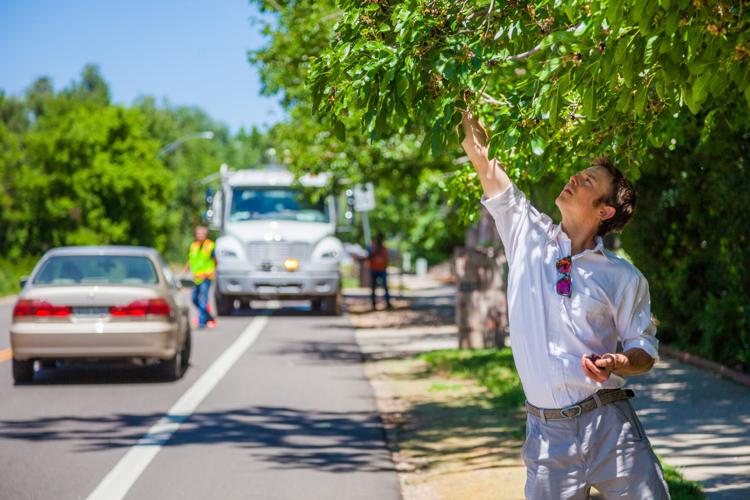
photos Courtesy of Ethan Welty, Falling Fruit
You didn’t hear it from me, but I know a spot where you can get fresh European pears. For free.
The pear tree, on the Colorado College campus near the Van Briggle building, swells every August with sweet, pale-green, fat-bottomed fruit. The pears hang low, taunting you with their ripeness and the taste of late summer.
And every summer, as I do my regular jaunt around Monument Valley Park, I watch these beautiful pears bud, ripen and then fall to the grass below, rotting in the sun, practically begging passersby to pluck them from the earth.
I’m not a huge pear person, but I’ve grabbed a few here and there, sometimes wondering if I’m a thief, but justifying it by the enormous load of pears that go uneaten. And I want to honor that tree and make it feel like it’s doing a good job.
Live Well: Feeling not so trendy
But I now know it’s OK to scamper off with a few pieces thanks to Falling Fruit, a map that tracks and promotes the unknown bounty of fresh, free food that decorates cities around the world. Most of the locations are on public land while some are on private property, added by or with the permission of the owner. Some are overhanging public land and the remaining are of the ask for permission variety. Find it online at falling.fruit.org. A more updated version is at beta.falling.fruit.org.
A year ago, someone named Nick Grimm added a review to the pear tree’s location: “Not ripe yet as of July 2024. Employee/property manager said usually ripen in late August. Fine with people taking them!”
Hooray. Thanks, Nick. I’ll bake you one sweet pear pie if you reach out. (I feel safe knowing I likely won’t have to make good on this offer.)
Before Falling Fruit co-founder Ethan Welty debuted the website in 2013, he foraged around Boulder, a pastime that earned him a lot of shocked responses from others, who found his hobby unusual. It wasn’t odd to him, though, after growing up in France, where he was influenced by the cultural concept of terroir, the idea that the environment where a crop is grown affects its characteristics.
As a child, Welty foraged for chestnuts and mushrooms in the forest with his parents, so it seemed natural to continue doing it when he moved back to Seattle, where he was born, and then to Boulder, where he got into home brewing and making apple cider with an apple press. When he needed more apples, he turned to the apple trees along a bike path, the fruit a remnant from Boulder’s history, when the city went through an agricultural period and attempted commercial orchards.
“It turns out to be a terrible place for that,” said Welty, who now lives in Switzerland after earning a doctorate in glaciology at the University of Colorado. “The city is full of apple trees still today. In a good year there’s a tremendous amount of apples. As soon as I started looking for them, I realized they’re everywhere in Boulder. It flipped a switch for me and I engaged with the city as a source of food. I amassed a vast portfolio of foraging locations.”
Live Well: Women, men will never share this burden
By the end of 2012, with the help of a city tree inventory he had from a former project, Welty was sourcing all of his fruit through urban foraging. There was a lot of fruit and very few people harvesting it, he says, but it was challenging to keep track of locations and when each source was in season. When he met Caleb Phillips, who also was foraging around Boulder, they devised a better way to gather information, also with the hopes of sharing it with others and focusing on urban areas versus in the wild.
“It’s irresponsible to deploy urban-dwelling humans into wild areas around the city to forage,” he said. “We’re too numerous and there’s not a lot of space left for those communities of animals, so let’s focus on making the city more livable and humane.”
The wealth of information on Falling Fruit comes from pre-existing knowledge the nonprofit finds online, including imported datasets from small neighborhood foraging maps, professionally compiled tree inventories and everything in between. They also rely on users to contribute information from their own neighborhoods, as well as reviews of sources, including quality and yield.
So far they’ve got thousands of types of edibles, mostly plant species, over millions of locations around the world.
“There are a lot of things that are edible but maybe have been forgotten,” Welty said. “They used to be used in the region, but are more sour or bitter. Or maybe the plant is from far away and used for food, but it’s unknown as food by residents. There are a lot of unusual opportunities for foraging from that.”
Last summer, I was surprised to wander by a tree laden with nectarines. It was in somebody’s front yard, so presumably not for public consumption, and I don’t see it on the website. I did swipe a few from the pile resting on the sidewalk, though. They were quite tasty. Please don’t call the nectarine police.
“I’d say it’s fair game if it’s laying on the sidewalk, but I’d also knock on the front door and ask,” said Jeff Cooper, a staff forester for the city of Colorado Springs and clearly a better human than I am.
Live Well: Miss Manners' guide to polite hiking
The Springs has about 102,000 inventoried trees, Cooper says. Those are the trees in parks, medians and the planting strips along the parkways between sidewalks and curbs. That number doesn’t include trees in open spaces, which he guesses brings the total to 200,000 to 300,000.
Of those inventoried trees, there are some fruit trees, mostly crabapples, but the city doesn’t plant fruit trees for a few reasons, the main one being most trees are planted as street trees.
“Fruit trees don’t make good growth trees,” Cooper said. “They’re low and wide. And you have constrained space in those spaces. Low, wide and bushy creates conflict between sidewalks and users. … And we get calls about the messiness of the fruit. Fruit trees aren’t long-lived trees. … And we prefer trees that live a long time so we don’t have to replace them.”
Hackberries, mulberries and black walnuts also part of the city’s tree inventory. All can be foraged: “There’s no ordinance against it,” Cooper said.
While hackberries aren’t considered a fruit tree, they do produce edible berries the size of a pea. The city plants them due to the shade they provide.
The city doesn’t plant mulberry trees, as the edible berries stain the sidewalks and get tracked into homes. But birds aren’t city employees so they will eat the berries, fly elsewhere and excrete plentiful seeds that sprout more trees.
Black walnut trees were once more plentiful, but most of them have been wiped out by thousand cankers disease, Cooper says. The squirrels also make quick work of whatever black walnut trees remain.
Live Well: Finding grace inside death
Residents are asked to look at the city’s approved list of trees before they go planting on city property around their homes, which is generally the parkway strip. However, they’re free to plant whatever they want in their yards, including fruit. But don’t expect to plant a peach tree and start your own booming preserve business, Cooper warns.
“Fruit trees are a lot more work than people think,” he said. “You have to prune hard to get good fruit production. And it’s not aesthetically pleasing. If you don’t prune back, you wind up with small fruit. I’m not trying to discourage people, but it’s a lot of work to get a good healthy harvest.”
Apple trees are the most reliable in the Pikes Peak region. Raspberries can be good, and, surprisingly, grapes can be prolific. Cooper’s got his own grape arbor in his backyard and gets oodles of seedless white table grapes every year. It also provides shade.
“In three years, I was able to shade my whole patio,” he said. “You never get that from a tree.”
Cooper likes the idea of urban foraging and offers a few words of caution for those who try.
Longtime herbalist near Colorado Springs teaches classes, makes old remedies in greenhouse | Live Well
“Make sure they’re not taking things from private properties without permission,” he said. “And also make sure there’s not any kind of herbicides or other chemicals when you take them.”
Welty knows many city trees are planted for reasons other than as food sources, but he’d like to see this change.
“The landscape is full of human decisions and mostly food has not been a primary objective in how we design cities,” he said. “This is one main mission of the project. There is so much available, often accidentally, or leftover from former times when it was a higher priority.”
His modest goal for the website was to make a model for foragers, but there’s also a more ambitious goal.
“To promote the idea that urban spaces are also abundant and if you can see what is already available or offered accidentally, imagine what we could achieve if we designed a city that was more edible deliberately,” Welty said. “I wanted to get more people interested and aware of urban foraging and demand a different city in the future.”
Contact the writer: 636-0270
