






‘The ADA was a start:’ The push for accessibility in Colorado Springs continues
More than 1,000 people marched from the White House to the U.S. Capitol decades ago to demand that Congress pass the Americans with Disabilities Act. When they arrived, 60 left their wheelchairs and other mobility aids behind as they crawled up the steps.
Known as the “Capitol Crawl,” the demonstration showed how inaccessible architecture impacts people with disabilities. Months later, the ADA was signed into law on July 26, 1990, by President George H.W. Bush. Saturday marks the 35th anniversary for the sweeping legislation, symbolizing a history of hard-fought battles for equality .
Breaking Down Barriers: Access for disabled people lags in the Pikes Peak region The Act Thousands impacted Building code issue The cost of change
“It was a protest saying that we really cannot fully access democracy,” said Gentrice Petrie, an advocacy specialist for Disability Law Colorado.
The ADA prohibits discrimination by local and state governments, provides standards for privately owned businesses and commercial facilities, and protects people with disabilities from discrimination in the workplace. It also ensures equal access to health care, social services, transportation and telecommunication.
As the first Colorado lawmaker to use a wheelchair, former Colorado state representative and DLC board member David Ortiz said the state is one of the greatest places to live in the U.S. for people with disabilities.
An Army veteran who suffered spinal injuries after a helicopter crash in Afghanistan, Ortiz used Colorado’s adaptive sports programs to get his life back after a spinal cord injury. He went to Craig Hospital, a world-renowned rehabilitation center, in Englewood, and he said it helped him become mobile again.
In Colorado Springs, the city has a therapeutic recreation program that provides activities for youth and adults with disabilities to develop skills of their choice. The activities include sports such as adaptive water skiing but also opportunities related to arts and culture.
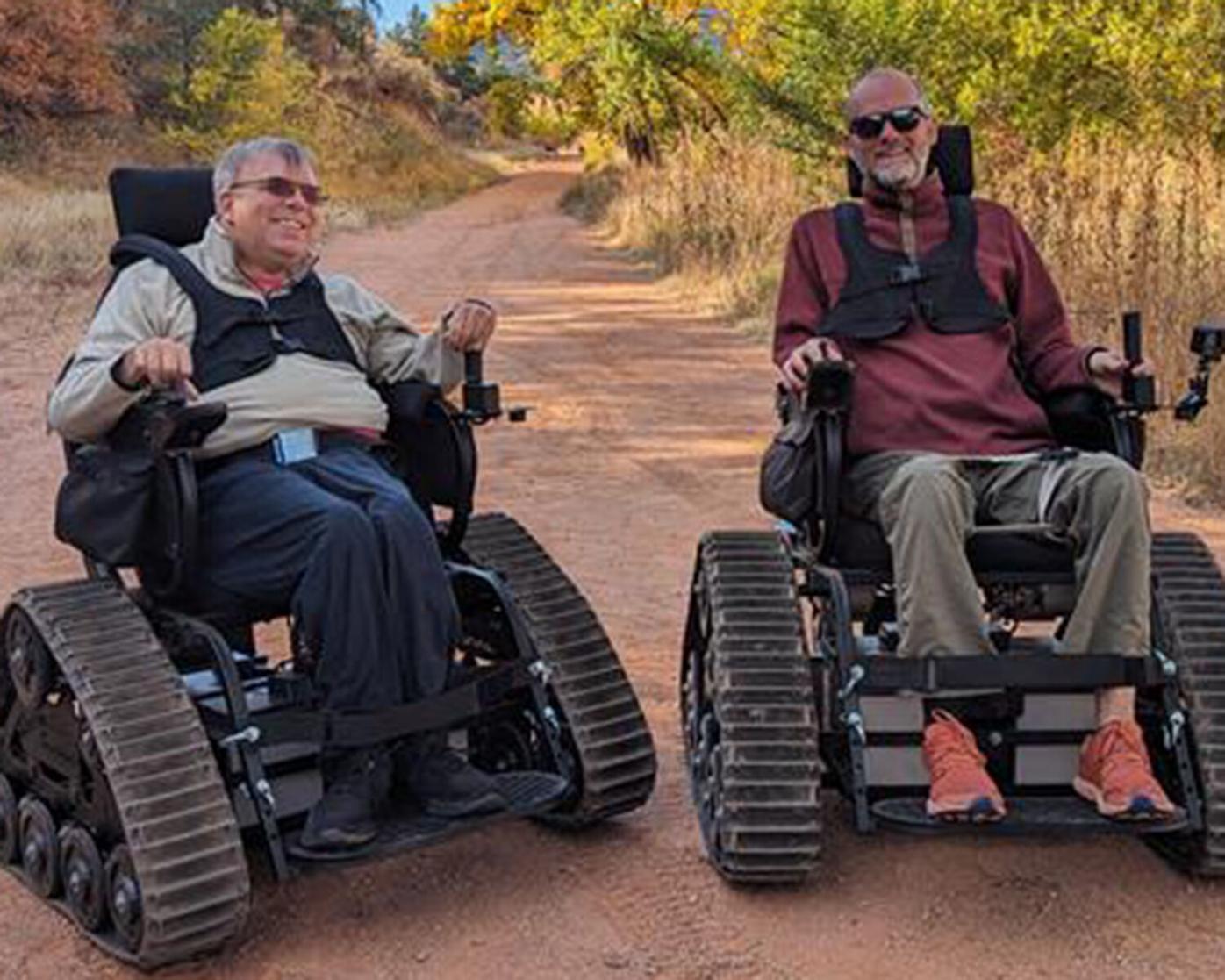
The city and El Paso County also in recent years rolled out trail-access programs, aiming to get people with disabilities on trails previously out of reach. They can roam on a chair perched atop tank-like conveyor wheels alongside friends, family and knowledgeable staff or volunteers at Blodgett Open Space and Red Rock Canyon Open Space.
City Trackchairs
City of Colorado Springs


City Trackchairs
Soft launched in 2024, the city’s Trackchair program has become very popular and is growing, according Jason Crowe, the manager for the city’s Office of Accessibility. This year, the city hired someone dedicated to run the program and now has 200 opportunities for people to use the chairs, a stark difference to the less than a dozen openings from last year.
“That being said, it’s still a mountain state. There are still very many places that are inaccessible,” Ortiz said. “The ADA was a start. It was the beginning of securing our civil rights. But if you look around, there’s still many entities that think it’s optional.”
The picture wasn’t pretty around Colorado Springs 10 years ago, an in-depth report by The Gazette found.
Concrete stairs blocked doorways, sidewalks and curb cuts were often too cracked to navigate in a wheelchair, and disabled parking spaces were not properly marked or were the incorrect size, The Gazette found.
In 2019, the city of Colorado Springs settled a lawsuit that claimed the city’s streets and sidewalks were inaccessible to people with disabilities. As a result, the city agreed to install more than 15,000 curb ramps over the next 14 years.
With a total of 36,000 curb ramps in Colorado Springs, the city has installed or retrofitted more than 20,000 to make them compliant to ADA standards over the past decade. Crowe said the lawsuit was a “wake-up call” that spurred the city to do more. Since 2018, there have been 12,932 completed curbs ramps that are ADA compliant. The city expects to reach the total agreed upon in the suit by 2026.
The fight for making the state more accessible doesn’t stop at adding more ramps. Petrie said it’s also about integration with the community to make a person living with a disability feel just like everyone else.
Settling lawsuit over accessibility for disabled was the easy part; now Colorado Springs has to find the money
“A ramp is important because it gets you into the building, but what happens in the building is what’s significant,” Petrie said.
Diagnosed with autism at 26, Petrie said people with “invisible disabilities” often go overlooked in the conversation and struggle to find a sense of community because of it.
“It might sound silly to some people, but the ability for me to ask for a reasonable accommodation at work to just wear headphones for sensory regulation can literally mean the difference between me keeping my job and me not being able to perform at work properly,” Petrie said.
In recent years, the city of Colorado Springs started having more conversations on how to accommodate for people with these disabilities. Crowe said the city has discussed how to make signage across town more accessible to the visually impaired and is considering adding QR codes on signs so people can access them audibly.
The city is also looking to improve playgrounds by making safer, more private spaces and including tactile and interactive playground equipment for kids with autism.
“We realize there’s more opportunity to do some better things for some of those people with invisible disabilities, but it’s challenging,” Crowe said. “I’ve been in this business for a long time, and it always takes a lot of creative ideas to make things successful.”
New program brings all-terrain wheelchairs to Colorado Springs trails
On a state level, legislators have passed bills that have provided some accommodation for these individuals. During his time at the state capitol as a House representative for District 38, Ortiz sponsored a HB21-1110, which prohibited “a person with a disability from being excluded from participating in or being denied the benefits of services, programs, or activities of a public entity or a state agency.”
Passed in 2021 during the tail end of the pandemic, Ortiz said it helped visually impaired people keep up with work and school when a lot of it was online by mandating that websites and other online tools are made more accessible to them.
Looking forward, both Ortiz and Petrie said there’s still a lot of work to be done around housing, employment and public transportation before equality for the disabled is achieved, adding that it’s a very “crucial” time in America to keep the momentum going.
For Colorado Springs, Crowe said the push on the accessibility end of the conversation has drastically improved from a decade ago. He noted that his office started with one ADA coordinator and no budget and has grown to a team of five with a project manager and a budget they can use to pursue projects.
“(But) we, the city, need to work better on everything. One of the key ways we do that is just listening to people, listening to those stories, listening to what lives they live and what challenges they see and then try to address that,” Crowe said.
El Paso County approves nearly $750,000 contract for ADA consulting services