



Colorado’s hot springs explained: Deep time, deep layers
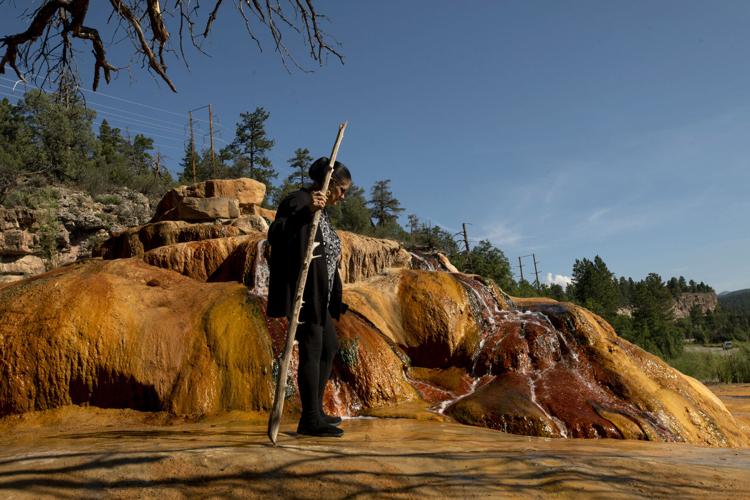
Chancey Bush, The tribune
We soak in Colorado’s hot springs. We feel the sweet relief on body and mind. And we commonly deduce a miracle.
Rather, there is a scientific explanation.
It’s an explanation dealing with deep time and the deep, subterranean layers of the Earth, where water meets minerals we associate with healing qualities.
But we begin in the sky.
“Our hot springs all derive from meteoric water, rain or snow,” says Paul Morgan, a longtime geothermal specialist with Colorado Geological Survey.
That water travels down the mountains to seep through the ground and travel onward through porous rock. The water “percolates down deep, a mile or a couple of miles, where temperatures are hotter,” Morgan says. “Then it comes back up to the surface through natural pathways.”
The water rises along the tilting cracks and fissures of faults that simultaneously serve like a plumbing system and water heater. The faults recall millions of years of shifting, pressurizing and uplifting that resulted in the Rocky Mountains.
It’s that ongoing process and topography to thank for Colorado’s hot springs. It’s the reason why this state and mountainous others produce thermal waters while flatter states do not. (Colorado Geological Survey maintains 93 springs and wells.)
“To get water down into the crust and back up again, you need something to drive it, and that driving force is gravity,” Morgan says.
You need, he adds, the “accommodation zones” of faults. “They either overlap each other or cause gaps,” he says. “It’s through those gaps where water comes up.”
Generally, the deeper that water traveled toward Earth’s scorching core, the hotter it will return.
Springs are thought to be hotter around the state’s southwest San Juan Mountains, the scene of powerful, volcanic activity some 20-30 million years ago.
That’s “young, geologically speaking,” Morgan notes. Volcanic heat is gone from the surface, “but deep down there is some heat left,” he says.
Then there’s the stench around Pagosa Springs, Glenwood Springs and Steamboat Springs. “You can smell sulfur, and that gives people the impression it’s coming out of the hot spring,” Morgan says.
It has to do with the hot water coming into contact with evaporates such as gypsum, calcium and sulfate. The gaseous breakdown is sulfur dioxide, “so you get that bad egg smell,” Morgan says.

PREV
PREVIOUS

Lake George 4H group hosts Paint Party
Facebook Twitter WhatsApp SMS Email Print Copy article link Save Facebook Twitter WhatsApp SMS Email Print Copy article link Save The Lucky Clovers 4-H Club in Lake George is presenting a Hot Cocoa and Paint Party on Feb. 1 at the Lake George Community Center. Two sessions are available; noon and 5 p.m. It’s a […]

Sheriff honors deputies and dispatcher
Facebook Twitter WhatsApp SMS Email Print Copy article link Save Facebook Twitter WhatsApp SMS Email Print Copy article link Save In a ceremony during the Teller County commissioners meeting Jan. 14, Sheriff Jason Mikesell paid tribute to three employees in the sheriff’s office. Dispatch supervisor Tim McMillin received recognition for five years of service. During […]