






Colorado officials highlight $7.2B from infrastructure law as America transitions to Trump presidency
Mary Shinn, The Gazette
Colorado officials on Friday cheered the state getting awarded more than $7.2 billion from the federal Infrastructure Investment and Jobs Act, a move likely meant to highlight how federal dollars have benefited projects in the state as the country transitions to a new presidency.
The act’s future is uncertain under the incoming Trump administration, though some analysis postulated that it would mean a reallocation of priorities within existing frameworks, with Republicans having more sway in how the money is used.
The federal funding is scheduled to expire in 2026 unless reauthorized by Congress. The act allocated money for surface transportation, drinking water, wastewater infrastructure, ports and waterways, airports, and passenger and freight rail.
The infrastructure law and the Inflation Reduction Act could look very different by 2025 under the next presidential administration, political observers said.
On Friday, a statement from Gov. Jared Polis said the infrastructure act has funded 1,000 projects that could create more than 40,000 jobs in Colorado to accomplish transportation, clean energy, clean water, climate resilience, and broadband projects.
Combined with funding from the Inflation Reduction Act, the state has raised almost $8.6 billion. The largest portion, about $2.6 billion, went for roads, bridges, and “major projects.”
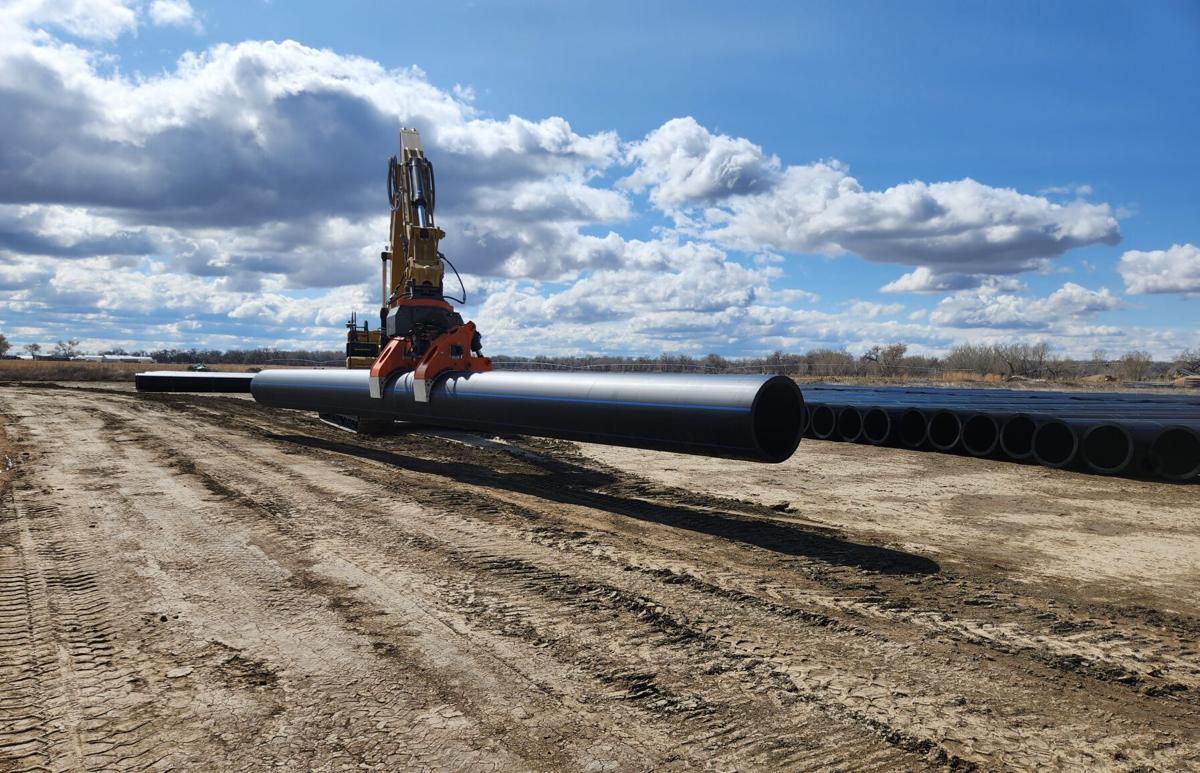
Another $860 million went for water projects, including $250 million toward the Arkansas Valley Conduit that will bring long-delayed clean water to 40 communities in the Lower Arkansas Valley.
Next Friday is the deadline for applications for funding through the second pot of drought mitigation funding under the Inflation Reduction Act. That’s a big date for the Colorado River Conservation District, which is hoping for $50 million to complete the funding needed to purchase the Shoshone water rights held by Xcel.
Funding for drought, wildfire, and flood — which supporters say are parts of efforts to ensure “climate resilience” — totaled $753 million.
In the same statement, U.S. Sen. Michael Bennet said the federal funding is helping Colorado.
“After decades of investing everywhere but the United States, Congress came together three years ago to pass the most significant bipartisan investment in our infrastructure since Eisenhower was President,” he said. “This historic law is helping Colorado communities build roads and bridges, expand broadband access, and improve wastewater infrastructure to keep Coloradans healthy, safe, and connected. There is no state better prepared than Colorado to benefit from these investments and lead the rest of the country into the 21st century.”
U.S. Sen. John Hickenlooper, noting the funding for the conduit and $100 million for improvements along I-70 at Floyd Hill, said the Infrastructure Investment and Jobs Act “has invested in 21st-century infrastructure all over Colorado.”
“That’s only the last three years; we’re not done yet,” he said.
On Friday, the Upper Colorado River Commission announced awarding of $7 million from the infrastructure law to the Colorado Water Conservation Board. The funding is for Colorado water users within the Upper Colorado River Basin that needs a device to measure their water diversions.
Given the results of last week’s election, the future of both acts is uncertain, some said.
At a recent National Conference of State Legislatures gathering, Susan Howard, director of policy and government relations at the American Association of State Highway and Transportation Officials, told the audience, “It remains to be seen if the next bill will be a capital ‘I’ infrastructure bill or a surface transportation reauthorization bill.”
Last September, President-elect Donald Trump told the Economic Club of New York in September he would cancel all unspent funds under the Inflation Reduction Act if elected, according to a report by Politico.
“To further defeat inflation, my plan will terminate the Green New Deal, which I call the Green New Scam,” said Trump, who also called Biden’s agenda a “waste” of money.
“It actually sets us back, as opposed to moves us forward. And (I will) rescind all unspent funds under the misnamed Inflation Reduction Act,” Trump said.
The uncertainty would likely prompt the Biden administration to get those dollars out the door sooner rather than later. The Biden administration has until the presidential inauguration day in January to award those dollars.
The League of American Bicyclists pointed out in an analysis this week that funding for “bicycling, walking and transit projects are not in the federal interest” from the Trump administration. That includes eliminating “Vision Zero,” which the city and county of Denver has launched to eliminate traffic deaths and serious injuries. Eliminating Vision Zero was a stated objective of the Heritage Foundation’s Project 2025.
Democrats, including Gov. Jared Polis, have tied the Heritage Foundation’s Project 2025 to Trump during the presidential campaign.
Trump has repeatedly said the blueprint isn’t tied to his campaign and that he wanted little to do with it. CNN reported in July that at least 140 people who worked for the previous Trump administration had a hand in developing the plan.
Denver has long embraced Vision Zero, which seeks to eliminate serious injuries and traffic fatalities. To achieve that goal, the city has, among other things, reduced traffic lines to give room to cyclists, added on some streets waist-high poles poking up from the pavement called bollards, and broke ground to build center medians that officials said would provide people “safe places to stand when crossing.”
In pursuing these strategies, the city has signaled a preference for cyclists and pedestrians using roadways, while restricting lanes for motorists in certain areas and viewing speed as the culprit.
Meanwhile, some postulated that Republicans can “put their own stamp” on both acts, given the billions of dollars that have gone to their states.
An analysis by the Global Infrastructure Investment Association pointed out that three-quarters of the clean energy funding from the Inflation Reduction Act went to Republican districts.
“Trump can immediately leverage his influence by managing how his administration handles various programs,” the group said. “This could include reallocating funds within existing frameworks, streamlining regulations to speed up project approvals, emphasizing public-private partnerships (P3s), focusing on energy infrastructure such as pipelines and refineries, and potentially directing funds towards border infrastructure as part of his broader immigration policy.”