






Proposed 36-story apartment tower in Colorado Springs: 7 things to know
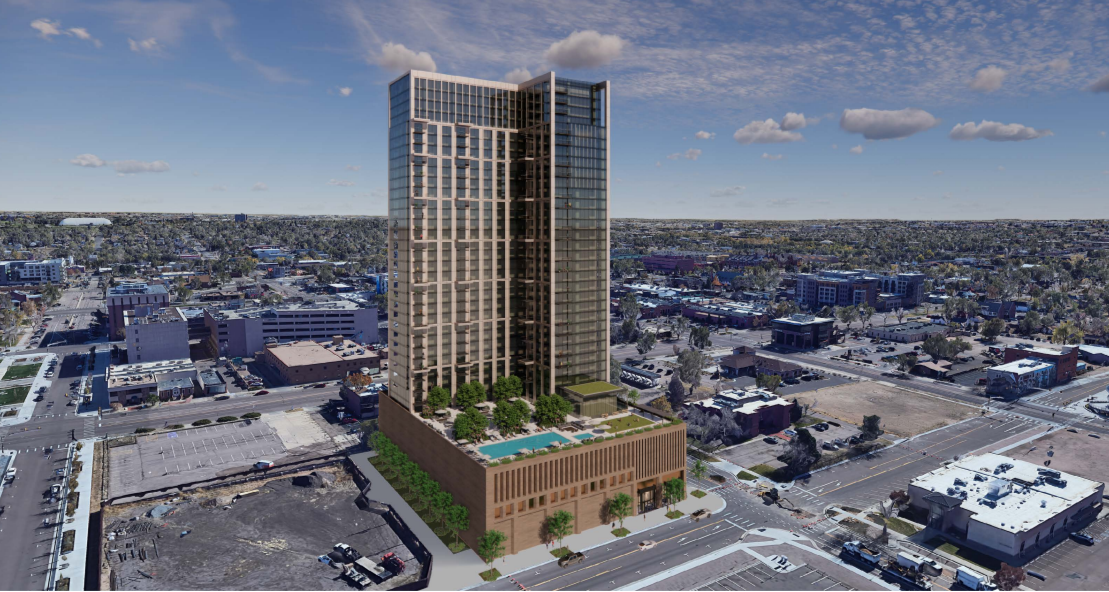
Here’s a closer look at the proposed high-rise apartment building in Colorado Springs.
• In November, The O’Neil Group, a local private equity group, and VeLa Development Partners, a Kansas City, Mo., high-rise, multifamily developer, submitted plans to the Colorado Springs Urban Renewal Authority that proposed a 36-story, 497-unit apartment building, which would be constructed on the southwest portion of a block bounded by Cascade and Vermijo avenues and Costilla and Sahwatch streets in southwest downtown. The project would be called VeLa Peakview.
• At 36 stories, the building would be 350 to 400 feet tall, though it might drop a few floors pending a final design. The downtown Wells Fargo Tower is Colorado Springs’ tallest building at 247 feet.
• VeLa Peakview would include a mix of studio, one-bedroom and two-bedroom apartments, along with a handful of three-bedroom penthouse units; monthly rents would range from $1,817 for a studio all the way up to $9,810 for a nearly 2,500-square-foot penthouse. The building also would include nearly 7,000 square feet of ground floor retail space; five levels of parking with almost 500 spaces and electric vehicle charging stations, with 10% of the spaces open to the public; and approximately 41,000 square feet of indoor and outdoor amenities, such as a fitness center, a conference room an indoor/outdoor bar and indoor/outdoor party room, a resort style infinity edge outdoor pool, grilling stations, dog runs and dog wash stations, a spa/hot tub and massage/lifestyle treatment rooms.
What’s next
• The O’Neil Group and VeLa Development Partners are seeking an urban renewal designation for the site of their proposed 36-story apartment high-rise; that designation would allow increased property and sales tax revenues generated by the new project — known as tax-increment financing or TIF — to be used to help fund the project. Without that financial assistance, The O’Neil Group and VeLa Development have said their project wouldn’t be feasible. Urban renewal designations and TIF revenues serve as incentives to encourage redevelopment of blighted areas, which otherwise would stand idle. In general, TIF revenues are used to fund public improvements at an urban renewal site, such as sidewalk, utility, road and parking upgrades. At the same time, the Urban Renewal Authority could authorize TIF revenues to be spent on other building-related costs.
• The site of the proposed 36-story apartment tower already has been determined to be blighted, according to a consultant’s conditions study that took place after an original 25-story apartment building was proposed for the property in 2021; the blight finding is one step in the process of developers securing an urban renewal designation for the property. Next up: a consultant hired by the Colorado Springs Urban Renewal Authority is expected to present the panel with a financial analysis that estimates how much sales and property tax TIF revenue the project would need for it to be viable; an impact study to estimate how much tax revenue the apartment building site generates now and how much it’s likely to produce over 25 years; and a draft plan that would spell out project details. The authority would review those documents and decide, possibly at its June meeting, whether to approve them. That approval would trigger a state-required process, in which the Urban Renewal Authority would request local governments who collect sales and property tax at the apartment tower site to pledge all or portions of their future tax revenues to help pay project costs.
• Ultimately, the Colorado Springs City Council must approve an urban renewal designation for the apartment tower site and sign off on the use of TIF revenues for the project. It’s possible the City Council won’t consider the urban renewal designation until late 2024 or early 2025.
• The O’Neil Group and VeLa Development haven’t yet submitted their 36-story apartment tower project to the Colorado Springs planning staff for review; it’s uncertain when that might happen. Once the developers decide to move forward, they must submit a development plan and subdivision plat, which would go through the city’s standard application process. Under the city’s form-based code that regulates downtown development, the apartment tower — or any project that meets the code’s development standards — can be reviewed and approved administratively by the city planning staff. That administrative action could be appealed to the Downtown Review Board, a nine-member, City Council-appointed panel that oversees development applications made under the form-based code. In turn, any Downtown Review Board decision could be appealed to the City Council. At the same time, if a project being developed within the downtown form-based zone requires a conditional use permit or if its developers are seeking relief from development standards, a public hearing would take place at the Downtown Review Board, whose decisions could be appealed to the City Council.
— Gazette research
