






Colorado Springs nonprofit works to improve standard of living in Asian and African countries
A little-known Colorado Springs nonprofit that strives to build people instead of building roads and other infrastructure is having a big impact in improving the standard of living in developing nations in Asia and Africa.
Resource Exchange International — REI — was launched in 1990 by three executives of another Colorado Springs nonprofit to train future business and other leaders living in economically distressed Eastern Europe countries controlled by the former Soviet Union. After the Soviet Union dissolved in late 1991, REI began to provide administrative help for agricultural survey work in the former Soviet republic of Kazakhstan.
Headquartered in Colorado Springs since its launch, Resource Exchange International shifted its focus to Vietnam in 1992; future REI executive Doug Sparks, who had lived in Vietnam while working for the other nonprofit in the 1950s, dreamed of returning there after he successfully battled cancer.
Sparks led a team of 20 education and agricultural professionals to ask the Vietnamese government what it needed to develop what was then one of the world’s poorest countries still emerging from decades of war.
“Doug came back from that trip with all kinds of ideas for Vietnam. They (government officials) liked our mission — building people to build nations — and over and over again we found that approach is welcomed by people we want to help,” said Paul Ronka, REI’s first president. “People are the most important resource — we don’t build buildings or practice medicine — we train doctors, English teachers and business owners so they can be more effective.”
That first trip led to REI’s strategy of building professional expertise in Vietnam by training future leaders in education, agriculture, medicine and economics.
Since then, the organization has sent 574 professionals to Vietnam for 1,259 short-term visits, with more than two-thirds of them traveling to the country to provide medical training. Another 31 REI staff members served a year or more in the country, while the organization brought 123 Vietnamese medical personnel and business educators to the U.S. for training.
“We were one of the first nonprofits in Vietnam, so when the U.S. Embassy arranged a briefing for the Peace Corps with nonprofits in Vietnam on how to work there, six of the eight (presenters) were from our staff,” said Brian Teel, REI’s senior vice president and director of resource development. “We started with business professionals making short-term trips, but expanded to medical, agriculture and veterinary as well as teaching English.”
REI’s programs grew quickly in Vietnam and the nonprofit soon was approached for support from people wanting to start similar programs in China, Eastern Europe, Indonesia, Mongolia and Russia.
The organization added programs in Morocco, Uzbekistan, Kyrgyzstan and nations in the Persian Gulf in the late 1990s and Djibouti, Cuba, Jordan, Laos, the Philippines and Egypt before the Great Recession. REI has vacated some nations because of political instability or when its development work no longer was needed.
The nonprofit, which now operates in eight African and Asian nations, plans to expand to another country this year, though officials didn’t identify it for security reasons. They also hope to expand to as many as 10 more countries in the next five years.
Resource Exchange International no longer has ties to the other nonprofit and is not connected to The Resource Exchange, a local nonprofit providing support to those with intellectual and physical disabilities.
“I think it is realistic to look at expanding to at least one new country every year,” Teel said. “If a doctor comes here and can observe a surgery, they pass it on and use it in both their public and private practice. That is what we want (to do) in the rest of the world — to train people to pass on the training” that REI facilitates.
REI now has about 35 staffers worldwide and an annual budget of nearly $3 million to support teams of business executives, educators, medical professionals and agricultural experts on short-term visits to train professionals in those countries, who then pass on what they’ve learned to others.
The nonprofit’s staffers also operate a school in Djibouti to teach English and a factory in Indonesia that dries fruit. They also teach natural childbirth in Egypt.
While making dozens of short-term visits to other nations, REI staffers have brought with them the former medical director of Memorial Hospital’s pediatric operations and a University of North Carolina at Chapel Hill professor of otolaryngology, who both returned many times to Vietnam.
Most REI volunteer professionals come from the U.S., but the organization also gets volunteers and staff from Canada, England, the Philippines and Singapore, where it opened a recruiting office last year.
“We have to help them (team members on short-term visits) understand what REI does, train them to work overseas and make sure they have a skill they can transmit; many of our team members have advanced degrees,” Ronka said. “We bring professional help and personal hope. We are meeting people’s needs by building friendships and relationships — I call them bridges of trust. We see a transformation in people’s lives.”
Colorado Springs entrepreneur Loren Lancaster is one of those volunteers. He heard about REI in 2015 through a friend who introduced him to Teel.
Lancaster agreed — reluctantly at first — to visit Vietnam and teach a business course at a college there. Once there, however, he fell in love with the food — and especially the people.
“I didn’t really understand it, but felt something unique, interesting and valuable,” Lancaster said. “I went a second time and now I live half my life in Colorado Springs and half in Vietnam. That (first visit) inspired me to start a company (called the Noble Network) that enables U.S. and Vietnamese companies to work together and build trade relationships. REI made it all happen.”
Noble Network provides financial strength and skills to Vietnamese firms and helps them develop business relationships with dozens of small- to mid-sized companies from the Colorado Springs and Denver areas, Lancaster said.
Lancaster’s business currently is working on seven projects in Vietnam, helping companies such as Colorado Springs-based Avant Garde Art Glass to establish markets in the country and work with Colorado construction firms to ship materials to build tiny homes there.
Teaching in Vietnam is the first stop for many REI volunteers.
Paul Yankey, a former technology executive who now teaches marketing at the University of Colorado Colorado Springs began as a volunteer making trips to Vietnam and several other countries before joining REI’s board and becoming chairman. This year, he also joined the nonprofit’s staff as chief advancement officer and will replace Teel when he retires in May.
Yankey’s passion is developing business and educational ties between businesses in the U.S. and Uzbekistan, a former Soviet republic in central Asia north of Afghanistan. He wants to build a partnership between UCCS and the new Samarkand International University of Technology in Uzbekistan’s third-largest city that eventually could include an exchange OF students and faculty, primarily in engineering and business.
“After interacting with students and businesses (in Uzbekistan), there is great opportunity and I expect to start seeing call centers and other employers there because the population has English fluency and there are few barriers to doing business,” Yankey said. “The economy is moving from state ownership to privatization and (the government) would love to have foreign investment. I want to do what I can to help move that forward.”
Yankey and high school friend, Jonathan Henick, who became the American ambassador to Uzbekistan in 2022, are promoting closer business ties between the two countries and opportunities for more trade between both nations.
Yankey plans another visit to Uzbekistan this year as a trade mission from Colorado, and will hold an informational meeting at 5:30 p.m. March 21 at the UCCS Downtown Campus, 102 S. Tejon St., Suite 105A. To register, go to https://www.paulyankey.com/event-details/uzbekistan-awaits.
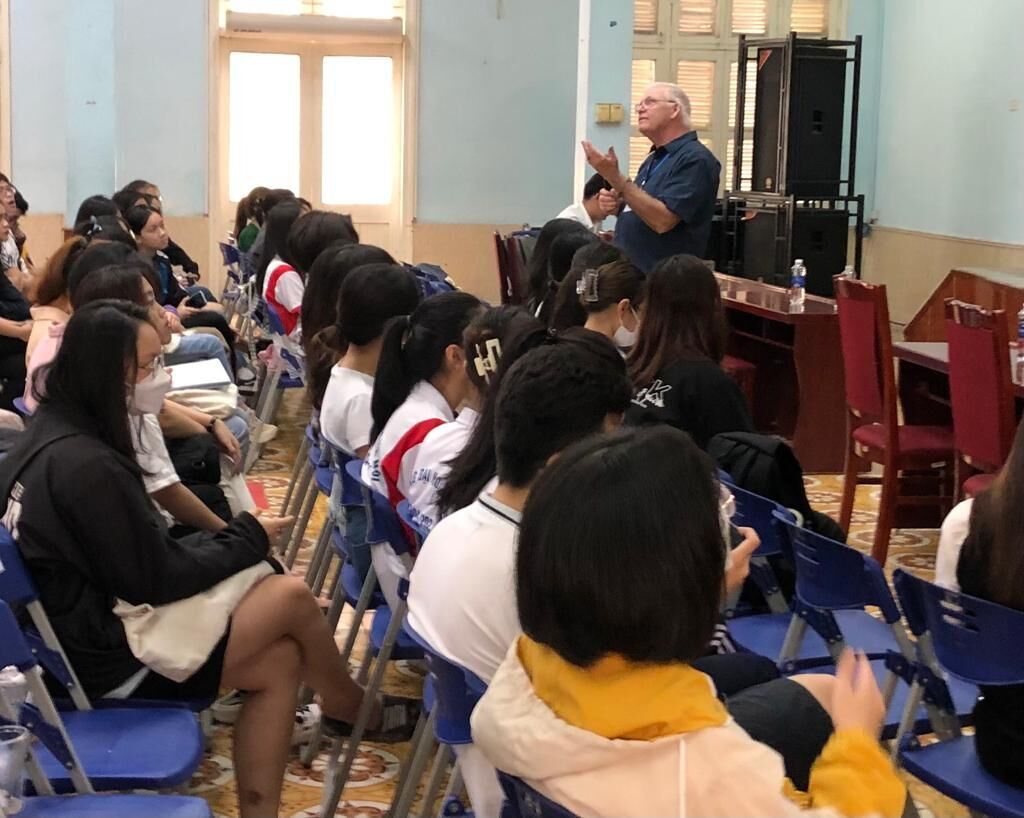
Terry McHugh, a board member of the Colorado Springs-based Resource Exchange International, leads a business team to Vietnam in October 2022.
Jill Vernon, a staff member of the Colorado Springs-based Resource Exchange International, works at the Samarkand International University of Technology in Samarkand, Uzbekistan. The nonprofit Resource Exchange International works to train and educate professionals in other countries with a goal of improving the quality of life in developing nations in Asia and Africa.
Medical students in Darkhan, Mongolia, are taught English as part of the work by the Colorado Springs-based Resource Exchange International, a nonprofit that to train and educate professionals in other countries with a goal of improving the quality of life in developing nations in Asia and Africa.
