






PRINT Critics blast Colorado Springs’ migrant response plan as vague ‘no plan’ (copy)
A document about undocumented immigrant response that the Pikes Peak Regional Office of Emergency Management presented to Colorado Springs City Council last week created confusion and produced criticism from some elected officials who cited it as being short-sighted.
“I am quite frankly shocked that this was supposedly months of planning. … There is no plan. There is no plan in that framework,” El Paso County Commissioner Carrie Geitner said at a meeting Tuesday.
The “City of Colorado Springs Migrant Response Framework,” dated Feb. 26, was not intended to be a strategic plan but rather a basis from which the city can develop a plan, said Andrew Notbohm, regional emergency management and recovery director for the Pikes Peak Regional Office of Emergency Management.
“It was put together for decision points to then go into an operational plan, if need be,” he said.
The one-and-a-half page document intentionally lacks the operational components and organizational structure that would be included in a plan of action, Notbohm said.
He reviewed the information with City Council at a meeting Monday. Some City Council members, including Dave Donelson, called the document “vague” and not useful.
Mayor Yemi Mobolade posted on X, formerly Twitter, that the document was the result of months of planning by five teams: a policy direction group that Mobolade headed, a coordination group that assessed and supported local nonprofits, a liaison group to state and federal agencies, a public safety group and a public information group.
“The community deserves for its leaders to plan ahead for any number of possibilities, which is why (the Pikes Peak Regional Office of Emergency Management) published the document and presented it to City Council,” the city posted on X on Monday.
Although Notbohm’s office covers jurisdictions that encompass the city of Colorado Springs and unincorporated El Paso County, the document produced solely for the city, and the county is not part of the planning effort, according to Jamie Fabos, chief of staff.
“It is intentionally a city plan,” she said at the meeting when questioned if the county was sharing a role in how the issue of migrants might be handled.
El Paso County spokesman Vernon Stewart said he didn’t want to speculate as to whether county leaders in the future would join in the emergency migrant planning.
County commissioners and City Council members recently approved separate resolutions declaring El Paso is not a sanctuary county and Colorado Springs is not a sanctuary city for undocumented immigrants crossing the United States’ southwest border.
The actions came after reports that a busload of immigrants had arrived in Colorado Springs from Denver and were staying at the Salvation Army’s Family Hope Center, the city’s only homeless shelter for families.
While county commissioners said they did not want nonprofit organizations to assist immigrants who entered the country illegally, nonprofits such as the local Salvation Army have said they would follow their mission to help anyone who shows up in need at their door.
Fabos said the city “does not and would not direct the mission of a nonprofit, especially a private nonprofit.”
Geitner and Commissioner Stan VanderWerf said last week that illegal immigration is the No. 1 issue among their constituents, based on conversations they have had with voters during their campaigns. Geitner is running for reelection on Nov. 5, and Vander-Werf is vying for a seat in the state Senate.
Geitner expressed frustration with the federal government’s and the city administration’s response to the issue, saying the mayor’s office is trying to downplay it.
“While finally we are getting the mayor’s office to acknowledge that it is more of a problem, there is still a concerted effort to try to obfuscate from the mayor’s office,” she said.
Colorado Springs has not seen the influx of new immigrants as Denver has, Notbohm said. Nearly 40,000 immigrants have sought assistance at Denver’s processing center in recent months, he said. Ninety-five percent were processed at the border, Notbohm said, though it’s unclear how many were issued alien identifications.
It is also unknown how many immigrants have come to Colorado Springs, he said, but gauging from nonprofits that provide services to transients, the numbers have been small, perhaps a few hundred.
Some nonprofits are reporting an increased demand for food, shelter and clothing, the framework states, adding, “However, not all can be directly attributed to migrants.”
“We do not have a clear picture,” Notbohm said. “Everybody is looking for the same information, and nobody has it except Denver, which has a process in place.”
Ryan Trujillo, Colorado Springs’ deputy chief of staff, said at the council meeting, “Without some type of Orwellian or dystopian measures, we can’t track the numbers of migrants we have.”
An “organic flow” of immigrants from Denver to throughout the state could occur, Notbohm said, as migrants living in temporary shelters in Denver time-out of their allowed stay.
Denver’s mayor announced last week that the city will close four shelters over the next month to reduce expenses, consolidate space, and will help migrants obtain housing and work permits, or pay for their transportation to another destination.
Also, Notbohm said, as the November election draws closer, national experts project significant surges of border crossings.
But Colorado Springs “does not have the ability to provide long-term shelter” for immigrants, Notbohm said.
Officials from the city and county of Denver have said they will notify the Pikes Peak region governments of “any efforts to rent additional hotel space outside” of the metro area.
Denver officials have said their cost to provide shelter, food and services is $750 a week per migrant. Of the nearly 40,000 arrivals in Denver, 20,000 have received transportation to go elsewhere, Notbohm said.
He noted that the situation has put a strain on hospitals in Colorado Springs, which say the problem isn’t only newly arrived immigrants.
While hospitals in the CommonSpirit Health system, which includes Penrose-St. Francis Health Services in Colorado Springs, do not track whether patients are immigrants and never turn away anyone who seeks care, hospitals and clinics have “seen a 65% increase year-over-year in uncompensated or charity care for our region,” said Becky Brockman, field communications advisor for Colorado, Kansas and Nevada.
That’s due to “an unprecedented wave of uninsured patients,” she said.
However, Brockman said CommonSpirit “cannot attribute the increase in uncompensated care to the migrant issue alone,” since nearly 550,000 Coloradans were disenrolled from Medicaid coverage as of January, as the federal public health emergency for COVID-19 ended.
Only 2% have requalified for Medicaid through CommonSpirit hospitals, Brockman said.
According to the migrant response framework, an emergency coordination call with city leaders and nonprofits would ensue to determine next steps and processes if one or more of these events happen:
• A significant and uncoordinated or unplanned surge of migrants enter the Pikes Peak region,
• Spontaneous tent encampments spring up,
• Public health identifies a communicable disease outbreak,
• Demand for shelter and other basic necessities from migrants exceeds the community’s capacity, or,
• Notification that local hotels are being contracted for sheltering migrants.
Notbohm said he did not have specifics on what would constitute a “significant surge” or the amount of demand that would trigger action.
Gazette reporters Mary Shinn and Breanna Jent contributed to this article.
Contact the writer: 719-476-1656.
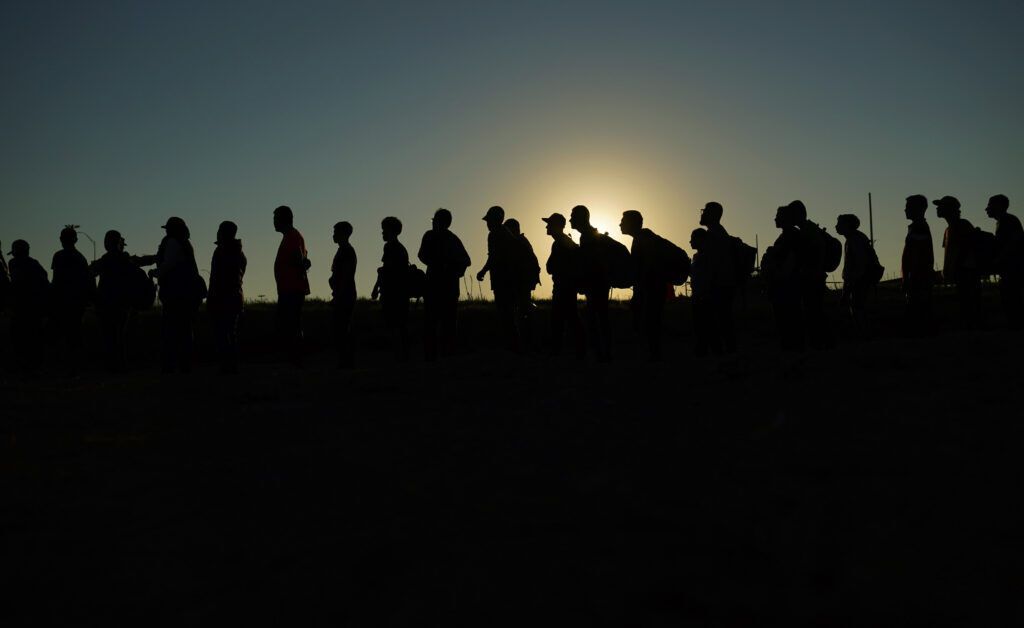
Migrants who crossed the Rio Grande and entered the U.S. from Mexico lined up for processing by U.S. Customs and Border Protection last year in Eagle Pass, Texas.
