






Case against district judge in Adams County allegedly “slow-walked” to discipline commission
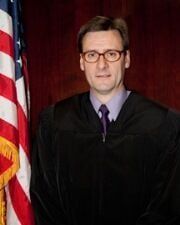
A second judicial discipline case, that of 17th Judicial District Judge Robert Kiesnowski Jr. who resigned last year, has key connections with Colorado Supreme Court Chief Justice Brian Boatright, according to documents and interviews.
Despite promises by Boatright to state legislators in 2021 that he would monitor all complaints of judicial misconduct personally and ensure they’re handled promptly, the state’s discipline commission said the Kiesnowski case took months to reach it and then languished for another two years before action was taken.
In that case, Kiesnowski, whose courtroom was in Adams and Broomfield counties, agreed to resign after admitting to a campaign of harassment and retaliation that lasted for years against a court clerk who had begun complaining to her courthouse superiors about his conduct as early as 2016.
Kiesnowski had accused his courtroom clerk, Emily Betz, of talking behind his back about an extra-marital affair he was having with another courthouse employee who was Betz’s supervisor and who eventually became the judge’s wife, according to public discipline records.
Kiesnowski embarked on a protracted campaign to harass Betz, including efforts to prevent her from speaking to anyone while working her courthouse job for him, public discipline records show.
Although Betz’s superiors took her concerns to the upper levels of the Judicial Department, they never made it to the discipline commission, people familiar with those events said.
When the harassment didn’t stop — Kiesnowski’s paramour was not transferred to a different judicial district as personnel rules required — Betz filed her own complaint with human resources within the Judicial Department’s State Court Administrator’s Office in May 2021, documents reviewed by The Denver Gazette show.
However, the discipline commission said in public documents that her complaint was not to them until August 2021 — roughly four months later, an assertion SCAO denies.
In February 2021 — three months before Betz filed her complaint to the SCAO, which answers to the chief justice — Boatright told a joint gathering of both houses of Colorado’s General Assembly that he would personally monitor all allegations of judicial misconduct across the state.
Betz’s complaint would have been one of them.
Boatright made the announcement just two weeks after newspaper reports exposed a multi-million-dollar contract that had been given to a high-ranking Judicial Department employee who faced firing. It was allegedly to silence the employee’s threats of a tell-all sex-discrimination lawsuit exposing years of undisclosed judicial misconduct. The allegations were laid out in a two-page memo the Judicial Department kept secret until the newspaper stories appeared.
“The branch takes allegations of misconduct by judges and staff extremely seriously,” Boatright told the legislators on Feb. 18, 2021, in response to the newspaper stories.
Then, referring to the memo, he told the General Assembly: “We need to know if human resources investigated any of these allegations, and if they did, what action was taken. And if they didn’t … we need to know why.”
Named chief justice just seven weeks earlier, Boatright called for a special investigation into the memo and its allegations of covered-up or soft discipline against judges.
“Until the investigation is completed and any recommendations are implemented, I am to be made aware of any new allegations of misconduct and kept appraised of the progress of any investigation on a weekly basis,” he said.
Two days before his General Assembly speech, Boatright issued a statement that said he had made a department-wide order that he get the weekly updates “to ensure each (complaint) is fully investigated and acted on as appropriate without delay.”
Boatright told The Denver Gazette he has maintained that vigilance.
“After I committed publicly to ensuring all complaints are appropriately routed to the Commission on Judicial Discipline, I have recused on every disciplinary matter before the Supreme Court when I have learned information in my capacity as chief justice,” he said in an email statement.
The independent investigations into the memo were not made public until June 2022 — a year after Betz had filed her complaint to SCAO.
In the months following Boatright’s speech, the Supreme Court and the discipline commission tangled over several issues involving their investigation into the memo scandal. As a result, Betz’s complaint languished for two years.
Finally, in March 2023, Kiesnowski agreed to resign in July that year, but for reasons that would remain secret from the public.
Just before he was to retire, however, the discipline commission found Kiesnowski had helped a family member during an unrelated criminal investigation, another violation of the rules of judicial conduct that prohibit sitting judges from working as attorneys.
It was over that misconduct the commission in October 2023 publicly asked the Supreme Court to admonish Kiesnowski. But in doing so, the commission also revealed the details behind the earlier private sanction behind his resignation. Those details implied the earliest allegations of misconduct against Kiesnowski from 2016 had been covered up.
The discipline commission’s recommendation also revealed that the chief judge and court administrator in the 17th Judicial District where Kiesnowski worked were aware of his extramarital relationship but did not transfer his girlfriend as was required nor reported the infraction to the commission, according to a copy of the document obtained by The Denver Gazette at the time the document was made public.
The commission also revealed that the 17th district’s court administrator had actually written SCAO officials in 2018 about the judge’s personal relationship and raised concerns about suspected violations of judicial conduct rules and potential criminal misconduct. That letter, the commission said, was never forwarded to them.
Lastly, the commission noted in its public recommendation for discipline how Betz’s complaint in 2021 took months to reach them, implying that Boatright would have known about it and, despite his promise to legislators for swift action, it languished nonetheless.
Boatright would not comment about any matters before the commission and said he has properly recused himself from any discipline cases brought to the Supreme Court when necessary.
State Court Administrator Steven Vasconcellos told The Denver Gazette the matter was actually shared with the commission on July 1, 2021, and the commission’s executive director at the time asked for the SCAO to gather additional information, which it did. The entire matter was then handed over in August, Vasconcellos said.
“Your understanding of the timing is incorrect,” Vasconcellos wrote The Denver Gazette. “The Commission has not communicated any concerns to me about the timing of our referral in this matter.”
Within days of the commission making its recommendation public, the Supreme Court ordered it to remove it from the commission’s website and, more specifically, to delete from any resubmission it would make the four paragraphs that described the delay for Betz’s complaint to make it to the discipline commission, as well as any reference that Kiesnowski’s misconduct wasn’t reported to the commission years earlier.
Boatright recused himself from participating in that Supreme Court order, records show.
The commission asked the court to reconsider its order to remove references to Kiesnowski’s private discipline, arguing it was an unprecedented — and likely unconstitutional — censure of the commission’s public recommendations for judicial discipline, records show.
The commission did not, however, ask the court to reconsider its order to remove its allegations of a cover-up, records show.
The court agreed and Kiesnowski’s previous discipline remained on the record, according to the court’s order. The cover-up and slow-walk allegations, which the court called “irrelevant” and “unproven assertions,” however, remained deleted, records show.
Boatright did not participate in that decision, either.
District Court Judge Robert W. Kiesnowski Jr.
Timothy Hurst Colorado Supreme Court Chief Justice Brian D. Boatright looks on during oral arguments of the Arnold R. Martinez v The People of the State of Colorado case during Courts in the Community on Thursday, Oct. 26, 2023, at Gateway High School in Aurora, Colo. (Timothy Hurst/Denver Gazette)
Scott Crabtree/Grand Junction Sentinel/Pool Colorado Supreme Court Justice Brian Boatright listens to oral arguments Thursday, May 4, at Colorado Mesa University in Grand Junction.
From left, Colorado Supreme Court Justice Monica Márquez, Chief Justice Brian Boatright and Justice William Hood III listen to an argument during a Courts in the Community session held at Pine Creek High School in Colorado Springs in 2022.