






Cheyenne Mountain Zoo celebrates milestone in efforts to help at-risk species
Cheyenne Mountain Zoo has raised more than $5 million toward driving conservation efforts, one quarter at a time.
The zoo in Colorado Springs announced a major milestone Tuesday in its fundraising goal of helping wild animals in wild places through its Quarters for Conservation Program.
“(We wanted) every guest that came into the zoo to immediately vote and engage with all of the animals that they could help us conserve,” Cheyenne Mountain Zoo President and CEO Bob Chastain said.
Since the program’s start in 2008, each patron of the Cheyenne Mountain Zoo has assisted in achieving this goal by placing the three quarters received alongside their ticket into one of the designated voting booths inside the zoo’s entrance.
Feisty, sunbathing diggers: Meet the meerkats at Cheyenne Mountain Zoo
Zoo visitors can choose a beneficiary species that their 75 cents will go toward assisting. The species include giraffes, orangutans, Panama frogs, African elephants and rhinos, Amur tigers, Wyoming toads and locally — the black-footed ferret.
Inspired by similar programs in Boise, Idaho, and Portland, Oregon, Quarters for Conservation works to involve Cheyenne Mountain Zoo patrons in its conservation efforts as soon as they step foot in the facility.


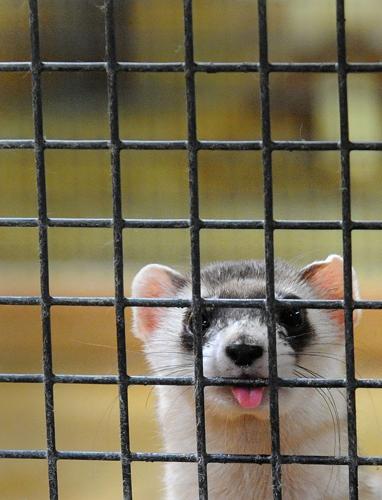
This black-footed ferret is among those that were released.
“For the first time, a zoo visit could directly benefit animals in the wild,” Chastain said.
Over 20,000,000 quarters have passed through the voting booths in the past 15 years, contributed by the 800,000-plus guests the zoo sees annually, according to Chastain.
How Cheyenne Mountain Zoo animals were impacted by the polar vortex
While much of the money raised goes to a variety of conservation organizations around the world, two of the beneficiary species — the Wyoming toad and black-footed ferret — receive direct assistance from the zoo through its breeding and reintroduction program.
According to Jeff Baughman, one of the zoo’s field conservation coordinators, the black-footed ferret is the only ferret native to North America, finding their homes amid the grassy prairies throughout the U.S., Canada and Mexico.
“These guys are, I would say, an American icon,” Baughman said.
While they were first discovered in 1851, Baughman said the species faced a rapid decline due to agricultural development that infiltrated its habitat, and the simultaneous decline of the prairie dog, which the ferrets rely on for food.


Zoo officials release a black footed-ferret back into the wild as part of their conservation efforts funded by the Quarters for Conservation project.
“They (black-footed ferrets) live on prairie dogs and their decline is due to human interaction” Baughman said.
Since 1991, Cheyenne Mountain Zoo has operated as one of the six black-footed ferret breeding facilities that are working to reintroduce the species to their natural, historic habitats.
Since the program’s start more than three decades ago, 610 black-footed ferrets have been born at the zoo. While half of the ferrets born at the zoo have been reintroduced to their wild habitats, the other half remain at the zoo for future breeding as a way to keep certain generations of genes of ferrets for future breeding and reintroduction.
An elusive, wild family unit: Meet the Mexican wolves at Cheyenne Mountain Zoo
“We raise the kits, they’re born in captivity and they go through pre-conditioning. They’ll then go through boot camp, which is in Fort Collins, where they learn how to hunt and survive before they get reintroduced to the wild,” Baughman said.
Rouge, the Cheyenne Mountain Zoo’s forward facing black footed ferret is enjoying her lunch Tuesday afternoon. Rouge represents one of the zoo’s many conservation projects, working to breed and reintroduce the ferrets back to their natural habitats in the Colorado prairies. pic.twitter.com/6ogaBeRdqj
— Abbey Soukup (@AbbeySoukup2) February 27, 2024
Described by Chastain as a “pioneer in the field,” Baughmaf has fostered a series of unique practices to assist in the wild repopulation of the black-footed ferrets in Colorado.
“Some of the things that we look at is how can we make the ferrets hardier,” Baughman said.
According to Baughman, the ferrets are given a plethora of enrichment activities to help them foster motor skills and agility to avoid predation in the wild.
Additionally, the ferrets are introduced to live prey at a very young age to teach them how to hunt, where they’ll eventually transition to learning how to hunt prairie dogs in the preconditioning pens at the zoo.
“Another thing we look at is the complexity of their burrow system. One thing that we joke about is it’s like, “’Tom and Jerry’ on the prairie.”
“When the ferrets are hunting at night, the prairie dogs are asleep. When the ferrets are sleeping during the day, the prairie dogs will pack dirt and trap them in their burrows. They need to learn how to explore and maneuver.”
Once the ferrets are ready to be released, they are brought to one of the 41 reintroduction sites across North America — six of which are in Colorado.
“Being able to focus on a local native species is important to demonstrate and set the example that conservation can be here, in our region, but we can also continue that action throughout the rest of the world,” Baughmaf said,
As the Cheyenne Mountain Zoo is just two years shy of celebrating its 100th anniversary, Chastain said he’s excited to see where the zoo’s conservation efforts will continue to help the wild world in the future.
“I have more hope for the natural world than I have ever had before. While nature is still endangered there’s plenty of good news if you look around,” Chastain said, citing the debated reintroduction of wolves in Colorado in recent months and the reintroduction of wild moose in the 1970s.
“There’s still work to do, but if we give nature half a chance it will continue to surprise us.”
Editor’s note: The Cheyenne Mountain Zoo will celebrate its 100th anniversary in 2026. An adjustment has been made to this report to accurately reflect this information.
