






Colorado officials look to expand state’s semiconductor industry
Colorado economic development officials have big plans for expanding the semiconductor industry, fueled by federal funding from legislation enacted in 2022 and a series of incentives approved by state legislators last year.
Chip manufacturers and suppliers in the state could land $780 million to $1.2 billion in grants and tax credits through the Creating Helpful Incentives to Produce Semiconductors (CHIPS) and Science Act, said Daniel Salvetti, semiconductor industry manager for the Colorado Office of Economic Development and International Trade. The legislation is designed to provide financial help for chipmakers to move more production from overseas to the U.S.
His estimate is based on semiconductor companies operating in Colorado making up 2% to 3% of the industry, thus potentially landing that percentage of the $52.7 billion available from the CHIPS Act for U.S. semiconductor research and development, manufacturing and workforce development. Colorado’s share of the industry is based on employment and the number of semiconductor facilities in the state as a percentage of the national totals.
Based on that forecast, Salvetti estimates the CHIPS Act grants and tax credits would generate $5.2 billion to $7.8 billion in private investment and 840 to 1,260 jobs at semiconductor plants, research operations and suppliers in Colorado. He expects those jobs would support an additional 5,600 to 8,400 workers through semiconductor industry employees spending on everything from groceries and restaurant meals to home and vehicle purchases.
“This is a once-in-a-generation opportunity,” Salvetti said in an interview. “The federal government is pouring trillions of dollars into expanding (U.S.) productive capacity through the CHIPS Act, the Inflation Reduction Act and the Infrastructure Investment and Jobs Act. The state is poised to grow from that investment. We know some of that investment will come to Colorado and that will produce more jobs — high-skill, living-wage jobs you can make (into) a career.”
Previously announced Colorado projects that have sought CHIPS Act help would exceed Salvetti’s jobs forecast — if those projects win federal funding, are completed and fulfill current hiring plans. The projects include expansions in Colorado Springs by chip manufacturer Microchip Technology and industry supplier Entegris as well as plans by Swiss solar manufacturer Meyer Burger to convert a former Springs semiconductor plant to manufacture solar cells. Combined, the companies would create more than 1,300 jobs.
The Colorado Economic Development Commission, meanwhile, last month approved tax credits for Project Silver Lode, described in a document from the economic development office as “a Colorado company that produces materials within the semiconductor supply chain.”
The document said the company is based in Jefferson County and employs more than 5,000 people in 70 countries. The description matches CoorsTek, a Golden-based manufacturer of technical ceramics, and Project Silver Lode was represented at the commission meeting by CoorsTek’s global marketing communications manager.
The company behind Project Silver Lode plans to spend $65 million to retrofit and equip two buildings to produce ceramic powder that is used in equipment that transports wafers while they are being manufactured into semiconductors, according to the document. The firm expects to hire 42 people during the next eight years at an average salary of $77,567 and is considering whether to expand in Jefferson County or South Korea, the document said.
There also are CHIPS Act projects in the planning stages but haven’t been announced by InnovaFlex Foundry in Colorado Springs and Broadcom in Fort Collins.
InnovaFlex applied for an unspecified amount of CHIPS funds for an expansion in Colorado Springs, Arizona or New York, while Larmer County commissioners in December approved a letter supporting Broadcom’s application for an unspecified amount of CHIPS Act funds to expand its Fort Collins plant.
Salvetti said other semiconductor companies in Colorado are considering expanding existing operations and two chip firms outside the state are looking at building plants in the state, but he declined to identify them because those companies have asked his office to keep their identities confidential. The Economic Development Commission is expected to consider offering incentives for another chip company at its March meeting.
The commission has approved tax credits linked to hiring for Microchip, Entegris and several other chip manufacturers and suppliers in the past two years and a variety of tax credits — for capital investment, research and development, buying commercial vehicles, job training, hiring, providing health insurance and rehabilitating vacant commercial buildings — are available to many types of employers through enterprise zones in El Paso and other counties.
Sweetening the pot
Although the incentives can total millions of dollars, Salvetti told the commission in December that “the form of these incentives are such that they (semiconductor companies) will not see benefits for many years” or that the incentives simply result in a reduction in operating costs, which also takes years to materialize.
In response to that issue, lawmakers last year approved a bill allowing the state to issue refund certificates for some income tax credits and creating a new “CHIPS zone” to offer tax credits similar to those in enterprise zones to facilities outside such areas. The credits can total $15 million annually for the next five years. Microchip and Entegris gained approval in December for the $13.3 million in refundable credits, in addition to previously approved tax credits.
The Economic Development Commission approved a CHIPS zone in July in Fort Collins, which includes Broadcom’s manufacturing plant, while the Longmont City Council voted in December to support plans for such a zone in that city.
The commission is expected to consider a request to approve another CHIPS zone at its Feb. 15 meeting. El Paso County is not seeking such a zone because semiconductor plants and other related facilities are in the Pikes Peak Enterprise Zone, said Crystal LaTier, the county’s economic development director.
Salvetti said the refundable tax credits and CHIPS zone programs are designed to make Colorado more competitive to attract semiconductor manufacturers, chip design facilities and suppliers. He said the state is a key hub for the semiconductor industry because it includes “every piece of the value chain — not just manufacturing, but also suppliers, assembly and testing, materials, equipment and design, which is at the core of innovation.”
A new research program that specializes in measurement, located at the Boulder Laboratory of the National Institute of Standards and Technology, is another key part of the state’s semiconductor “ecosystem,” Salvetti said.
The state also is trying to attract parts of semiconductor research operations affiliated with the National Semiconductor Technology Center, a flagship federal laboratory created through the CHIPS Act. The center’s location has not yet been selected.
Potential in the Springs
The Colorado Springs area is well positioned to attract more semiconductor industry facilities because it offers a large, well-trained pool of workers for the industry, said Johnna Reeder Kleymeyer, CEO and president of the Colorado Springs Chamber & EDC. Chamber research through JobsEQ software, which is used to gather labor market data, determined the area’s labor pool for semiconductor technology companies and suppliers totals more than 99,000 people, including those with “transferable” skills in other jobs or industries.
“Those transferable skills could include machining, CNC (computer numerical-controlled) milling, engineering and precession manufacturing,” Reeder Kleymeyer said.
“We have a built-in talent base that is a differentiator for this community, especially when compared with communities losing population. Our labor cost also is very competitive — the national average hourly wage for the semiconductor industry is $68.38, but in Colorado Springs is $47.29, or 30% lower, so our cost of doing business is quite attractive” to the semiconductor industry.
The chamber’s JobsEQ research indicates the semiconductor industry has the potential to grow at a 5.4% annual rate during the next five years, seven times the national average and more than triple the area’s overall employment growth rate last year, though those numbers likely will be revised upward.
Reeder Kleymeyer expects the industry’s growth should continue as the chamber has a “robust” pipeline of potential economic development prospects, including some in the chip industry.
Sites for future semiconductor manufacturing plants or supplier facilities could be an issue — Meyer Burger has leased the former Intel chip plant on Garden of the Gods Road, taking the last vacant former such facility off the market. Reeder Kleymeyer said the area lacks many “shovel-ready” sites — with zoning, roads and utilities such as electricity, water and wastewater, already in place — where a semiconductor plant could be built.
“We don’t have enough sites identified and moved along to buildability. Any (site) we can move along and be ready for development with zoning, permitting and infrastructure in place reduces the risk, cost and time to market for potential projects,” she said.
“This is how we compete with other states that do have shovel-ready sites, such as Ohio, Indiana, Arizona and Texas. As a region, we have to identify our highest and best sites and move them to shovel-ready before we have prospects.”
The chamber — working with El Paso County, cities in the region, Colorado Springs Utilities and other utility providers and private landowners — plans to launch a second-quarter study to identify potential sites or existing buildings for semiconductor plants and other industrial projects to get them ready for development or redevelopment.
That will start with an inventory of potential sites, then a request for proposals and hiring a site selection consultant to evaluate the sites using a mock chip plant project, she said.
The organization plans to evaluate three to five industrial sites and available buildings a year and complete the evaluation of each site or building within three to six months.
Reeder Kleymeyer said the chamber is willing to help pay some of the initial costs to get a chip plant site closer to shovel-ready, such as putting together a site plan for future development or working through wetlands issues.
Note: This list may not be complete since CHIPS Act applications are confidential.
Microchip Technology: The Arizona-based semiconductor manufacturer reached preliminary agreement in December with the U.S. Commerce Department for $162 million in incentives under the CHIPS Act to modernize and expand manufacturing plants in Colorado Springs and Gresham, Ore. The tentative award will be split, with $90 million for retooling the Springs plant that the company estimates will cost $940 million and $72 million for an $800 million expansion of the Oregon plant. Microchip also was approved for more than $60 million in state and local financial incentives for the Springs project.
The preliminary memorandum of terms between the department and company is followed by due diligence, or further research and investigation into facts and details that would lead to a “long-form term sheet” that contains more detailed terms of the award agreement. Microchip and a BAE Systems project in New Hampshire are the only CHIPS Act applications to reach the preliminary stage, so how long the rest of the approval process will take is not clear.
The retooling of the 580,000-square-foot Colorado Springs plant near the Broadmoor World Arena will allow the company to triple the capacity of the facility, which is not operating at full capacity. The project is expected to add 371 jobs at an average annual wage of $75,000 during the next eight years to the nearly 1,000 workers at the plant, which produces microcontrollers used in the aerospace, automotive, communications, consumer, defense and other industries.
Microchip had announced plans a year ago to retool the Colorado Springs plant and expand production of silicon carbide wafers for chips that produce high power with low energy usage and are used in electric vehicles as well as industrial, aerospace and defense applications.
Entegris: The Massachusetts-based chip industry supplier applied for $130 million in CHIPS Act funding after starting construction in June on a 130,000-square-foot plant in northwest Colorado Springs that will produce liquid filter and wafer handling products for semiconductor plants. The company also was approved for nearly $120 million in state and local financial incentives.
Contractors are completing site work and foundations on the plant with structural steel erection expected soon; the $200 million plant is scheduled to begin production in the fourth quarter and employ about 200 people. The 88-acre site off Rockrimmon Boulevard, which formerly had been home to a Hewlett-Packard manufacturing plant that was demolished a decade ago, could accommodate up to 700,000 square feet of manufacturing space costing $600 million and employing up to 1,000 people.
Entregris has operated another plant off Garden of the Gods Road for more than 30 years and has spent up to $10 million since 2021 on the facility to ramp up production of photolithography and advanced wafer packaging products. That expansion has added 75 more workers to the plant’s 350-person staff with another 25 people still to be hired.
Meyer Burger: The Swiss solar manufacturer announced plans in July to spend about $400 million during the next five years convert the former Intel semiconductor plant on Garden of the Gods Road into a solar cell manufacturing facility employing 350 people. The plant is designed to be a 2 gigawatt-per-year facility that will manufacture solar cells — a semiconductor product that helps turn light into power and becomes part of solar modules often installed on building rooftops.
The company expects to qualify for up to $1.4 billion in federal tax credits for the next eight years available through the Inflation Reduction Act, signed into law in 2022 by President Joe Biden, and is seeking a $300 million loan for the project from the U.S. Department of Energy. The Colorado Economic Development Commission, the city of Colorado Springs, El Paso County and Colorado Springs Utilities have approved $95 million in financial incentives for the project.
Meyer Burger has leased the former Intel plant, begun demolition and some interior work and is seeking city approval for construction work, which is expected to begin in a few months. The company plans to open the plant in the fourth quarter.
InnovaFlex Foundry: Lindsay Pack, CEO of the Colorado Springs-based flat-panel and thin-film semiconductor manufacturer, said in an email last month that the company has applied for CHIPS Act funding, but declined to disclose the amount requested or how the company would use the money.
The Colorado Economic Development Commission approved more than $2.8 million in state income tax credits in June for Project Dots, a code name for a company that plans to add 189 jobs. Information supplied to the commission by the state’s economic development office describes Project Dots as a “nontraditional semiconductor, design and manufacturer that has capabilities to create a variety of electronics on both glass and flexible substrates.” That is identical to the description that InnovaFlex has on its LinkedIn profile. The privately held company changed its name from dpiX after a rebranding in May.
Project Dots includes a “10-year plan for capital investment, research and development, and job creation to expand current capacity and capabilities. The plan includes four key projects that will require infrastructure investment, equipment investment, new research and capabilities as well as significant job creation,” according to the OEDIT document. The company behind Project Dots is considering El Paso County, Arizona and New York for the planned expansion.
Broadcom: The California-based semiconductor manufacturer and software developer is seeking CHJPS Act funding to expand its Film Bulk Acoustic Resonator (FBAR) filter production facility in Fort Collins, which employs 950 people. Film bulk acoustic resonators reduce interference on cellphones. The company did not respond to an email seeking comment, but the Larimer County commissioners approved a letter in September supporting Broadcom’s CHIPS Act application.
A memo included in the supporting documents for the letter said Broadcom plans to build 35,000 square feet of cleanroom space in a new 200,000-square-foot building that would include additional chemical storage and chemical dispensing space. The new cleanroom space will replace 27,000 square feet of cleanroom space that “can no longer support the air quality requirements and equipment needs for modern RF (radio frequency) fabrication,” the memo said.
The project “focuses on securing the future of their (Broadcom’s) manufacturing site by modernizing and expanding the facility’s infrastructure and adding new equipment and process technology to bolster their competitiveness in the RF market,” the memo said. The cost of the project and amount of CHIPS Act funding Broadcom is seeking are not available.
Source: Gazette research
Manufacturing plants
Microchip Technology: Operates 580,000-square-foot manufacturing plant in southern Colorado Springs for microcontrollers and other semiconductors that employs nearly 1,000 people; it began a $940 million upgrade a year ago. Chips made there are used by the aerospace, automotive, communications, consumer, defense and other industries. The company has signed a preliminary agreement with the U.S. Commerce Department to receive $90 million in CHIPS Act funding for the project.
Broadcom: Operates 1.4 million-square-foot manufacturing plant in Fort Collins that employs 950 people to produce film bulk acoustic resonators that reduce interference on cellphones for Apple, Broadcom’s largest customer, and many others. The company plans to seek CHIPS Act funding for an expansion and upgrade, but few details are available. The company also operates a chip design and engineering operation in northern Colorado Springs.
InnoFlex Foundry: Operates a 200,000-square-foot plant near the Colorado Springs Airport employing 140 people. The company’s website says InnovaFlex “has capabilities to create a variety of electronics on both glass and flexible substrates.” The company’s digital sensor technology is used in the military, medical, industrial and security imaging markets. The company is seeking CHIPS Act funding but no details are available.
Frontgrade Technologies: Operates a 100,000-square-foot plant in northwest Colorado Springs employing 435 people who complete testing, packaging and special processing to turn silicon wafers it buys from other manufacturers into chips used in space. The company has declined to comment on whether it is seeking CHIPS Act funding.
Major suppliers
Entegris: Operates 64,000-square-foot plant in northwest Colorado Springs employing 350 to manufacture photolithography and advanced wafer packaging products. The Massachusetts-based semiconductor industry supplier also is building a 130,000-square-foot plant in another part of Colorado Springs to produce liquid filter and wafer handling products for semiconductor plants. The site could eventually accommodate up to 700,000 square feet of manufacturing space, costing $600 million, and employ up to 1,000 people. The company is seeking $130 million in CHIPS Act funding for the project.
CoorsTek: Operates its corporate headquarters, manufacturing and its Center for Advanced Materials research and development operation spread across six locations in Golden and employing 1,200. The company manufactures engineered ceramics and advanced materials for the semiconductor, energy, transportation, information technology, health care, and defense markets. A company matching the description of CoorsTek is planning to spend $65 million to retrofit and equip two existing facilities for ceramic powder manufacturing used in semiconductor handling equipment.
Design and research operations
Analog Devices: Operates a research and development office in northern Colorado Springs largely focused on the automotive, communications and industrial markets. The company declined to provide employment numbers for the operation.
Infineon: Operates an office in northern Colorado Springs to develop memory products for a number of different applications — from industrial to automotive, computing and storage, and aerospace. The office handles product line management, marketing, applications, design, development and product engineering. The company declined to provide employment numbers for the operation.
Luminar: Owns Black Forest Engineering in northeast Colorado Springs, which specializes in pixel-based sensor readouts and displays as well as designing, testing, and providing consulting services for nonstandard chips, according to the company’s website. The company declined to provide employment numbers for the operation.
AMD: Operates chip design and research offices in Fort Collins and Longmont with 550 employees.
Cadence: Operates research and development operation in Louisville; the company didn’t respond to an email seeking information about the operation.
Intel: Operates chip design office in Fort Collins; the company didn’t respond to an email seeking information about the operation.
Micron: Operates chip design office in Longmont; the company didn’t respond to an email seeking information about the operation.
NVIDIA: Operates chip design and research and development offices in Boulder and Fort Collins; the company declined to provide information about the operation.
Solidigm: Operates research and development office in Longmont employing 140 people.
Western Digital: Operates chip design and research and development office in Longmont; the company didn’t respond to an email seeking information about the operation.
Sources: Gazette research, Semiconductor Industry Association
NCR: Opened in 1975 on Fillmore Street, moved to 1635 Aeroplaza Drive and went through several ownership changes before it was acquired by dpiX, which produces flat-panel and thin-film semiconductors and has changed its name to InnovaFlex Foundry.
Honeywell: Opened in 1977 at 1150 E. Cheyenne Mountain Blvd., expanded several times and was acquired first by Atmel, which was later bought by Microchip Technology.
Mostek: Opened in 1980 at 1615 Garden of the Gods Road, was acquired by United Technologies and merged with the company’s microelectronics center, which later relocated to a building owned by another United Technologies unit. The plant was then sold to Rockwell International and later Intel, which shuttered the facility. Meyer Burger plans to convert the plant to solar cell production.
Inmos: Opened in 1981 at 1110 Bayfield Drive, was later sold to Cray Computer, then to defense Honeywell Technology Solutions and is now leased to the General Services Administration and is used by the U.S. Air Force.
Ford Microelectronics: Opened in 1983 at 9965 Federal Drive, acquired by medical laser manufacturer Spectranetics, which was bought by Philips.
United Technologies Microelectronics Center: Opened in 1991 as Hamilton Standard, a United Technologies subsidiary, and transferred to the company’s microelectronics center, which went through a series of owners until New York private equity firm Veritas Capital acquired the test, packaging and processing operation and renamed it Frontgrade Technologies.
Vitesse Semiconductor: Opened in 1997 at 4225 Arrowswest Drive, acquired by Verizon Wireless and converted to data center.
Source: Gazette research
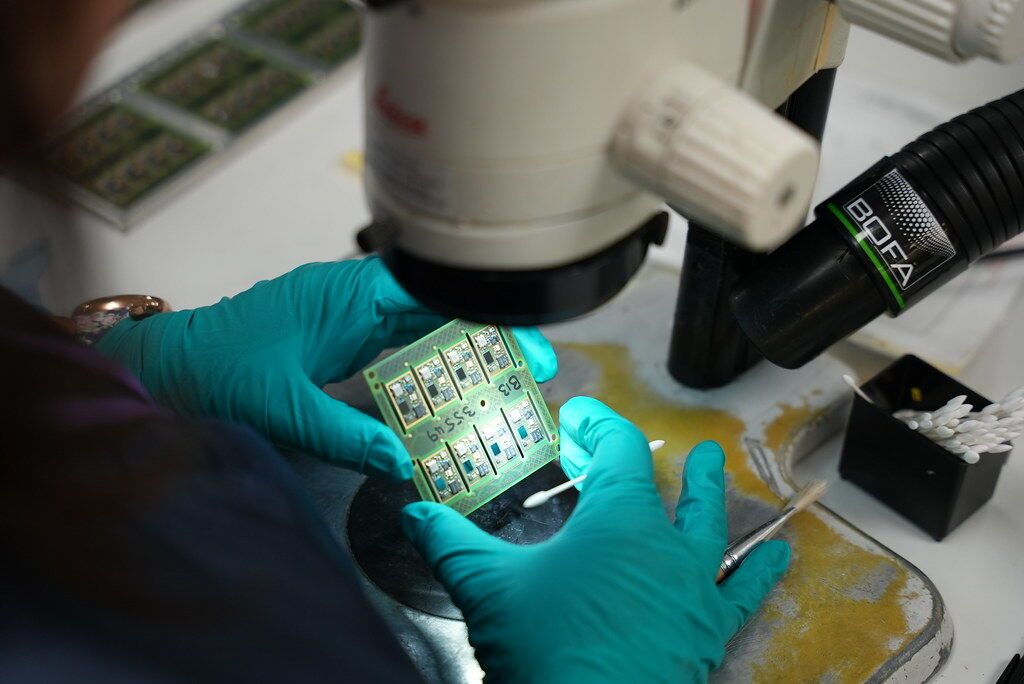
An expansion by chip manufacturer Microchip Technology is among announced Colorado projects that have sought CHIPS Act help.
Construction was started last year on a 130,000-square-foot manufacturing plant being built on Colorado Springs’ northwest side by Entegris, a Massachusetts-based global supplier of electronic materials for semiconductor makers and other industries.
The U.S. Department of Commerce plans to award $90 million in federal tax incentives to update and boost production at Microchip Technology’s Colorado Springs manufacturing facility.
