






For more than 100 years, St. Mary’s Cathedral in downtown Colorado Springs has rung the same bells
The bells at St. Mary’s Cathedral had been ringing for more than 100 years.
But in 2008, after the cathedral in downtown Colorado Springs underwent major renovations several years earlier, the bells went quiet. So, church member and volunteer Jerry Schaefer investigated.
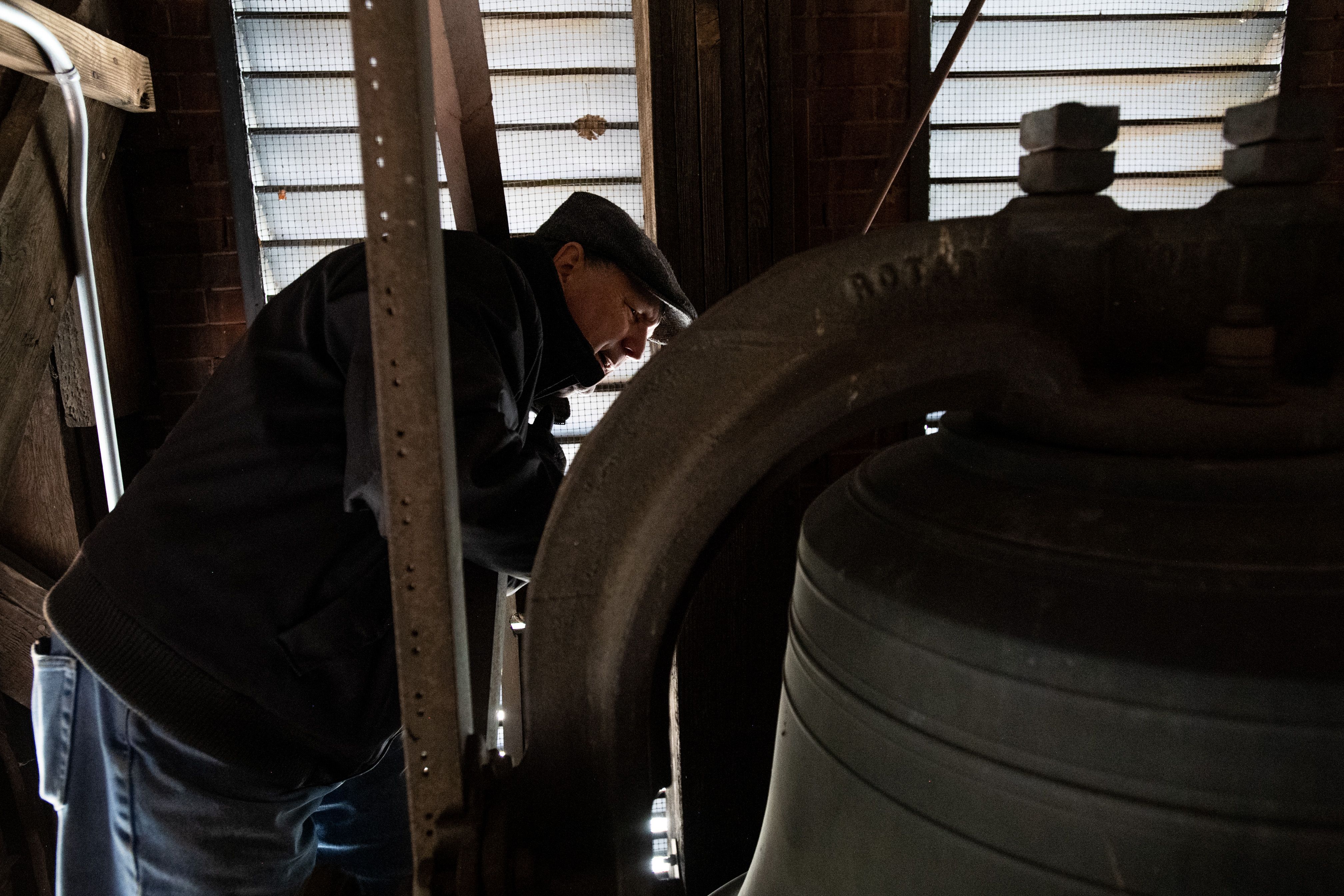
Jerry Schaefer looks at the “Sanctia Maria,” one of two bells at the Cathedral. (Parker Seibold, The Gazette)
Climbing up a narrow stairway and navigating platforms up the 95-foot tower, Schaefer discovered that the clapper of one of the original two church bells had been lost from a rusted pin.
“There was really nothing that was wrong with the bell, except the one had lost its clapper,” he said.
From there, the church began working to fix the bell, which by then was more than 105 years old. After some maintenance, replacing the larger bell’s pin and reinstalling the clapper, both bells were ringing again.
Now, the bells are rung by a computerized carillon instead of ropes. The carillon utilizes both loudspeakers with automated bell sounds and the two real bells, said the Rev. David Price, who led the change at St. Mary’s.
The St. Mary’s Cathedral’s carillon speaker sits above the church’s two bells. (Parker Seibold, The Gazette)
The two original bells are used as an alert system to call people to Mass, ringing 10 minutes before each service — except for the 7 a.m. weekday Mass, Price said.
“We do use both. As far as programming, there is the Angelus, the Mass calls, hymns, and the hour strike,” Price wrote via email.
“The programming is reflective of customary Catholic prayer traditions both devotional and liturgical.”
A computerized carillon rings the St. Mary’s Cathedral’s bells instead of ropes. It utilizes loudspeakers with automated bell sounds and mechanisms on each bell to ring them.
While modern technology is used to ring the bells, the church also embraces its historic features.
The cathedral’s first bell was put in the east tower and blessed in 1898. With no clear records on the purchase of the 400-pound steel alloy bell, Schaefer’s research led him to one likely conclusion: a Sears catalog. That’s right — similar bells for churches and schools were offered in catalogs from the 1890s.
The cathedral’s first bell, this 400-pound steel alloy bell, was put in the east tower and blessed in 1898.
“We looked at the Sears Roebuck catalog online, and they have exactly the steel alloy bell,” he said.
The second bell, installed in 1905, is named the Sanctia Maria, which is engraved within the bell. It’s not clear if the bell was named by St. Mary’s or by the Vandusen Bell Co., which made the 40-inch bronze bell. The bell was cast in 1900, and weighs an estimated 1,500 pounds. Schaefer describes this bell as “the real prize.”
Jerry Schaefer pulls the rope of one of the St. Mary’s Cathedral’s bells. Although they’re now automated, the bells still can be rung manually.
Jerry Schaefer, a member and volunteer at St. Mary’s Cathedral, looks up at the ropes hanging through the levels of the church’s bell towerr on Wednesday, Jan. 17. When the bells stopped working in 2008, Schaefer took it upon himself to figure out the reason why they wouldn’t ring.