






Pikes Peak recreation under Colorado Parks and Wildlife? Coalition has the idea
Don’t call it Pikes Peak State Park.
A regional collaboration has arrived at an idea years in the making: for recreation on America’s Mountain — largely U.S. Forest Service turf spotted with other governmental and commercial interests — to be managed by Colorado Parks and Wildlife.
But the idea through the state-funded Outdoor Pikes Peak Initiative is only that: an idea.
And the idea is far from any such proclamation of the 14,115-foot landmark joining CPW’s state parks portfolio, said Frank McGee, the agency’s Colorado Springs-based regional manager.
That would be “exceedingly premature,” he said, “when we’re just involved in a conversation about what recreation management looks like.”
McGee added: “I’m interested in having more conversation. I do think we have a lot to offer potentially in this situation.”
The conversation has been steered by Pikes Peak Outdoor Recreation Alliance (PPORA).
The nonprofit composed of local advocates, outdoor industry people and land managers was formed in 2017 to, at the state’s direction, think big about recreation and conservation amid a surge in outdoor play and projected population growth. PPORA is the local version of 18 statewide coalitions established in the vision of the Outdoor Regional Partnerships Initiative, funded by CPW and Great Outdoors Colorado.
Following a $225,000 grant, PPORA has spent the past few years convening interested parties across El Paso, Teller and Fremont counties to learn about desires and concerns across public lands. The Outdoor Pikes Peak Initiative has also consisted of data collection and survey of several planning documents by land managers over the years.
“It’s been a journey,” said PPORA Executive Director Becky Leinweber. “We’re at a very interesting point in discussions and considerations. I thought it was time to share with the public.”
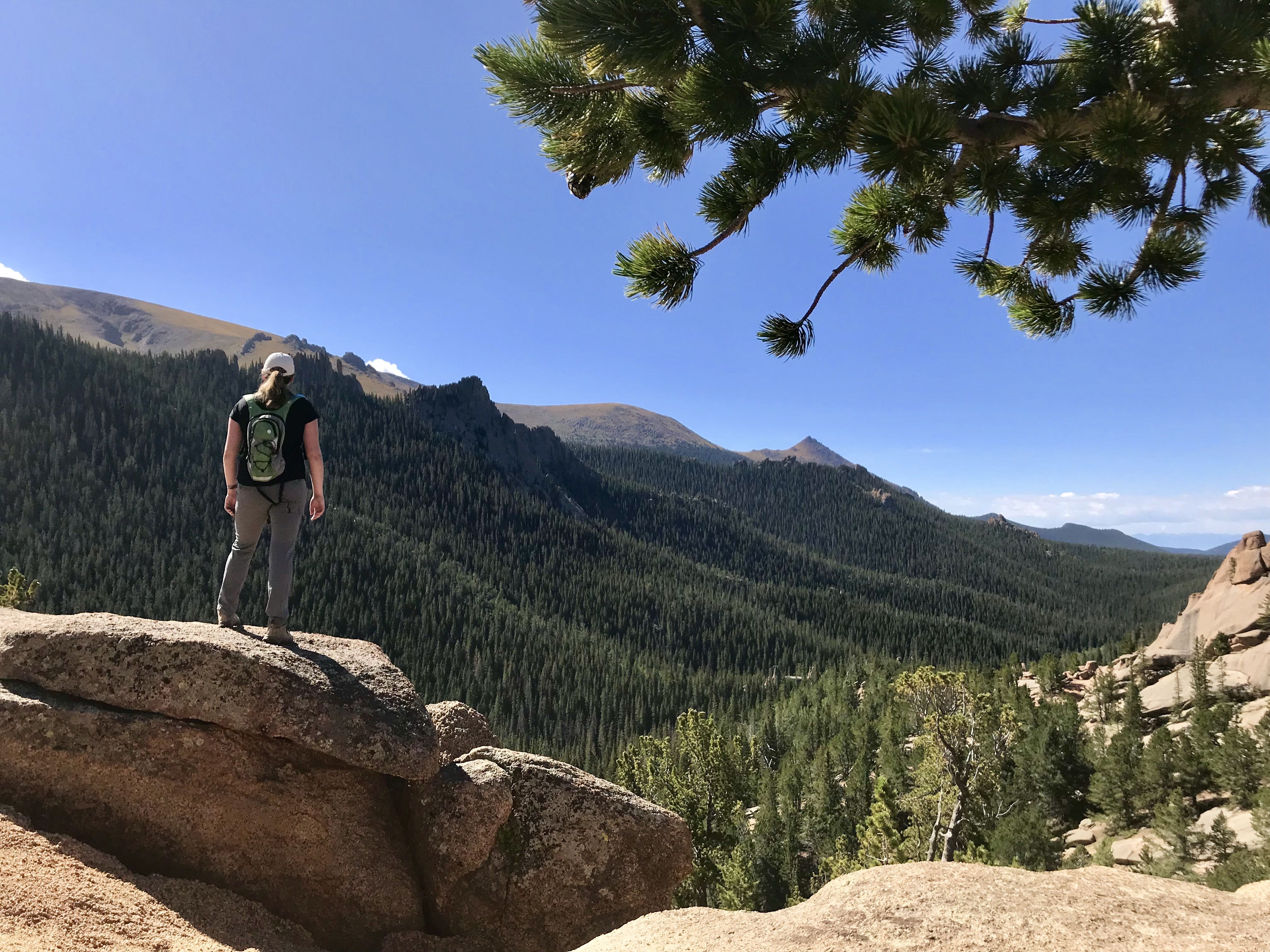
A hiker overlooks the Pikes Peak Massif from the top of the Crags trail in Teller County.
A PPORA news release shared the idea, however still vague, about the famed peak home to several entities having a single entity to manage recreation.
After close to a dozen community meetings and many more meetings among PPORA’s own leadership, the idea is a larger role by CPW.
“CPW manages wildlife and has authority across the landscape for that layer, regardless of jurisdiction,” Leinweber explained. “What would it look like for them to potentially be managing the people?”
It’s a complex proposition, considering, for one, the city of Colorado Springs’ long arrangement managing Pikes Peak Highway by collecting toll revenues. Also present is The Broadmoor Manitou and Pikes Peak Cog Railway. And there’s Colorado Springs Utilities, which allows limited recreation across its north and south slope reservoirs, tightly protected drinking water sources. Parties have historically operated on agreements with the land-owning Forest Service.
“Not changing any of that ownership, not changing other land manager responsibilities,” Leinweber said. “But could (CPW) support that diverse landscape of land managers through bringing in their resources at what is kind of a unique time?”
It’s a time of “real challenges” facing the Forest Service, Leinweber said, specifically mentioning trash, dumping, off-trail degradation and enforcement. Staffs have been short-handed across a vast landscape that backdrops a growing metro.
“We have 100 years of experience working with our partners and working with our communities to manage the peak,” said Jason Robertson, the Forest Service’s Rocky Mountain Region director of recreation, lands, minerals and volunteers. “We’re not able to manage it ourselves with the resources we have, which is why we do manage it in partnership with (the city of Colorado Springs) and others.”
As for PPORA’s idea for a new partnership, “we really haven’t had any substantive conversations about it,” Robertson said.
Colorado Springs Utilities has been involved in the Outdoor Pikes Peak Initiative, an agency spokesperson, Jennifer Jordan, told The Gazette in an email.
The idea of an increased role for CPW, she wrote, “was presented by the Pikes Peak Outdoor Recreation Alliance — it’s not being driven by the land managers.”
Jordan added: “As one of those managers, we are waiting for more information about this proposal, as well as more discussion about what this type of partnership with Colorado Parks and Wildlife might look like.”
That’s the question, McGee recognized. “What are we looking at in respect to a footprint?”
PPORA’s mention of “overuse” calls to mind some of the most popular destinations on Pikes Peak’s flanks: the Manitou Incline, managed under reservations by the city of Colorado Springs; the adjacent Barr Trail leading to the top of the peak; and the summit route on the backside, via the Crags Trail.
PPORA’s news release also mentioned “opportunities not evenly distributed throughout the Pikes Peak region.” The release alluded to public and private lands on the peak’s south slope — much less explored lands around Cripple Creek and Victor.
“That’s beautiful country,” said Steve Bremner, president of advocacy group Friends of the Peak.
For decades he has been part of the push for Ring the Peak Trail, the dream of a loop trail circumnavigating the mountain. Bremner has envisioned “a spoke” of summit paths while also waiting for a new return route on the north side of the Incline, atop Forest Service property.
“I’m in favor of making things happen,” Bremner said.
Things could happen under CPW, PPORA has suggested.
The agency is coming off its first calendar year selling Keep Colorado Wild passes, an optional $29 add-on to vehicle registrations granting entry to state parks and other fee areas. CPW reported success beyond expectations: about a 30% buy-in spelling an additional $41 million in revenue.
Previously, in 2018, the Future Generations Act allowed CPW to enact “modest increases” to fees and licenses. That was in a multi-pronged, governor-directed mission that included expanding public and private land access.
“Certainly, there is potentially some expanded interest and capacity to do some more things,” McGee said.
Hence the development of Fishers Peak State Park and another potential state park at Sweetwater Lake, where locals have opposed the concept, fearful of accompanying CPW development and crowding.
Rather than a state park, PPORA has in mind a designation closer to the Arkansas Headwaters Recreation Area.
Proponents have pointed to that as a potential model for Pikes Peak: CPW manages boating, fishing, camping and more along the 152-mile stretch of river through several federal, state and local jurisdictions. The concept is rooted in a history of enthusiasts seeking consistent regulations for outfitters and private boaters.
That’s another role of CPW, Bremner noted. “When I think of Colorado Parks and Wildlife, I think mainly of restrictions,” he said.
Wildlife protections and fees would theoretically be part of any greater CPW role on the mountain, McGee said. As it theoretically would for a national park — another concept floated by advocates over the years.
Robertson has heard that idea, too. Such ideas come from a passionate place, he recognized.
“We know Pikes Peak is important to a lot of people,” he said. “We just need to make sure everybody is at the table, that everybody knows what’s being discussed and what those parameters are.”
Meetings are set to continue this spring, Leinweber said. She pledged “a very thoughtful process,” adding: “I don’t think you want to fast-track something.”
From the summit of Raspberry Mountain, hikers enjoy 360-degree views, including the Crags and Pikes Peak to the east.
Jeremy Jones of Stafford, Va., follows the Barr Trail Friday, Feb. 2, 2007 after a snowstorm covered much of the trail. Jones spent the night at Barr Camp and was returning in Manitou Springs.
