






Snowpack lagging last year’s bounty as Colorado River negotiations intensify (copy) (copy)
After a blockbuster winter last year fended off tough decisions for the Colorado River basin, a Colorado River commissioner warned last week high snowpack levels may not bless the West again and states need to prepare.
Becky Mitchell, the state of Colorado’s commissioner to the Upper Colorado River Commission, said the seven basin states of the Colorado River must adapt to a drier climate and must more equitably reduce water use from the river.
“The bottom line is (climate) variability,” Mitchell told the Colorado Springs Utilities Board of Directors during a presentation at the board’s regular meeting Wednesday. “We have to build in flexibility and have the ability to adapt to (environmental) conditions. Some years are going to be dry. Some are going to be great for snowpack. We should use that to build storage in our reservoirs.”
After more than 20 years of drought across the West, the Colorado River is facing a crisis exacerbated by overuse.
The amount of water available for the 40 million people relying on the river, including about 5 million users on Colorado’s Front Range, has dropped significantly in recent years. Critically low water levels at Lake Powell, on the border of Arizona and Utah, and Lake Mead, on the border of Nevada and Arizona, have threatened hydropower and agriculture that generates billions of dollars for the economy.
Representatives from the seven states — Colorado, New Mexico, Utah and Wyoming in the Upper Basin; and Arizona, California and Nevada in the Lower Basin — alongside federal officials from the Bureau of Reclamation that operates reservoirs and dams on the Colorado River, are negotiating how to manage the river after 2026. Operating guidelines for the river, Lake Mead and Lake Powell expire at the end of that year.
High volumes of snowpack in the 2022-2023 winter season staved off the worst, water officials said last spring.
The snowpack melts and streams down Colorado River tributaries, eventually flowing into Lake Powell. Under current operating guidelines, when water is drawn for use from Lake Mead, water is then drawn from Lake Powell into Lake Mead.
A map from the National Water and Climate Center shows snowpack in various Colorado River basins reached more than 125% of average as of May 17.
Snowpack is not as plentiful so far in the 2023-2024 winter season, but the more than three feet of snow that fell across Colorado’s mountains over the last week brought levels closer to seasonal averages.
As of Thursday, the San Miguel, Dolores, Animas and San Juan basin is at 84% of average; the Gunnison basin at 95%; Colorado Headwaters at 104%; and the Yampa, White, Little Snake basin at 101% of average.
That’s compared with levels on Jan. 1, when snow water equivalents in the San Miguel, Dolores, Animas and San Juan basin were at 62% of average; the Gunnison basin at 71%; Colorado Headwaters at 74%; and the Yampa, White, Little Snake basin at 71% of average.
While there is still time for snowpack to catch up to average levels, Colorado water users are bound to using only what’s available, while users downstream consistently overuse supplies.
The Colorado River Compact, which went into effect in 1922, apportioned in perpetuity the usage of 7.5 million acre-feet of water a year to both the Upper Basin and Lower Basin. An acre-foot of water can serve about four families for a year in Colorado Springs.
In 2020, 2021 and 2022 Lower Basin states used 10.5 million acre-feet, 10.8 million acre-feet and 10.4 million acre-feet of water, respectively, according to Mitchell’s presentation. That’s compared with the Upper Basin states, which used 4.5 million acre-feet, 3.5 million acre-feet and 4 million acre-feet those respective years, she said.
“That doesn’t really look equal to me,” Mitchell said, adding that Upper Basin states have already grappled with climate change that has led to less water in the Colorado River.
John Berggren, a regional water policy manager with Western Resource Advocates, said Friday those numbers “don’t compare apples to apples.”
“It provides a reasonable approximation of how much water the Upper Basin is drawing from the Colorado River, but it does not properly show what the Lower Basin states are consumptively using under the Law of the River,” he said.
Mitchell’s data included reservoir evaporation and system losses, which aren’t accounted for in the Lower Basin’s allocation, Berggren said. It also included nearly 20-year-old consumptive use data from Lower Basin tributaries. The compact allocates an additional 1 million acre-feet of water from Colorado River tributaries to Lower Basin states.
Data Berggren provided from the Bureau of Reclamation show the Lower Basin used 6.66 million acre-feet of water in 2022, less than its annual allocation granted by the compact.
“It’s also important to note that the Lower Basin states recently expressed a willingness to ‘own’ the structural deficit going forward, which is roughly 1.5 million acre-feet. The Lower Basin still needs to do more, but the water use data presented by Colorado is misleading,” he said.
Mitchell told the Utilities board the Upper Basin has shown it can adapt to actual Colorado River water levels.
“So while this is only a part of the Colorado River system, we should absolutely focus on rebuilding the storage in our country’s largest reservoirs, because storage is what will get us through the rough times. Storage is what gets us through the dry times. Storage is what provides the certainty,” she said.
Most of the water — 70% — across the Colorado River basin serves about 4.5 million acres of farmland, including farms in Arizona and California that provide most of America’s winter vegetables.
In December, on the opening day of the three-day annual Colorado River Water Users Association conference in Las Vegas, Lower Basin states signed an agreement to conserve 1.6 million acre-feet of water over the next three years.
Representatives from California and Arizona told Colorado Politics last month that action was no small feat.
Berggren agreed with Mitchell’s statements this week that all seven basin states need to contribute to solutions for the Colorado River in the era of climate change and diminishing flows.
A recent poll of Colorado voters found 80% of respondents wanted the state to cooperatively work with neighboring states in the endeavor, he said.
Colorado and other Upper Basin states can continue taking measures to use less water, such as limiting water intensive turf and landscaping in favor of more conservative, native landscaping, he added.
“We can put our money where our mouth is and work with water users to find out how to use less. Then we can not only deal with emergencies and crashing reservoirs, but we can actually thrive. The river can stabilize and become a healthy flowing river,” Berggren said.
Colorado River basin negotiators are working with limited time to develop new alternatives for its use.
According to a Jan. 6 report from The New York Times, the seven basin states hope to agree on the new plan by the end of the year. The states are worried a change in presidential administrations after November’s election could hinder negotiations.
“It’s imperative that we stay focused on Colorado River issues and we stay focused together,” Mitchell said.
Parker Seibold, Gazette file The Colorado River flows through Kremmling. The drive to conserve on the river is prompted by more than 20 years of historic drought.
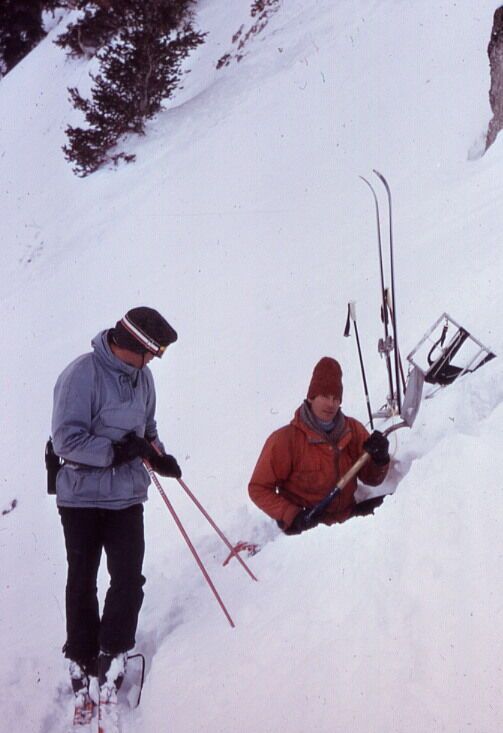
Throughout its 50-year history, Colorado Avalanche Information Center forecasters have dug snow pits to better understand snowpack. Photo courtesy Colorado Avalanche Information Center
After early morning rain, a rainbow over a bright red Colorado River appears during sunrise near Moab, Utah. Some people who live, work and recreate on river water that accumulates from snow runoff and rainfall say drought conditions ebb and flow. They are optimistic water levels will rebound. But in many locales, levels have reached historic lows.
