






Mill Street neighbors could avoid long-feared city razing of homes and businesses, as new wrinkle arises
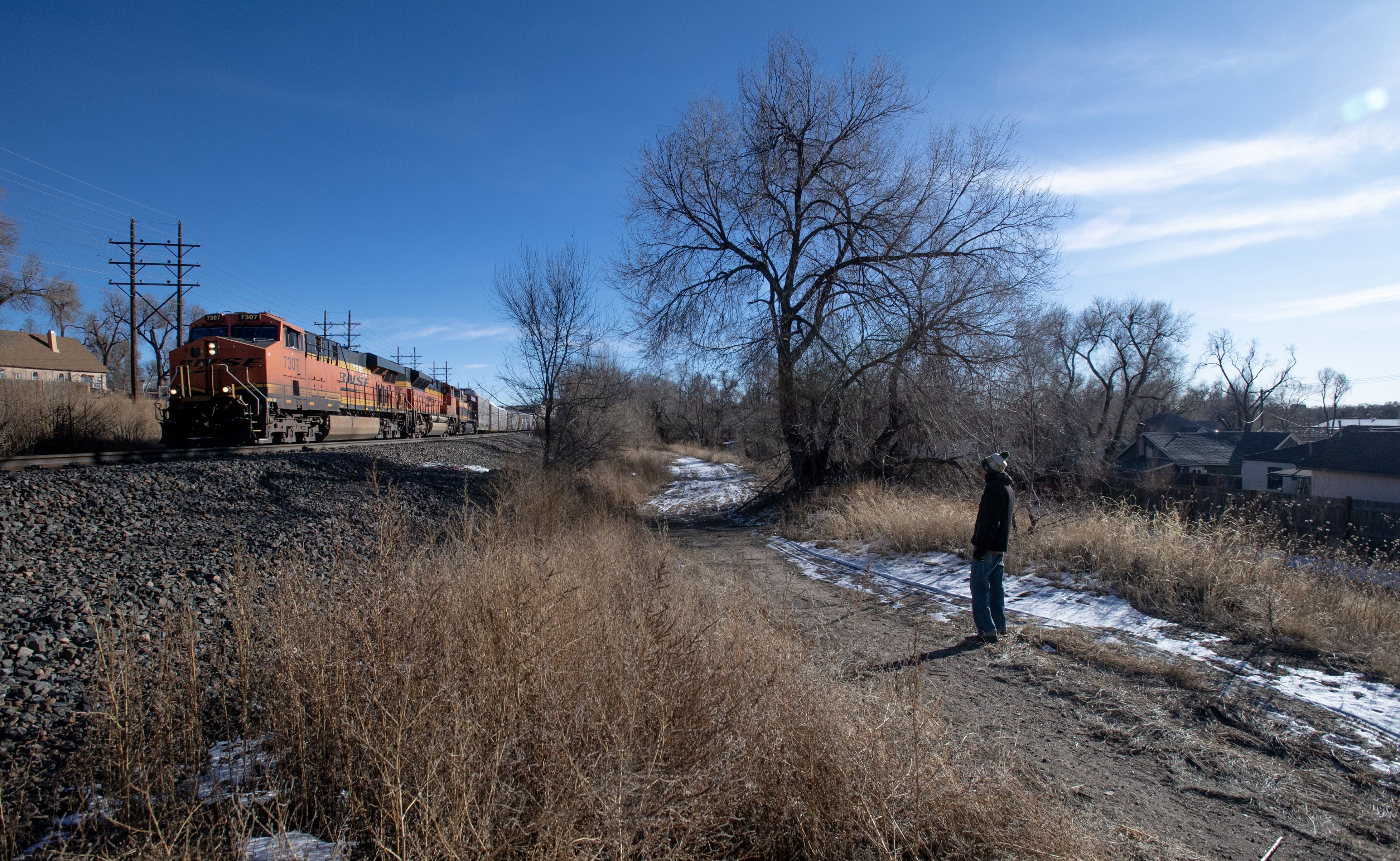
For five years, residents of the Mill Street neighborhood just southwest of downtown Colorado Springs have been “living in fear of the big bulldozer coming,” as longtime urbanite Peter Sprunger-Froese puts it.
While several homeowners bugged out soon after they were notified in 2018 that their property lies in the path of a potential realignment of nearby railroad tracks, Ramona Lidmila says she’s not leaving the 624-square-foot house she’s lived in for 23 years until someone carries her “out in a body bag” after she dies.
“They want to mow us down, and most of us have lived here 20 years or more, and we’re all older people,” Lidmila said. “We fought 20 years ago to save our neighborhood, and 20 years later, it’s the same crap. We’re tired of fighting.”
Today, the fate of up to 16 residential properties and 12 commercial properties that would be affected by the South Downtown Rail Underpass Realignment project remains unclear.
But a new twist in the years-long plot could put the brakes on residents having to call a moving company.
A recent announcement that BNSF Railway, the largest freight railroad in the United States that runs a route through Colorado Springs, intends to replace the South Tejon Street underpass beginning in April gives rise to the possibility that a forced exit from the historic working-class neighborhood for targeted residents and businesses could be off the table, according to Gayle Sturdivant, interim director of public works for the city of Colorado Springs.
Ramona Lidmila watches as a train passes by on the tracks behind her home Friday. Although she opposes realignment of the tracks to the south, she enjoys watching some of the 15 to 20 trains that pass through daily.
The nearly $4 million BNSF project will provide more distance between the roadway and the underside of the bridge, she said, with the work paid for and handled by the railway company. Construction is scheduled to be completed in October.
Now, the city will reevaluate its longstanding, $59.3 million improvement plan that for years has included rerouting those tracks to the south to eliminate curves and in the process displace residents and businesses along the corridor, said Sturdivant, an engineer and project management specialist.
“BNSF doing that opens up the opportunity to leave that baseline (existing track),” she said. “Before, there was structural need to realign the track.”
The scheduled upgrades on South Tejon Street come after a BNSF train derailed three months ago on an older overpass track near Pueblo, killing a truck driver on Interstate 25.
But no decision on how the city of Colorado Springs will proceed on its underpass realignment project has yet been made, Sturdivant emphasized.
“We can’t make any commitment one way or the other,” she said. “We have had an opportunity open up that we didn’t have before with BNSF coming in to do that work.
“Obviously, the neighbors have very serious concerns, and there’s a genuine reason based on what they’ve received in the past,” she said. “Options are being evaluated that could potentially eliminate the need for the properties to be acquired.”
ABOVE: The Weidner Apartment Homes, an upscale complex under construction, towers over the Salvation Army’s Montgomery Family Hope Center on South Sierra Madre Street. When residents of the Mill Street neighborhood express concern over gentrification of the area, they often refer to the stark contrast between the new high-rise apartments and the Salvation Army’s shelter.
That’s news to residents, who at last week’s first City Council meeting of the new year presented 29 letters from neighbors opposing the realignment project during the public comment period.
Other Mill Street residents have been required to move in the past, they mentioned. Private property was acquired to create America the Beautiful Park to the north in 1998, the Colorado Springs Utilities rail spur in 2000 and a wide-scale effort in the early 2000s to build a $6 million, one-stop complex for services for homeless people south of the power plant.
The latter generated a lawsuit and never came to fruition at that site. Pikes Peak Habitat for Humanity homes were built instead.
“We’ve been jerked around before,” Lidmila said.
So they’re rising up to air their frustrations, concerns and desires to ward off a future they say is looking too much like the past.
Steve Werten bought his first home in the neighborhood in 1978.
“The neighborhood looked rough then, as it does now,” he said at a neighborhood association meeting last week. “It turned out to be a great neighborhood.”
He likes it so much, he bought a second house on Mill Street.
“If they tear down more houses, it’ll change the character of the neighborhood and turn it into something other than what we’ve come to love,” Werten said. “That would be a shame.”
‘Tight-knit community’
The push to realign and move the old tracks over not only South Tejon Street but also South Nevada Avenue began a few years before the pandemic.
In 2018, Lidmila received notice from a consulting agency that her South Cascade Avenue home was preliminarily earmarked for destruction, and she attended many of the 20 meetings that were held that year.
Ramona Lidmila stands on her front porch. Lidmila says she’s not leaving the 624-square-foot house she’s lived in for 23 years until someone carries her “out in a body bag.”
“They showed us variations of what they wanted to do,” she said. “Consultants walked our properties, telling us we would get fair market value. We didn’t believe them.”
Residents consulted lawyers and real estate agents, and some homeowners “sold their properties thinking it was going to happen, which turned a lot of people off from buying and devalued the homes,” Lidmila said.
At this time, the plan includes complete city acquisition of 11 residential homes and partial acquisition and potential displacement of another five homes. Twelve commercial properties, including the longtime Luigi’s restaurant, also lie in the identified realignment area.
The project sat dormant during COVID until being revived last year. This year, a federal grant is paying for an environmental review and preliminary engineering to study the existing track alignment and the possibility of keeping the tracks in place while still making safety improvements.
Union Pacific Railroad owns the rights of way, while BNSF, formerly Burlington Northern Santa Fe Corp., maintains the track and operates the trains that use it, Sturdivant said.
Between 15 and 20 trains chug through Colorado Springs daily, carrying anything from coal and building materials to heavy-duty military equipment and double-stacked containers, she said.
Leaving the tracks where they are instead of reconfiguring them would be far less costly.
“We wouldn’t have to acquire those properties and relocate residents and businesses and build the new realignment,” Sturdivant said.
Also, the city did not receive a federal grant it applied for last year to fund upgrades of the underpass and bridges, along with other elements of the South Downtown Rail Underpass Realignment proposal. Regardless of which plan of action is selected, funding still would need to be obtained to move the project forward.
The scope of the proposed work includes adding “quiet zones” — requested by neighbors — as well as safety improvements for the grade-level railroad crossings at South Sierra Madre and Las Animas streets. Safer bicycle and pedestrian access on Tejon and Nevada also would be constructed, and the project would further connect the city’s Legacy Loop recreational trail around downtown.
Lidmila describes Mill Street as a “nice, tight-knit community” where people take care of each other.
Frozie Abbott runs a food pantry out of her Mill Street house with 12 to 15 neighbors picking up free groceries each week.
Second and third generations live in the area, she said. “We can’t lose our community. This is my heart, my soul. I will fight to the end.”
Power plant site
The Mill Street neighborhood was platted by Colorado Springs founder Gen. William Jackson Palmer in 1870, a year before the city came into being, making it one of the oldest enclaves.
LEFT: Demolition of the Martin Drake Power Plant in the Mill Street neighborhood is scheduled to be completed by the end of this year. Concerned about the future of the 40 to 50 acres of power plant property that will be vacant once the structures are gone has residents rallying behind creating a community benefits agreement related to the redevelopment.
The area is racially and ethnically diverse, with a gristmill producing flour from 1877 until it burned in 1902. Small, modest bungalows and cottages for low-income working folks began being built in the late 1800s. Lidmila’s house dates to 1899, but some are older, she said.
A steam-powered municipal power plant began operating in 1925, was renamed in 1962 as the Martin Drake Power Plant and rebuilt in the 1970s. It was decommissioned in 2022 to eliminate coal in favor of cleaner electric generation.
The impending decision on the railroad tracks is not the only issue Mill Street residents are facing. They’re also concerned about what will happen to the 40 to 50 acres of power plant property that will be vacant once the structures are gone.
“They’ve lived in the shadow of the Drake power plant and put up with pollution and noise,” said Susan Bolduc, a member of the Colorado Springs Faith Table, a faith-based organization that supports affordable housing.
Demolition of the power plant will be completed by the end of this year, said Colorado Springs Utilities spokesman Steve Berry. The tall stacks will be removed this month, he said.
During demolition, trucks are using alternate routes outside the Mill Street Neighborhood, he noted. The contractor is minimizing noise and dust, removing buildings piece by piece, “only after significant abatement work has been completed,” Berry said.
The municipally owned utilities company will build a new transmission line from its Kelker Substation off South Academy Boulevard to the existing substation at the Drake site, but the line will not go through the Mill Street neighborhood, he said.
Six natural-gas generating units built last year at a cost of $120 million and the substation “will remain onsite for the foreseeable future to meet the service needs of our customers,” Berry said.
Beyond that, there are no utilities-related plans for the property, he said, and no significant changes are anticipated for the next several years. “If non-utilities’ uses are ever considered for the Drake site, it will only come after a comprehensive environmental review and a public process led by City Council and the city of Colorado Springs,” he said.
A large “Community Visioning” task force met with residents across the city in 2022 and in February 2023 issued to the Utilities Board a report “Reimagining the Martin Drake Power Plant,” detailing the project’s findings. Ideas for reuse of the site ranged from building a community center or a children’s museum to more affordable housing and gardens.
No further work has occurred since the report was released nearly a year ago, said Zach McComsey, founder and president of the Legacy Institute, a philanthropic funder in Colorado Springs that was one of the spearheading organizations.
Gentrification rises
With recent neighborhood additions that include Weidner Field, an 8,000-seat soccer stadium that opened in 2021, at least three new apartment complexes that will be erected around it, and the U.S. Olympic & Paralympic Museum across U.S. 24, Mill Street residents also worry that development is encroaching on the small neighborhood. Several older businesses, including a café, were eradicated to make room for the new development.
“We just get the feeling they’re trying to demolish our entire neighborhood and only have new apartments,” Lidmila said.
Gentrification, along with the threatened rail realignment and power plant demolition, is also much on residents’ minds.
Throughout downtown, homeownership has declined to 35%, with 65% of downtown housing being rentals, compared with 64% homeownership and 36% rentals across the rest of the city, said Chief Housing Officer Steve Posey, who leads the city’s Housing and Community Vitality Department.
About 430 new apartment units opened downtown in 2023, and more than 1,600 are expected to come online in the next year and a half, according to the Downtown Partnership of Colorado Springs.
Pikes Peak Habitat for Humanity’s CEO Kris Lewis is worried that the 20 affordable homes her organization has built in the Mill Street neighborhood will reach a point where payments on property taxes exceed the principal balance on the homes.
“We’re seeing prices go crazy,” Lewis said. “We want to see that neighborhood retain its unique eclectic character of workforce families.”
Mortgages for recipients of Habitat homes are capped at 30% of income, but owners must pay property taxes and insurance. Lewis said participants earned 30%-60% of area median income when they were accepted into the program.
“As property values go up, their insurance and taxes go up, and that impacts their ability to live affordably,” she said.
A new tiny home village for homeless young adults also is nearing completion at South Sierra Madre Street and Fountain Boulevard, built on land that previously contained six old houses, which were boarded up or in need of numerous repairs.
As home prices hold at high rates across the city, gentrification is rightly a concern for many neighborhoods, said Posey.
As a result, the city and the Council of Neighbors and Organizations are building a “toolkit” for groups in lower-income neighborhoods experiencing redevelopment to use in seeking to protect existing affordable housing. The approach was presented at the first meeting on Friday.
The Mill Street coalition is calling for a legally binding document called a community benefits agreement, which advocacy groups in other cities have used to obtain affordable housing requirements, or designating a certain percentage of new jobs for residents, and neighborhood amenities such as community centers and grocery stores.
Under an agreement, developers would abide by the conditions in exchange for a coalition’s support of their projects.
Mill Streeters want to see consideration for affordable housing, the homeless population in the area, community space, and parking and traffic.
No developers have expressed interest in designation from the Colorado Springs Urban Renewal Authority for future projects in Mill Street, said Executive Director Jariah Walker. However, he said, “I think there will be interest in the Drake site moving forward.”
Danny Mientka, owner of The Equity Group, which has led redevelopment of a blighted area along South Nevada Avenue, sees Mill Street’s future as bright.
Weidner Field and its anchoring master-planned multi-family housing will not only improving property values but also will “encourage others to live in the single-family housing that is south of this redevelopment area.”
Also, Mientka said, efforts of longtime developer Chuck Murphy to “preserve and restore many single-family residential structures east and north of Mill Street is supportive of continued transformation of this neighborhood.”
Mill Street’s association has had a preservation plan agreement with the city since 2003, to protect homes from industrial uses and commercial enterprises. City Council approved an updated plan in 2019, but residents say they need more safeguarding, with the realignment project undecided.
Across the street from Weidner Apartment Homes, a posh complex under construction, the Salvation Army’s Montgomery Family Hope Center on South Sierra Madre Street shelters up to 31 homeless families a night. The Salvation Army plans to build a new family shelter at its headquarters 4 miles away, after raising $35 million-$40 million to construct it, said Capt. Doug Hanson, who leads the El Paso County Corps.
The Salvation Army intends to sell its Mill Street holdings that include the main shelter, a duplex for homeless vets and an adjacent empty lot after a soon-to-begin fundraising campaign gets underway and a new center is operational. That will take years, Hanson said.
He’s courted every month by developers, but Hanson said the three-address property isn’t on the market and won’t be until 100% of the costs for a new shelter are raised.
The neighborhood association has garnered several allies who support its advocacy, including Colorado Springs Faith Table.
“We have to look at this from a human dignity perspective,” the organization’s Bolduc said. “All of our residents deserve a safe, sustainable place to live, no matter what’s in their wallet, where they come from, the color of their skin, who they worship and where they live.”
Ramona Lidmila poses for a portrait Friday between the BNSF railroad tracks across from her home in the Mill Street neighborhood. Lidmila’s home of 23 years would be demolished if Colorado Springs’ South Downtown Rail Underpass Realignment project rerouted the tracks to the south.
The Mill Street neighborhood has a tightly knit and outspoken community. Many residents have signs in their yard with a link to the Mill Street Neighborhood Association’s website that features relevant news, information about proposed projects such as a Community Benefit Agreement, upcoming meetings and other resources.
Deconstruction of the Martin Drake Power Plant is underway. The tall stacks will be removed this month, according to Colorado Springs Utilities spokesman Steve Berry.