






A ‘visionary’ in Colorado Springs: EDC leader and developer David Sunderland dies at 93
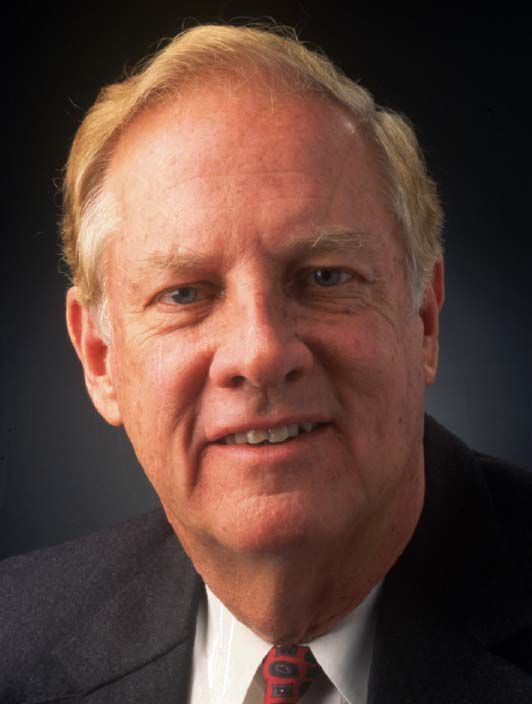
David Sunderland did more than develop land in Colorado Springs; he helped develop long-term visions to make the city a more desirable place to live, work and do business.
As president of the Gates Land Co., Sunderland oversaw development of Cheyenne Mountain Ranch, a 3,300-acre master-planned community on the Springs’ southwest side that helped serve as a blueprint for similar projects citywide.
Over 30 years, from the late 1960s to the 1990s, Cheyenne Mountain Ranch became home to thousands of residents as well as shopping centers, hotels, major employers such as the Microchip semiconductor manufacturing plant and signature amenities that include The Broadmoor World Arena, the Country Club of Colorado and the Cheyenne Mountain Resort.
But beyond real estate, Sunderland recognized Colorado Springs’ future depended on the need to attract quality jobs.
More than a half-century ago in November 1971, Sunderland and developers Steve Schuck and Bruce Shepard co-founded Quality Economic Development — a program that led to creation of what is known today as the Colorado Springs Chamber & EDC.
With Schuck and Shepard, Sunderland saw the need to diversify Colorado Springs’ economy beyond its dependence on tourism and the military and develop strategies to attract high-tech companies and manufacturers, among other employers, along with better paying jobs.
“David was a visionary and was super passionate about Colorado Springs and having this community reach our potential and offer the best possible quality of life,” Schuck said Monday. “While his focus was on real estate and Cheyenne Mountain Ranch, he was dedicated to improving the economy as a community so that we have the resources that are necessary to support those extra community assets that would make us special, including the arts and physical amenities.”
Sunderland, a respected business and civic leader for decades in the Pikes Peak region, died Dec. 17, according to an obituary published Sunday in The Gazette. He was 93.
“Their visionary strategic plan created 50 years ago affected economic development and established the Quality Economic Development Council, an organization that helped bring new businesses to the Pikes Peak region, creating thousands of jobs throughout the 1970s and ’80s,” Johnna Reeder Kleymeyer, president and CEO of the Chamber & EDC, said of Sunderland, Schuck and Shepard, who died in 2015. “The three businessmen helped shape economic development in our region.”
Born in Detroit, Sunderland spent much of his youth in Pittsburgh, where he developed a love for baseball and the Pittsburgh Pirates, the obituary said. He graduated from Dartmouth College in New Hampshire with a degree in economics before advancing to the University of Michigan Graduate School of Business.
He served in the Navy from 1952 to 1955 as a lieutenant on a naval destroyer, the obituary said. He later worked for General Motors, defense contractor Raytheon Corp. and real estate development company Janss Investment.
In Colorado Springs, he became president of Gates Land Co., which was part of the Denver-based Gates Corp.
Gates’ Cheyenne Mountain Ranch became one of the city’s early master-planned communities, which was designed so that residents could live, work and play in the area without leaving the development.
Under Sunderland’s leadership, Cheyenne Mountain Ranch helped set standards — such as building roads and utility lines before lots were sold to builders and businesses — that became common in large-scale, mixed-use projects found around the city, according to Gazette archives.
“I think David was ahead of his time,” said Julie Boswell, who worked at Gates with Sunderland for five years and went onto a lengthy career with the city’s economic development organization. “I think the ideas he had were, I would describe him as a futurist. He understood what was needed.”
As part of Cheyenne Mountain Ranch, the Country Club of Colorado was built in the early 1970s as a private club. It included an 18-hole golf course designed by renowned golf course architect Pete Dye, tennis and an Olympic-sized swimming pool, said Springs businessman Chuck Fowler. He first met Sunderland as an eighth grader in 1968; Fowler’s father, a state senator, had a successful advertising agency and Gates Land Co. was one of his biggest accounts. Fowler later worked two stints with Sunderland at Gates.
“It wasn’t like most country clubs,” Fowler said. “Most country clubs don’t have a 50-meter pool.”
Gates later developed the Cheyenne Mountain Resort, originally known as the Cheyenne Mountain Conference Resort, which Sunderland designed with a focus on attracting business people and business meetings, Fowler said. It included a high-tech ballroom and state-of-the-art audio-visual system, and even buffet-style dining so that business people could eat and then get back to their meetings, he said.
One of Cheyenne Mountain Ranch’s biggest amenities came in January 1998 with the opening of The Broadmoor World Arena — then known as the Colorado Springs World Arena — and built on 33 acres donated by Sunderland and Gates Land Co.
As the World Arena was under construction and after it opened, it was joined by several nearby hotels, the Target-anchored Cheyenne Mountain Shopping Center and Cinemark’s Tinseltown movie theater complex, among other retail, restaurant and commercial projects in the area.
“It opened up that entire piece. We were trying to figure out what to do with it back in day,” Fowler said of the World Arena site.
Gates Land Co. also donated land for the headquarters of Junior Achievement in Colorado Springs.
Sunderland’s efforts on economic development and job creation were arguably as impactful as anything he did in the community.
Schuck said he, Sunderland and Shepard recognized the need for Colorado Springs to be more than just a tourist destination or home to military installations.
When they sought to develop an economic development strategy for the community, they visited a handful of cities around the country to glean best-practice ideas about job creation, Schuck said. They came back to the Springs and struggled to put their ideas in writing until Sunderland took over and put everything down on paper, he said.
Among other observations, the Sunderland-authored document — a copy of which Schuck still has today — noted that the area’s “heavy dependence on the national defense budget is today a major economic risk for Colorado Springs,” bemoaned a lack of growth of manufacturing jobs and sounded the alarm for “a renewed and vigorous effort to lift and diversify our economic base.”
“His leadership with Bruce Shepard and me in creating what is now the EDC, but was formerly called Quality Economic Development, his contribution was incalculable,” Schuck said. “He was unrelenting in his commitment to doing it right. We traveled to other cities that were good role models for us to emulate and he translated what we learned into a road map for Colorado Springs and much of what we enjoy today and take very much for granted is a result of David’s vision and drive for excellence that made it happen.”
In October, the Chamber & EDC presented Sunderland, Schuck and Shepard with its first Trailblazers of Economic Development award.
Sunderland held other roles, including chairman of the University of Colorado Board of Regents and chairman of the then-Greater Colorado Springs Chamber of Commerce, which named him Business Citizen of the Year in 1995, the obituary said.
He also was recognized as the Colorado Association of Home Builders Industry Man of the Year and served as president of the organization; was named Colorado Springs Builder of the Year; and was a director of the Colorado Springs World Arena Corp.
Sunderland also led fundraising efforts in the 1990s to establish a U.S. Olympic Hall of Fame; served as president of the Colorado Springs World Affairs Council; and was a member of the Community Development Council of the Urban Land Institute in Washington, D.C.
Sunderland was preceded in death by his wife, Brooke, his obituary said. He is survived by his four children, Mark and (Liz) Sunderland, Cary (Sunderland) and (Brad) Meuli, Matthew Sunderland, and Tracy Sunderland; eight grandchildren; and five great-grandchildren.
In lieu of flowers, the obituary said memorial contributions can be made to the Humane Society of the Pikes Peak Region; the American Rose Society; and the University of Colorado Foundation.
A private memorial was planned.
Longtime Colorado Springs businessman and civic leader David Sunderland died Dec. 17 at 93. THE GAZETTE FILE