






PRINT An urgent political message from President Lincoln | Vince Bzdek (copy)
At the end of the Netflix hit movie “Leave the World Behind,” the character of Rose, a preteen girl, sits down alone in a bunker to watch the final episode of “Friends” as the world around her falls apart after an apocalyptic cyberattack.
Hanging with her virtual “Friends” is her response to the chaos all around, and this is the final moment of a movie without any sort of resolution, or real ending at all, let alone a happy ending.
And it left me with this thought: Are we too distracted and withdrawn into our TVs and phones and internet to even bother trying to save the world? Maybe it’s easier just to doom-scroll and binge-watch ourselves into oblivion rather than care about our country’s sad state, and do something about it.
The problem is, our country, our Constitution and our country’s institutions are not self-executing. They only work if we are making them work, putting their principles into action, participating. In an of-by-for-the-people arrangement, if we all just “leave the world behind” there is no world left.
In that spirit I have a gift for all my reader friends during this holiday season.
It’s called the Lyceum Address, and it was delivered 185 years ago by Abraham Lincoln, when he was 28 years old and worrying about much the same sort of things we’re worrying about now.
Lincoln wrote it because he sensed a growing disregard in the land for America’s political institutions (just like today), and he was worried about how those institutions were going to perpetuate themselves in the long run.
A lot of violence was happening at the time. Abolitionists were being killed, Blacks being lynched, citizens taking the law into their hands. He was alarmed at the disregard for the rule of law.
He fretted that at such a time, people will put into power “somebody who wants to tear down rather than build up,” as historian Doris Kearns Goodwin once explained in a talk at the National Constitution Center. “He warned us against a Julius Caesar or some sort of autocrat that might come into our being.”
“At what point then is the approach of danger to be expected?” Lincoln asked his audience. “I answer, if it ever reach us, it must spring up amongst us. It cannot come from abroad. If destruction be our lot, we must ourselves be its author and finisher. As a nation of free men, we must live through all time, or die by suicide.”
How do we prevent such an internal threat from stress-testing our republic?
The answer, Lincoln believed, was for Americans to keep reading about the Constitution, keep reading about the Declaration of Independence, keep the Spirit of ’76 fully alive. He worried way back in 1838 that the scenes of the revolution were fading. And he worried that we were forgetting what we fought for, forgetting our country’s ideals.
“He felt that people should be reading these things like we read the Bible to your kid,” Goodwin said. “Read them every night. Make people understand what it is we as people are, and that’s the way we’ll be able to tear down that kind of dictatorship should he arise. It’s an incredible statement. And it really is talking about civic education and the importance of remembering as citizens what this extraordinary beacon of hope is that we were founded on.”
In practice, Lincoln believed the answer to sustaining America’s grand experiment was an unaltering respect for its institutions. The only way to fortify our democracy against the dangers of “mobocracy,” Lincoln believed, was for every American “to pledge his life, his property, and his sacred honor” to the Constitution and our laws.
“… Let every man remember that to violate the law, is to trample on the blood of his father, and to tear the character of his own, and his children’s liberty.”
He even believed bad laws needed to be respected — until they were changed. He believed that the essential lubricant for self-government was respect.
Respect for our American institutions, like Congress, the courts, and the press — what a quaint idea in 2023.
Jan. 6 and its violence against the ultimate symbol of our republic aren’t the only problem here. The left is hardly blameless. Lincoln would not approve of the people who offered justifications for months of destruction of public and private property in the name of social justice movements against police violence.
And social media companies that allow hate speech and corrosive, anything-goes divisiveness on their sites would find a enemy in Lincoln as well. I’m betting Lincoln would see all of social media as a kind of giant “mobocracy.”
And he would not be pleased with the communities that have let their newspapers — the continuing education of democracy — wither or die.
All these things that are undermining who we are right now, creating an epic cynicism in our country, were foreseen by Abe.
“Having ever regarded Government as their deadliest bane, they make a jubilee of the suspension of its operations; and pray for nothing so much, as its total annihilation,” he warned of such times.
“And good men … men who love tranquility, who desire to abide by the laws … seeing their property destroyed; their families insulted; their lives endangered; and seeing nothing in prospect that forebodes a change for the better; become tired of, and disgusted with, a Government that offers them no protection; and are not much averse to a change in which they imagine they have nothing to lose.”
His conclusion in the Lyceum address about such times was pretty scary.
“Whenever this effect shall be produced among us … this Government cannot last.”
This Government cannot last.
But you know, Lincoln being Lincoln, he also foresaw people of talent and ambition who would be willing to “seize the opportunity” and “strike the blow” for the Spirit of 76.
I’ve seen some inkling of this spirit in recent weeks.
During a recent forum we sponsored, Colorado’s top Republican and Democratic legislative leaders offered a unified front against what they described as the rising tide of destructive discourse that’s been creeping up at the state Capitol.
House Speaker Julie McCluskie, House Minority Leader Mike Lynch, Senate President Steve Fenberg and Senate Minority Leader Paul Lundeen vowed to address the problem head on, both in their capacity as party leaders and as individual legislators.
Colorado State University has declared the coming year as the “Year of Democracy” during which its students will be encouraged to renew their familiarity with our founding ideals.
I’ve seen the governors of Colorado and Utah launch a “Disagree Better” campaign to improve our civic conversation.
I have seen a national civics engagement group, A Starting Point, expand their nonpartisan educational effort to all 50 states in a partnership with the Colorado-based National Conference of State Legislatures.
Groups like the Civic Alliance and the Leadership Now Project are starting to organize workshops on strengthening democratic values in the workplace. Yes, businesses are finding they need to bolster their employees in the face of increasingly divisive political debate. The groups provide webinars, research, and support civic education and get-out-the-vote efforts.
And first lady Jill Biden and former first lady Laura Bush have teamed up with Nickelodeon and an organization started by the late Supreme Court Justice Sandra Day O’Connor, iCivics, to create new “Schoolhouse Rock”-like videos to teach children civics. The videos are called “Well Versed.”
I‘m thinking Mr. Lincoln would approve.
He worried in his later days that the Civil War would prove to the world that we couldn’t govern ourselves, that countries need a larger authority or king or dictator to function properly.
“That was the idea that he was fighting the Civil War for. It was that big, that idea. And he wanted everyone to remember that idea,” Goodwin said.
Lincoln asked in the Lyceum address that reverence for our political institutions and the law “be breathed by every American mother, to the lisping babe, that prattle on her lap — let it be taught in schools, in seminaries, and in colleges;” he said, “let it be written in Primers, spelling books, and Almanacs; — let it be preached from the pulpit, proclaimed in legislative halls, and enforced in the courts of justice.”
Let it “become the political religion of the nation.”
Vince Bzdek, executive editor of The Gazette, Denver Gazette and Colorado Politics, writes a weekly news column that appears on Sunday.
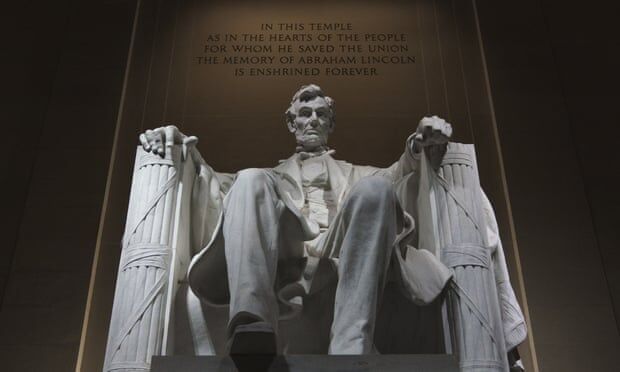
The statue of Abraham Lincoln is seen at the Lincoln Memorial in Washington.
