






New Denver program to address Black maternal mortality rate
As a 17-year-old, Birdie Johnson sat bleeding in an emergency room waiting to be seen by a doctor.
Johnson ultimately miscarried her unborn daughter never knowing — as a Black woman living in the United States — that her pregnancy was a grim statistic.
“I did almost die,” said Johnson, 39. “I didn’t understand the problem that it is.”
It wasn’t until years later when Johnson became a doula helping White women in pregnancy that she discovered her experience as a teen was vastly different.
Colorado Access, which offers public health plans in Colorado, and Johnson’s Mama Bird Maternity Wellness Spa have partnered to strengthen the doula community, particularly among minorities, to improve Black birth outcomes.
“I didn’t know that there was support around being pregnant,” Johnson said. “I just went from being pregnant to giving birth.”
Johnson, who has three children, became a doula in 2016.
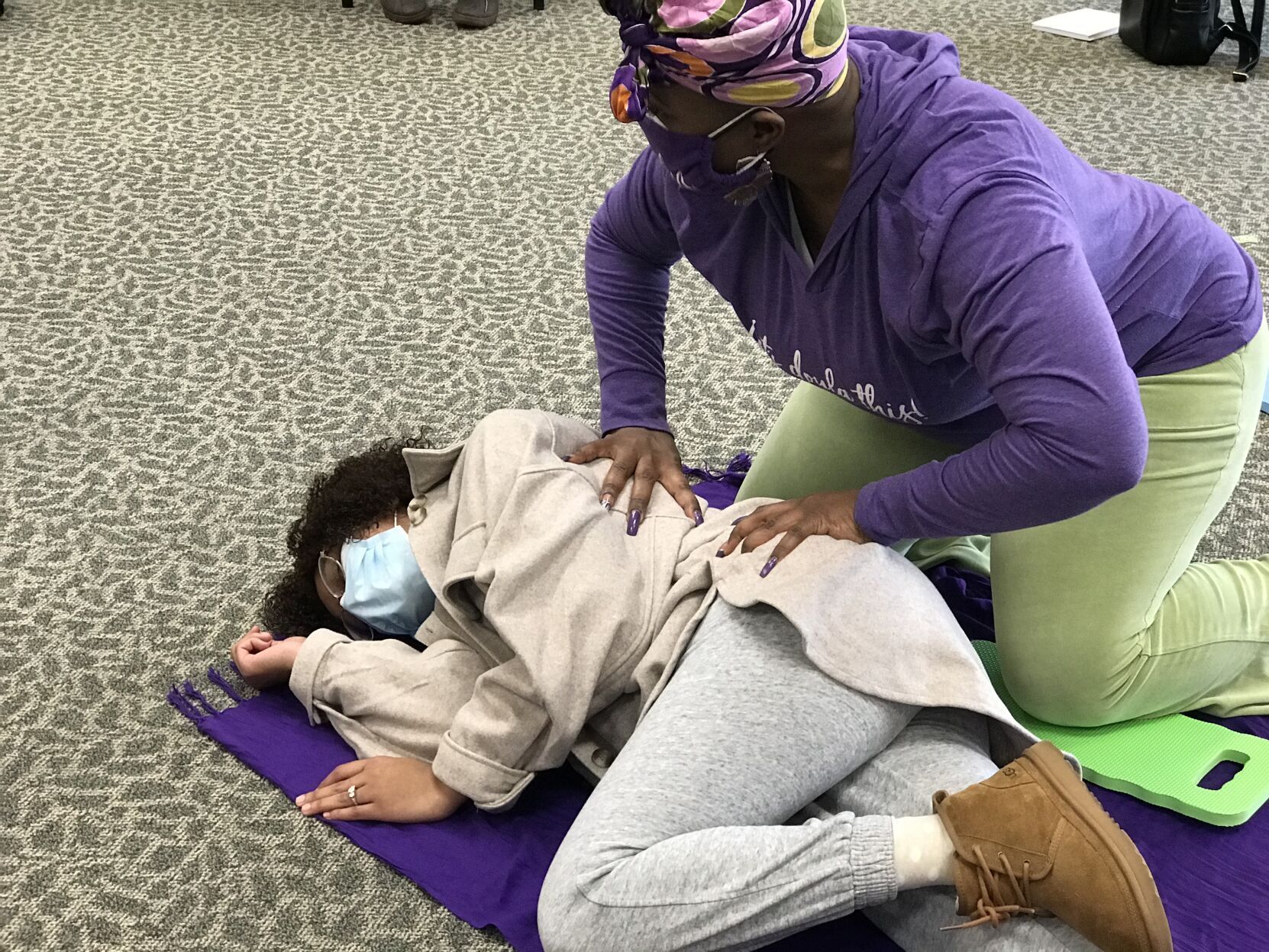
Doulas are nonclinical workers trained to provide education and support before, during and after childbirth.
While more than 40% of U.S. births are covered by Medicaid, coverage of doula services is an optional benefit. Because of limited insurance coverage, access to doula services is largely limited to those with higher incomes who can afford to pay out-of-pocket.
Doulas, too, are overwhelmingly White, accounting for more 80% of the practitioners nationally, according to the U.S. Department of Labor.
Johnson hopes to change that.
The maternal mortality rate for Black women in the U.S. is 2.6 times that of White women.
Earlier this year, Johnson launched a new program for doulas who are racial minorities with the help of a $640,000 grant from Colorado Access. The program was designed to create a professional doula community by providing continuing education, personalized support and mentoring.
Because Colorado does not have any standards or requirements for doulas, Johnson said she is working on a curriculum that is also culturally relevant for addressing the disparities.
The grant runs through next year.
“It was already clear that there were disparities in the maternal health space,” said Joy Twesigye, Colorado Access vice president.
Twesigye added: “It’s not a light matter. The disparities can impact generations of lives when you lose a mother or daughter to these disparities.”
Maternal deaths in the U.S. are on the rise.
Overall, since 2018, the U.S. has seen a 55% increase in the number of maternal deaths, according to the Centers for Disease Control and Prevention (CDC).
The maternal mortality rate in 2018 was 17.4 deaths per 100,000 live births. By 2021, it had ballooned to 32.9, CDC data shows.
The mortality rate is used detect disparities by subgroup.
Defined by the World Health Organization, maternal deaths are those that occur while pregnant or within 42 days of being pregnant, except for accidental or incidental causes.
Colorado also reflects high rates of maternal mortality that disproportionately affects people of color, the poor, individuals with less than a high school education, those over 40, and people living in rural areas.
The causes are varied.
The factors, according to the Colorado Department of Health & Environment, include access to health care, systemic issues and social determinants of health.
Social determinants encompass the environment where people live, learn, work and play that affect health risks and quality of life outcomes.
The Colorado Maternal Mortality Prevention Act established a statewide advisory body that reviews each death during pregnancy up to one year postpartum to decrease preventable deaths and make the health care system more equitable.
The most recent data from 2016-2020 was released in September.
In that time, Colorado had 80 pregnancy-related deaths for a rate of 25 mortalities for every 100,000 live births, state data shows.
Blacks in Colorado had the worst pregnancy-related death rate at 52.2.
No other race or ethnicity came close.
Asians and Pacific Islanders had the second highest rate in Colorado at 28.2.
Discrimination — whether implicit bias, structural or interpersonal racism — is believed to have contributed to roughly 40% of all maternal deaths, according to the Colorado Perinatal Care Quality Collaborative.
“The statistics for Black women dying does not belong to birthing centers,” Johnson said. “They belong to hospitals. That’s why a lot of Black women are opting out.”
The CDC became so concerned about these disparate outcomes that officials called for “unconscious bias” training in August to combat the disparities.
“Making sure there’s respectful maternity care requires action from multiple levels, from healthcare systems, healthcare providers and the community,” Wanda Barfield, the director of CDC’s Division of Reproductive Health, has said.
“Healthcare systems can encourage a culture of respectful maternity care, training healthcare providers to recognize unconscious bias [and] stigma, support shared decision-making, improve interactions and communication with patients, and be culturally aware.”
Jennah Farooque is an Aurora visual artist turned doula thanks to Mama Bird and Colorado Access. She received doula training this year along with 80 hours of clinical work at two Denver metro-area hospitals.
The way Farooque, a Black Muslim woman, sees it, a diverse doula workforce allows individuals giving birth to experience a safe place that requires no explanation. People see her hijab and can instantly connect with her, she said.
“We all have bias and it comes into play with the assumptions that we make,” said Farooque, 37. “I wish I could have had this care when I was in the hospital. Representation matters.”
Birdie Johnson, founder of Mama Bird Maternity Wellness Spa, stands for a portrait in Kinyata’s Sanctuary, a space at the spa dedicated to Kinyata Jackson who died in September 2021, months after giving birth.
Nikia Lawson, a certified doula, offers instruction on childbirth relaxation techniques for the Diversifying Doulas Initiative in Lancaster, Pa., on Feb. 2, 2021.
Nikia Lawson, a certified doula, demonstrates a breech birth for the Diversifying Doulas Initiative in Lancaster, Penn. on Feb. 2, 2021.