






Local authorities keep watchful eye as public engagement continues in Front Range Passenger Rail development
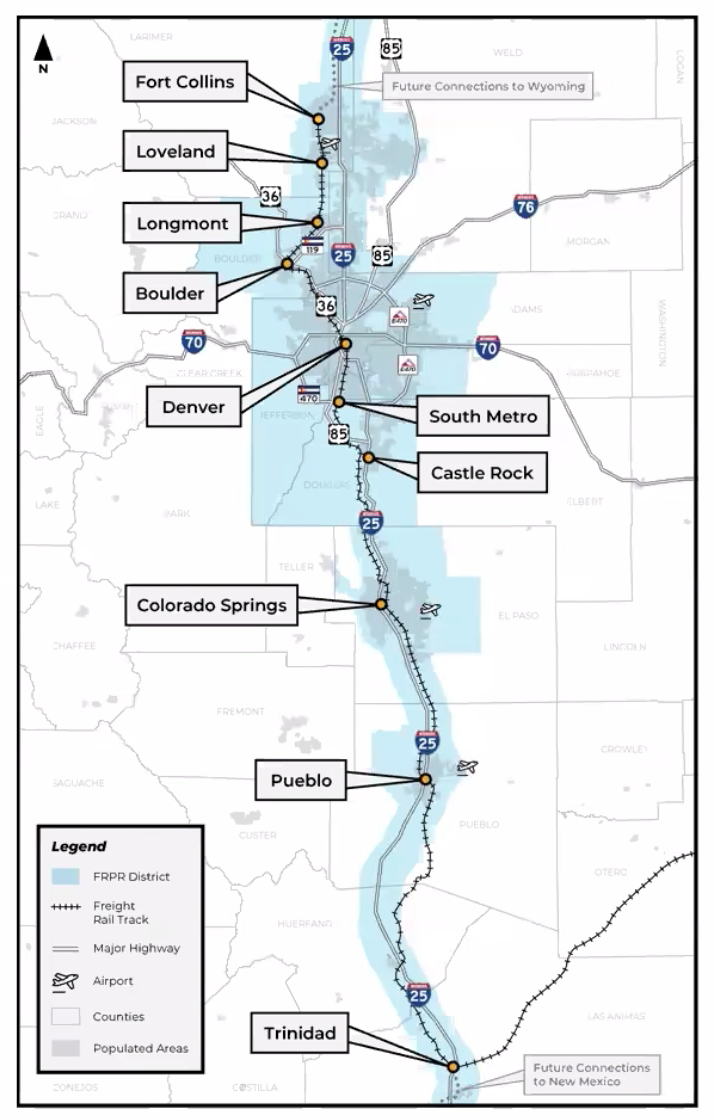
As the Front Range Passenger Rail continues to be examined, public engagement has been among its next steps as a service plan is now in the works of development.
The Front Range Passenger Rail District in cooperation with Colorado Department of Transportation and HNTB, an infrastructure solutions company known for the designing and construction of rail systems across the U.S., hosted a public seminar Dec. 13 online through Zoom. A collective of project managers and others involved with the cooperative agencies involved were present to field public questions and provide updates.
David Singer, from CDOT, said the purpose of the inter-city rail is to connect train service from Pueblo through Denver and north Ft. Collins with stops along the way as its initial backbone. Its long-term vision is to connect New Mexico and Wyoming as well. To minimize costs and accelerate the service start date, initial plans look to use existing tracks shared with the freight railroads.
The inter-city rail would not be like the commuter rail in the Denver metro area operated by RTD, which serves one metro area and connects suburbs to an urban core. While commuter rails have stops 2-4 miles apart, the inter-city rail looks to have stops 20-30 miles apart or more. Average speed would be 45-55 or more miles per hour.
“The experience is much different than a commuter rail. Buying tickets is different. The amenities are different. There is different technology,” Singer said. “Our team is working with RTD to examine how both these rail systems can coexist.
“Advocates have long thought about this rail and have looked at it through different lenses.”
The FRPRl has been in talks and development for over the past decade.
Singer noted despite several initial ideas over the development history for the rail, it wasn’t until the Front Range Passenger Rail Commission was created and determined viable first steps to its creation.
Andy Karsian with the Front Range Passenger Rail District, which was established in 2021 by Colorado state legislature, said following voter approval, the district can levy taxes to fund the rail system and is tasked to work with local communities to support station development as well as determine the rail system’s financing, design, construction and operation of it.
“This is a once in a lifetime opportunity for commuters along the Front Range,” Karsian said.
In the first quarter of this year, the FRPR District launched its efforts to design a service development plan which would determine the rail’s route, major markets for stations, service frequency, onboard amenities, fare structure, infrastructure improvements, costs and financial plan and of course a plan for implementation. The service plan is presently managed by CDOT and being developed with and for the Federal Railroad Administration. According to the project timeline, the service plan development looks to conclude mid to late 2024.
Don Spaethling with HNTB, an infrastructure solutions company known for the designing and construction of rail systems across the U.S., who serves as the project manager on the consulting team, confirmed the rail system would interoperate predominantly on existing freight railroad tracks through existing corridors. Preliminary analyses demonstrate that FRPR could be a viable service with comparable ridership and competitive travel times, he said.
“The project compares to the other successful inter-city passenger corridor service in the U.S.,” Spaethling said. “Preliminary planning indicated that it is possible for FRPR to be operating within the next decade.”
Initial planning cites a need for stations in Pueblo, Colorado Springs, Castle Rock, South Metro Denver, Denver, Boulder, Longmont, Loveland and Fort Collins at its inception.
Although there are no plans in the rail system’s inception to establish a station in the Tri-Lakes area, local municipal leaders are still apprehensive on the effects the passenger rail would have on the local region.
“It is definitely something I will be watching as the passenger rail continues to develop,” Palmer Lake Mayor Glant Havenar said. “There is much talk of a $6-12 billion dollar price tag and perhaps an ask of our citizens to form a special taxing district in order to pay for the hefty price tag of this project.
“While the prospect of a more viable means of travel can be an exciting one, I’d definitely be concerned about creating a special taxing district to accomplish this.”
While the Front Range continues to grow at rapid rates, Havenar said the region needs to be careful what it wishes for. Changing the landscape and architecture of the area’s gorgeous and quiet communities come at a cost, she said.
“The monetary costs coupled with increased noise, traffic and visitors could be more than we bargained for,” Havenar said. “We need to ask ourselves if this growth could affect our quality of life in Tri-Lakes.”
Mitch LaKind, Town of Monument Mayor, said he would love for Monument to be in the discussions on having the northernmost stop along the proposed passenger rail in El Paso County.
“Given Monument’s status as a commuter town, with a Park-and-Ride, it only makes sense that we are in the conversation,” LaKind said. “Maybe not an initial stop, but at least one in the near future.”
For more information on the Front Range Passenger Rail, visit www.RideTheFrontRange.com.
A map of the conceptual route and stop stations for the Front Range Passenger Rail of which, if project managers are able to follow its creation timeline, would be up and running within the next 10 years.