






Yemi’s journey: From Nigeria to America to Colorado Springs mayor
Step by step.
That’s how Yemi Mobolade journeyed from Nigeria to the U.S. to the mayor’s office of the country’s 40th largest city. And he says his wasn’t a solo journey, thanks to the help — human and divine — he received at key points along the way.
Family and faith
Mobolade’s parents grew up in rural Nigeria, where polygamy and idol worship were customary. They converted to Christianity as young adults, married, and pursued the schooling that would lead to his father’s career in finance, his mother’s work in education, and the family’s entry into the country’s small middle class.
His parents also served churches in the International Church of the Foursquare Gospel, a Pentecostal denomination that was founded a century ago in the U.S. and reached Nigeria in 1955.
Their commitment to their faith was evident when they gave names to their second son, born in 1979. In a sacred naming ceremony, they called their second son Blessing Adeyemi — prioritizing a Christian name over a Yoruba tribal name that means “the crown fits me.”
“They took ownership of our faith development,” Mobolade said. “It wasn’t left to church to raise us.”
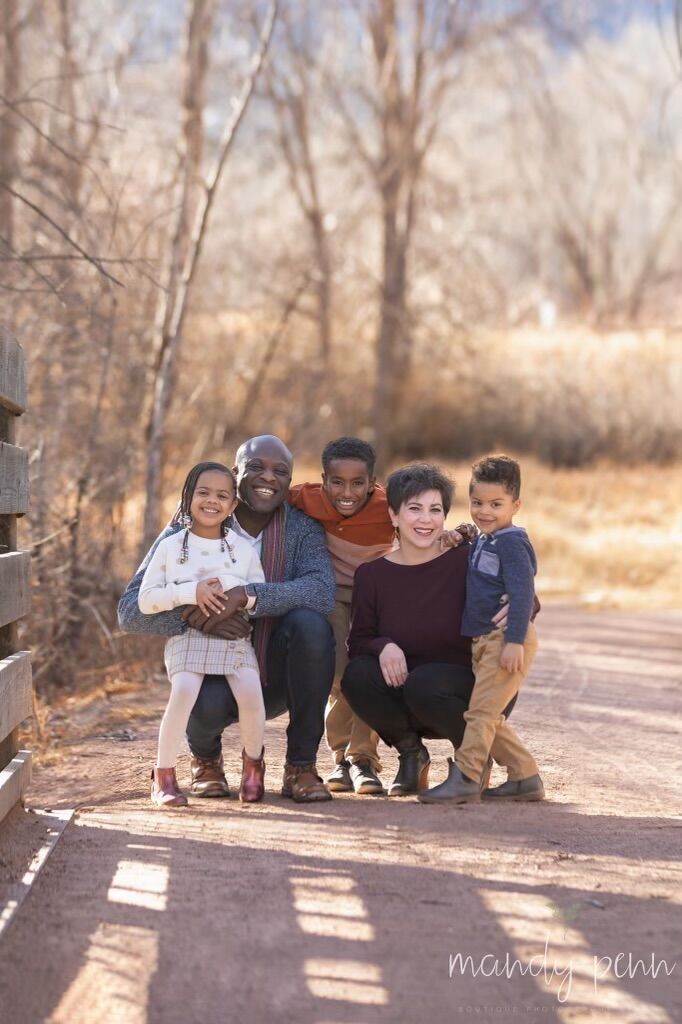
Now, Mobolade and his wife, Abbey, do the same with their three children, encouraging their faith development and ending every day with prayers of thanks.
His parents also modeled a lifestyle that balanced professional obligations and spiritual commitments, evangelism and entrepreneurialism. He calls this bi-vocational approach “co-vocational” to indicate that work and ministry aren’t competing callings but should be integrated.
By age 17, he was “a lost and angry young man” who concluded Nigeria’s poverty and unemployment couldn’t provide the opportunities he sought.
Coming to America
Mobolade’s faith flourished as a business student at Bethel University in Indiana, a private Christian school that mandated attendance at three weekly chapel services and required students to take three Bible courses.
He dived into campus life and soon discovered he had the gift of leading worship among the largely white student body — a cross-cultural ability he would use decades later at First Presbyterian Church in the Springs. He also led the school prayer team and got involved in youth ministry.
There were incidents of racism and one brush with the law for “jogging while Black.” When he and a White student went out for a run, he grew winded and fell behind, leading a police officer to stop him and ask why he was “chasing” the White student.
He also earned master’s degrees in management and leadership from Indiana Wesleyan University in Marion, Ind.
At A.W. Tozer Theological Seminary in California, church history opened his eyes the many ways Christ’s followers have carried out God’s work outside the walls of the church through service, education, charity, hospitals, the arts and sciences, government, and more.
Along the way, he wrestled through crises of faith, vocation and relationships.
“It was as if I had been standing on a rug all my life until somebody yanked the rug, and I fell,” he says of a dark season that endured two years. He emerged through a “second conversion” to Christ that brought him a deeper faith, a new calling, and a family with Abbey, his wife.
“I had a clear vision of where I was going next and who God was calling me to be,” he says. “I would be going to help lead change and direct people’s hearts toward the things of God.”
From minister to mayor
Tozer is affiliated with the Christian & Missionary Alliance denomination, formerly based in the Springs. The denomination hired Mobolade to start a new church in the Springs and work with it.
During his 13 years here, the scope of his “co-vocational” approach grew wider: church planter, worship leader, restauranteur (Wild Goose Meeting House and Good Neighbors Meeting House), nonprofit founder and leader (COSI LoveYou and CityServe Day), community mobilizer, and small business development executive.
He once told friends he would never run for mayor but changed his mind once he concluded he could help make a good city better. Voters agreed, bringing about a change in local politics that some called a “seismic shift.”
He says his goal as mayor is the common good for all, not favoring his faith tribe over others.
“I’m the mayor for all people,” he says, and he now aims to run for a second term in four years.
Political theology
Mobolade’s political theology is based on the two “greatest” commandments cited by Jesus: “Love the Lord your God with all your heart and with all your soul and with all your mind,” and “Love your neighbor as yourself” (Matthew 22:37-40).
He’s trying to apply this theology in practical ways. Wayne Williams, Sallie Clark and Tom Strand formerly campaigned against him but now work with him. He has also initiated a community listening tour to invite citizens to the table so they can be heard.
He also recently named Thomas Thompson, former senior pastor of Pulpit Rock Church, as senior adviser of community affairs and liaison to local faith-based organizations. Thompson recently met with leaders of local Mormon and Muslim communities and said he seeks to “bring everyone to the table to help solve our most pressing issues, and to find common ground in the common good.”
Mobolade opposes efforts of those on the left and right to allow political passions to hijack faith: on the left through liberation theology; on the right through Christian nationalism.
“That’s the ‘Christ of culture’ approach,” he says, citing H. Richard Niebuhr’s classic “Christ and Culture,” which described how people accommodate their faith to cultural norms.
And he rejects Seven Mountains Dominionism, a politicized approach to faith promoted by some local Christian ministries that claims Christians should rule the world through government, education, the arts, etc.).
“I’m as apolitical as they come,” he says, a relief to supporters who’ve grown increasingly worried about the division and demonization of contemporary politics.
Some of his speaking events have generated anger. Fellow evangelicals criticized him for speaking at Pikes Peak Pride Fest in June, where he read the names of those killed at the LGBT Club Q last year. Others criticized him for speaking at a recent “Fire and Glory” revival meeting in July.
He says he worships a God who loves everyone, who created everyone in his divine image, and who commands his followers to treat each person with the love and respect due them. So, how can he do anything less?
His goal is transcending “cultural hospitality,” which means “Hanging out with people who think as I do,” with something better that he calls “biblical hospitality.”
“This means we should be a lover of the other, a lover of the stranger, a lover of people who don’t think like us.”
Yemi Mobolade and his family.
Yemi Mobolade with fellow students at Bethel College in Indiana.
Yemi Mobolade as worship leader at Bethel College in Indiana.
Yemi Mobolade and family.
Yemi Mobolade and his wife, Abbey.
Yemi Mobolade with his mother.
The parents of Yemi Mobolade.
