






The ‘power to save a life’: Suicide Prevention Summit of El Paso County aims to reduce suicide by 20%
Instead of saying, “How are you” in casual passing, try saying, “It’s nice to see you.” Because 90% of people go through their day feeling unseen, said David Galvan, a Colorado Springs-based national mental health and suicide prevention trainer.
Next time you come across someone who seems lonely, connect with them, even if it’s just making eye contact and smiling. Because isolation, feelings of hopelessness and a lack of connection with others can lead to thoughts of suicide, said experts at Friday’s Suicide Prevention Summit of El Paso County.
“Hope and social connection are the ethos of how we will prevent suicide in our community,” Galvan said.
“The reality is if we’re going to talk about connectedness, we must look for people who are hurting, people who are alone and people who nobody knows.”
Between those who are thinking about taking their lives, those who are worried about someone, people who know someone who died by suicide and those who have experience with suicide, “over half of the community has been impacted by suicide in some way,” Galvan said.
What if a virus was affecting half of a community, he asked about 200 summit attendees from various sectors.
The same kind of mass mobilization and response that would be deployed needs to happen with suicide, speakers said, and involve every resident, not just those who work in the field.
“We’ve got limited resources, we need to collaboratively, collectively and holistically go full throttle,” said El Paso County Coroner Dr. Leon Kelly, who’s also the county’s chief medical examiner.
After remaining flat for three years, deaths by suicide in El Paso County increased in 2022, according to preliminary data from the Coroner’s Office.
Kelly estimates that 193 died by suicide last year, pending late November and December autopsy reports. If the number holds, it would signify a jump from the 176 deaths in 2021, 178 in 2020 and 180 in 2019.
The majority of people who take their lives have jobs and are out and about in the world but have a background of depression, substance abuse or social stressors, Kelly said.
When a dramatic event happens, such as a breakup with a spouse, a DUI arrest, job loss or other personal mishap, “that spirals them almost immediately into a suicidal act,” he said.
Certain categories have seen vast improvements, including children ages 17 and under.
Teen suicide in El Paso County reached an all-time high in 2015 with 15 deaths, a number that was repeated in 2020. But last year and in 2021, just four children ages 17 and younger took their lives each year, according to coroner’s reports.
“In a very human way, tragedy made us take action,” said Cass Walton, executive director of Pikes Peak Suicide Prevention and co-chair of the Suicide Prevention Collaborative of El Paso County.
In response, representatives from schools, hospitals, law enforcement, nonprofit organizations, parent groups and others came together to try to figure it out.
Increasing awareness of the issue, training anyone who wanted to learn how to recognize the signs and respond, recruiting youths to work with their peers in distress and rallying trusted adults to be ready to assist students have worked, Walton said.
“If we put the same kind of effort toward other demographics, I think we’ll have success,” she said.
Suicide is complex, Kelly said, and often not a crisis type of scenario but a building of depression and desperation that arises out of unexpected and unwanted change.
Populations most at risk include youths, seniors, military veterans, LGBTQ+ people and men, who more likely to kill themselves than women, summit speakers said.
In 2021, the average age at death by suicide in El Paso County was 44 years old, statistics show.
In 2022, males constituted 74% of suicide cases, Kelly said. Overall 60% of completed suicides last year involved a gun and 19% were by hanging, he said.
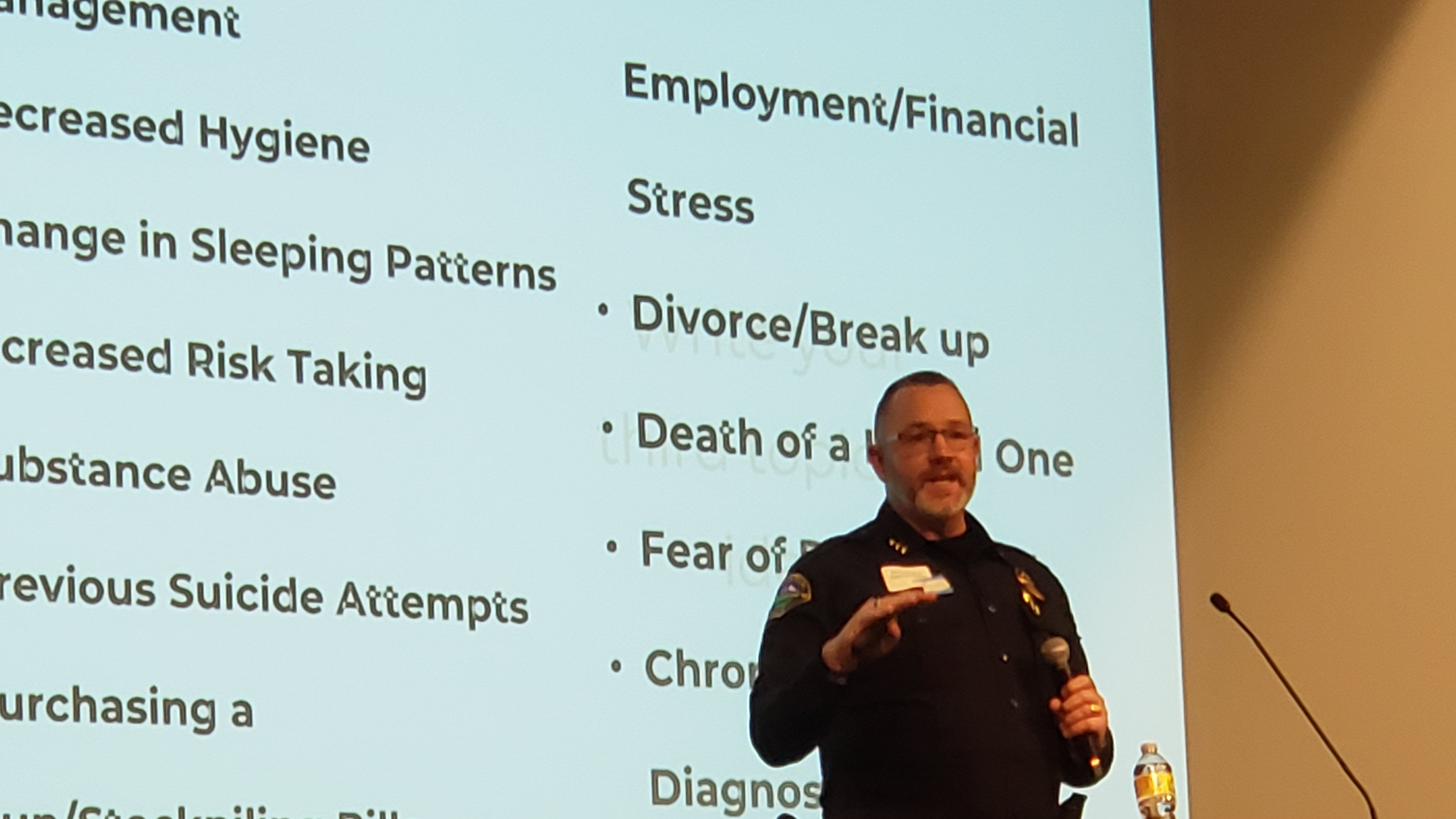
Firearms are the most lethal means of suicide, said Fountain Police Chief Chris Heberer, who also co-chairs The Suicide Prevention Collaborative of El Paso County.
Herberer advocates for gun owners using cable gun locks, safes and biometrics to secure guns at home, or removing them temporarily from a home if a loved one is displaying suicidal tendencies.
Suicide fatalities of military active-duty and veterans also improved last year, to comprise 22% of suicides countywide, Kelly said, which is close to historic numbers yet “still unacceptable.”
The marked decline from 30% in 2021 is likely attributable to prevention efforts such as Next Chapter, speakers said.
The community wellness collaborative for veterans and their families was born out of state legislation and lets clients decide what they need and when, said Damian McCabe, a behavioral health specialist with UCHealth.
“We’re flipping the script — you get to drive how you access care, and we’re going to respect that. You tell us when you want to come in and what you need first,” he said. “If I start telling a veteran what I think they need instead of what they think they need, I’m never going to see them again.”
Increasing strong protective factors, such as having trusted people to talk to, building resiliency for handling adversity in a healthy way, reducing bullying and preventing discrimination, decreases mental health struggles, violence, substance abuse and other reactions that may prompt thoughts of suicide for LGBTQ+ people, said Liss Smith, spokesperson for Inside Out Youth Services, which serves LGBTQ+ teens and young adults.
The goal of The Suicide Prevention Collaborative of El Paso County is to reduce the suicide rate by 20% by 2024. Walton, of Pikes Peak Suicide Prevention, said she thinks that’s attainable.
“But we need your help,” she said. “We need our whole community doing something every day. I see the possibility of impact. I know everyone in this room has the power to save a life.”
A recording of the summit will be posted by Jan. 20, according to organizers.
A new nationwide suicide and crisis hotline is available 24/7 by dialing 988 from any phone.
Contact the writer: 719-476-1656.
If you or someone you know is having suicidal thoughts, a new nationwide suicide and crisis hotline is available 24/7 by dialing 988 from any phone.
In an evidence room at the El Paso County Coroner’s office, a bin is filled with suicide notes from past years. About one-third of people who die by suicide in the county leave a note or indicate their suicidal tendencies on social media, said County Coroner and Chief Medical Examiner Dr. Leon Kelly. (Photo by Jerilee Bennett, The Gazette)
Fountain Police Chief Chris Heberer spoke at Friday’s Suicide Prevention Summit of El Paso County about changes in behavior to watch for and triggers that can cause people to spiral into having thoughts of suicide. (Debbie Kelley/The Gazette)